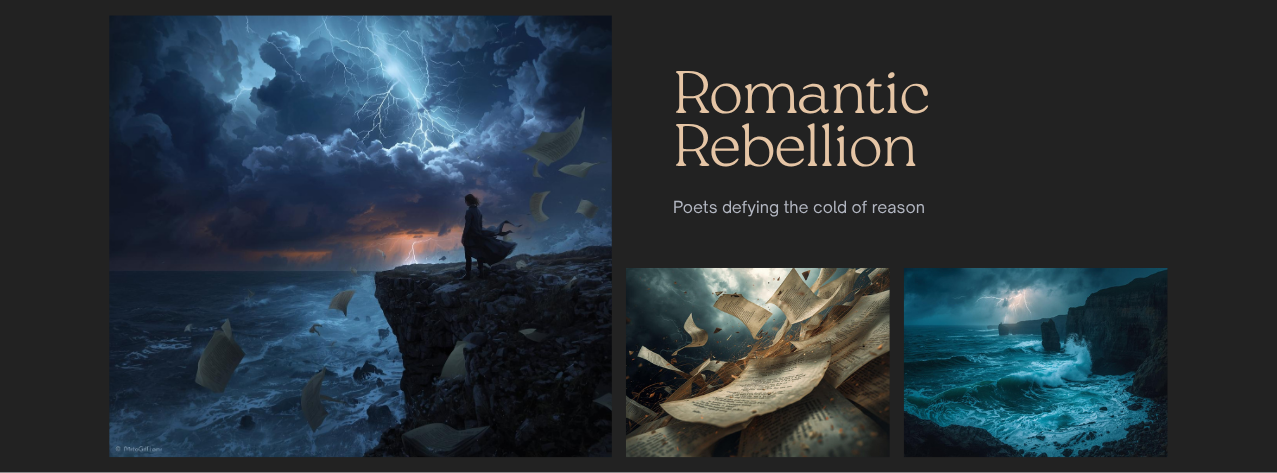
Romanticism: When Poets Rebel Against Philosophers
Series: Digital Rebirth of the Renaissance #09/12 | Read time: 25-30 min | Language: Python
Author: Wina @ Code & Cogito
When Feeling Declared War on Reason
- A small English village in Somerset.
Two young poets — one intense and brooding, the other gentle and contemplative — published a slim volume of verse that would detonate like a bomb across European culture.
The book was called Lyrical Ballads.
Its preface contained a single sentence that rewrote the rules of Western art:
“Poetry is the spontaneous overflow of powerful feelings.”
The author was William Wordsworth. His collaborator was Samuel Taylor Coleridge.
They weren’t just publishing poetry.
They were launching a revolution.
For over a century, the Enlightenment had reigned supreme. Reason was king. Logic was law. The universe was a great clockwork mechanism, and humanity’s job was to understand its gears.
Wordsworth looked at this gleaming rational edifice and said: you forgot the heart.
What followed was one of the most dramatic cultural upheavals in history. Across Germany, England, France, and beyond, artists, poets, musicians, and philosophers rose up against the tyranny of pure reason.
They didn’t reject thinking. They rejected the idea that thinking was all there was.
In this article, we’ll trace the Romantic rebellion from its earliest sparks to its fullest blaze. Then we’ll use Python to do something the Romantics themselves might have found deliciously paradoxical: analyze emotion with data.
Can an algorithm detect the difference between Enlightenment prose and Romantic poetry? Can we cluster artworks by aesthetic sensibility across painting, music, and literature?
Let’s find out.
The Enlightenment’s Blind Spot
To understand why Romanticism erupted with such force, we need to understand what it was rebelling against.
The Rational Machine
The Enlightenment gave humanity extraordinary gifts. Science. Democracy. Human rights. The scientific method.
But it also carried a hidden assumption that grew increasingly suffocating:
Humans are fundamentally rational beings.
Descartes (1596-1650) set the template. Cogito ergo sum — I think, therefore I am. Not “I feel, therefore I am.” Not “I love, therefore I am.” Thinking. Pure, disembodied thought was the foundation of existence. The body was a machine. Emotions were noise.
John Locke (1632-1704) went further. The human mind was a tabula rasa — a blank slate. Experience writes upon it. Sensation produces ideas. Ideas produce knowledge. It was a beautifully clean model, and it left almost no room for passion, intuition, or the irrational depths of human experience.
Immanuel Kant (1724-1804) built the grandest rational architecture of all. In his Critique of Pure Reason, he argued that the human mind doesn’t passively receive reality — it actively structures it through categories of understanding. Reason doesn’t just observe nature. Reason legislates nature.
Powerful ideas. Transformative ideas.
But by the late eighteenth century, a generation of young artists looked at this magnificent rational cathedral and felt something was missing.
What Was Missing
Where was grief? Where was ecstasy? Where was the feeling you get standing on a mountain peak at dawn, watching clouds pour through valleys like rivers of light, and feeling simultaneously tiny and infinite?
Where was the shiver down your spine when you hear a cello play in a minor key?
Where was love — not as a chemical process or a social contract, but as the force that makes you write terrible poetry at three in the morning and not care that it’s terrible?
The Enlightenment had no vocabulary for these experiences. Worse — it treated them as obstacles to clear thinking.
The Romantics said: these experiences aren’t obstacles. They’re the whole point.
The Spark Catches Fire: Romanticism Across Europe
Romanticism didn’t begin in one place. It ignited almost simultaneously across the continent, as if an entire generation had been waiting for permission to feel.
Germany: Sturm und Drang (Storm and Stress)
The first sparks flew in Germany.
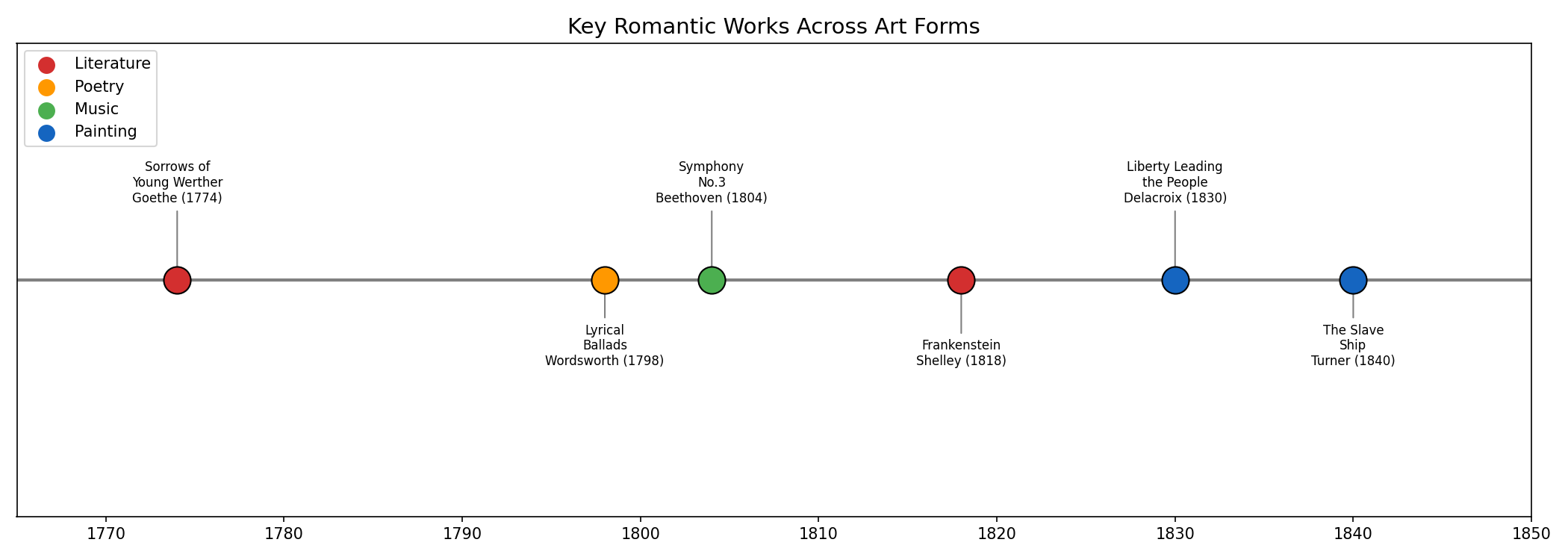
In 1774, a twenty-four-year-old Johann Wolfgang von Goethe published The Sorrows of Young Werther — a novel about a young man who falls hopelessly in love, finds the world unbearable, and kills himself.
The effect was electric.
Young men across Europe dressed like Werther. They talked like Werther. Some of them — disturbingly — died like Werther. The book triggered what may have been the first documented wave of copycat suicides.
The Sturm und Drang movement — Storm and Stress — exploded out of this energy. Friedrich Schiller wrote plays about rebellion and freedom. Herder championed folk culture against French rationalist universalism. The message was clear: feeling is not weakness. Feeling is power.
England: The Lake Poets and Beyond
In England, Romanticism took a gentler but equally revolutionary form.
Wordsworth and Coleridge retreated to the Lake District — the wild, mountainous northwest of England — and wrote poetry about daffodils, ancient mariners, and the quiet revelations of ordinary life.
But don’t mistake gentleness for timidity.
Wordsworth’s revolution was radical: ordinary people feeling ordinary emotions are worthy of great art. You don’t need Greek heroes or biblical kings. A farmer watching a sunset is enough.
The next generation turned up the intensity. Lord Byron lived as wildly as he wrote — scandal, exile, death in the Greek war of independence. Percy Bysshe Shelley wrote visionary poetry and drowned at twenty-nine. John Keats wrote some of the most beautiful verse in the English language and died of tuberculosis at twenty-five.
And then there was Mary Shelley, who at eighteen years old, during a ghost story competition at a Swiss villa, wrote Frankenstein (1818) — the first science fiction novel, and one of the most profound meditations on the dangers of unrestrained reason ever written.
A scientist creates life through pure intellect and technical mastery. He succeeds. And his creation destroys him.
The Enlightenment’s nightmare, written by a teenager.
France: Revolution and Canvas
In France, Romanticism was inseparable from political upheaval.
Eugene Delacroix painted Liberty Leading the People (1830) — revolution as ecstasy, freedom as a half-naked goddess striding over the barricades. Victor Hugo wrote Les Miserables and The Hunchback of Notre-Dame — vast novels that made readers weep for the poor, the outcast, the forgotten.
French Romanticism was louder, more political, more confrontational than its English counterpart. It didn’t retreat to lakes. It stormed the barricades.
The Romantic Universe: Five Dimensions
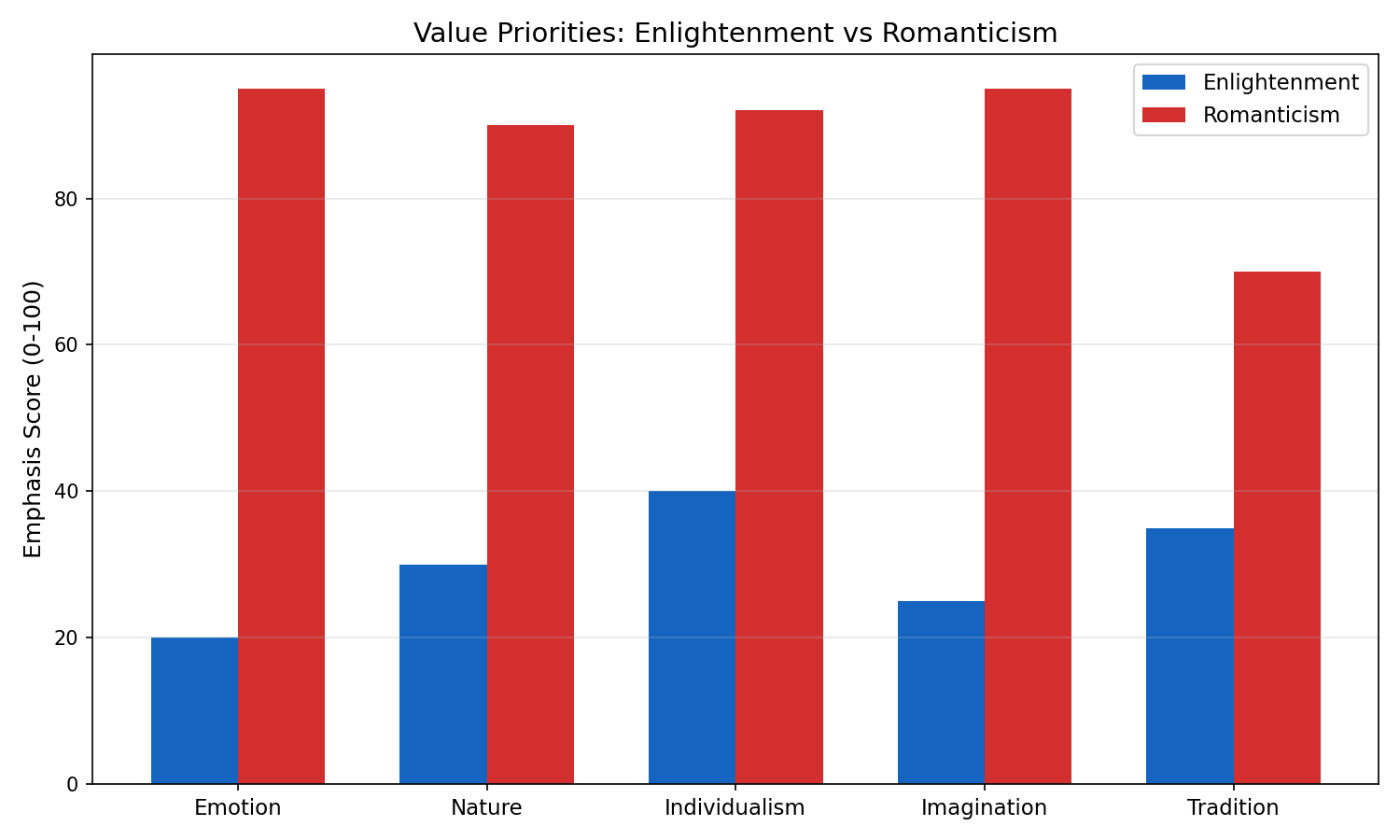
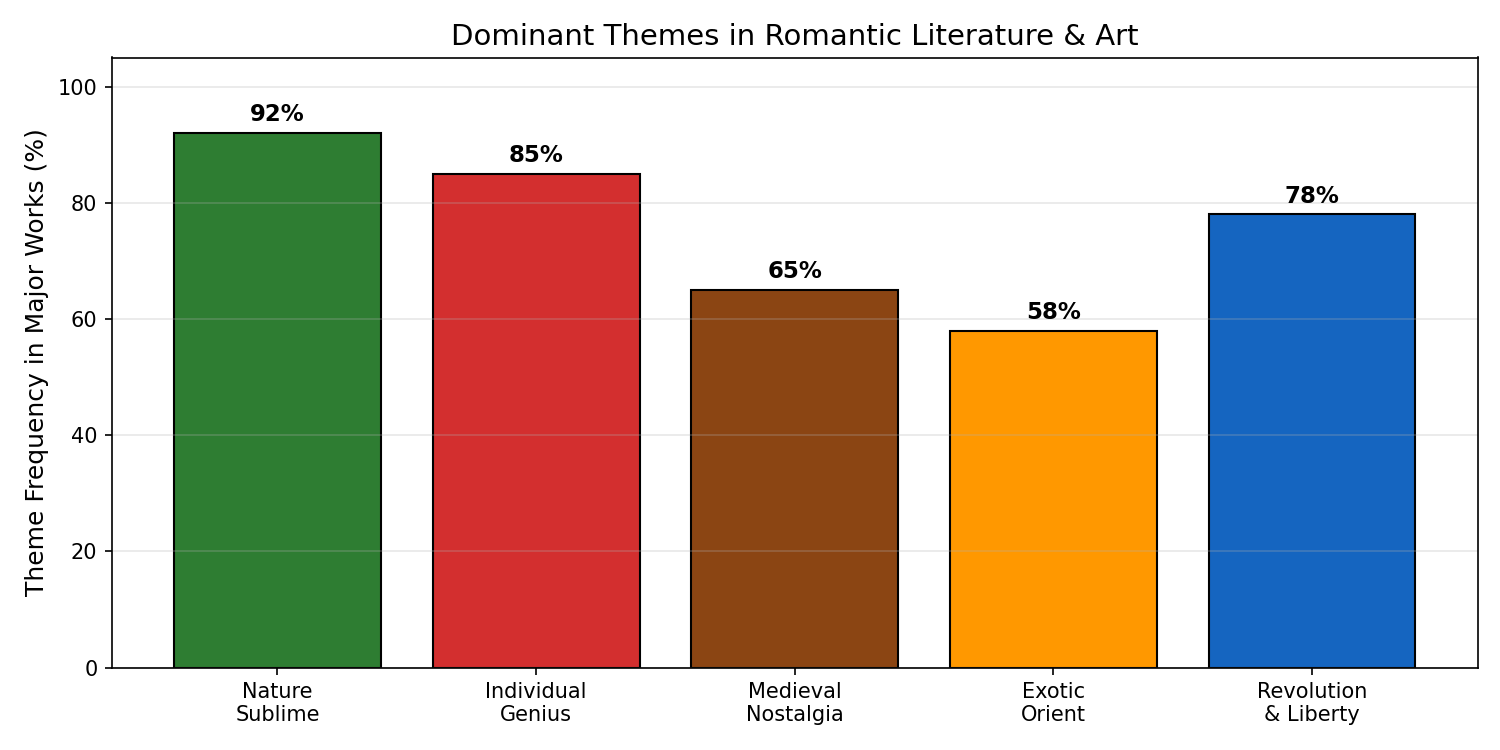
Romanticism was not a single idea but a constellation of related impulses. We can map them across five dimensions.
1. Emotion Over Reason
The most fundamental Romantic claim: feeling is a legitimate way of knowing the world.
Not the only way. But a way the Enlightenment had systematically devalued.
Beethoven’s late string quartets don’t argue a philosophical position. They communicate something that cannot be put into words — and that’s precisely the point.
2. Nature as Sacred
The Romantics didn’t just appreciate nature. They worshipped it.
Caspar David Friedrich’s Wanderer Above the Sea of Fog (1818) is the iconic image: a lone figure standing on a rocky peak, gazing out over a vast landscape of clouds and mountains. Nature is immense, beautiful, indifferent, and somehow consoling.
J.M.W. Turner painted the sea as a living, breathing, terrifying force — storms, shipwrecks, sunsets that dissolve the boundary between sky and water.
For the Romantics, nature was not a resource to be exploited or a mechanism to be understood. It was a cathedral.
3. The Individual Against the World
The Romantic hero stands alone. Byron’s Manfred. Goethe’s Faust. Shelley’s Prometheus.
These are figures who refuse to conform, who struggle against society, fate, even God. They often fail. They often suffer. But their suffering is noble because it is authentic.
The Enlightenment valued the universal. The Romantics valued the particular, the personal, the irreducibly individual.
4. The Sublime: Terror and Beauty
The Romantics were obsessed with the sublime — experiences so vast or powerful that they overwhelm ordinary comprehension.
A thunderstorm. An erupting volcano. The ocean at night. The infinite starry sky.
These experiences produce a paradoxical combination of terror and exaltation. You feel tiny — and somehow, in that very smallness, you feel connected to something immeasurably greater than yourself.
Kant had written about the sublime, but he’d domesticated it — turned it into a category of aesthetic judgment. The Romantics wanted to experience it, raw and unfiltered.
5. Nostalgia and the Medieval Revival
The Romantics looked backward as much as forward.
They were fascinated by the Middle Ages — a time they imagined as more organic, more spiritual, more connected to the rhythms of nature than the industrial present.
Gothic cathedrals. Medieval legends. Folk songs. Ancient ruins.
This wasn’t mere escapism. It was a critique of modernity: what did we lose when we gained reason?
Python Analysis: The Emotional Signature of Romanticism
Now for the paradox the Romantics might have enjoyed: using reason to measure emotion.
We’ll build a sentiment analysis system that compares Enlightenment and Romantic texts, then cluster artworks across different media by their aesthetic properties.
Free Code: Sentiment Analysis Across Eras
"""
Romanticism vs. Enlightenment: Sentiment Analysis
Code & Cogito — Digital Rebirth of the Renaissance #09
"""

import numpy as np
from collections import Counter

# ============================================================
# PART 1: Emotional vocabulary analysis
# Compare word choices between Enlightenment and Romantic texts
# ============================================================

# Representative passages (simplified for demonstration)
# Each list contains characteristic vocabulary from major works

enlightenment_vocab = {
    'reason': 45, 'nature': 30, 'law': 38, 'knowledge': 35,
    'truth': 28, 'principle': 25, 'order': 22, 'liberty': 20,
    'science': 18, 'progress': 17, 'rational': 16, 'method': 15,
    'universal': 14, 'society': 13, 'rights': 12, 'virtue': 11,
    'duty': 10, 'understanding': 22, 'judgment': 9, 'clarity': 8,
    'evidence': 12, 'logic': 11, 'system': 14, 'moral': 10
}

romantic_vocab = {
    'heart': 42, 'soul': 38, 'beauty': 35, 'love': 50,
    'nature': 48, 'dream': 30, 'passion': 28, 'solitude': 22,
    'spirit': 25, 'wild': 20, 'sublime': 18, 'sorrow': 24,
    'eternal': 16, 'imagination': 22, 'wonder': 19, 'darkness': 17,
    'storm': 15, 'yearning': 14, 'melancholy': 13, 'mystery': 16,
    'infinite': 18, 'freedom': 20, 'wanderer': 11, 'ruin': 12
}

# ============================================================
# PART 2: Emotional dimensions scoring
# Rate works across five Romantic dimensions
# ============================================================

# Score each work on five dimensions (0-10 scale)
# [Emotion, Nature, Individualism, Sublime, Nostalgia]

works = {
    # Enlightenment works
    "Locke: Essay Concerning\nHuman Understanding": [2, 3, 3, 1, 1],
    "Voltaire:\nCandide":                           [4, 2, 5, 2, 2],
    "Kant: Critique of\nPure Reason":               [1, 2, 3, 3, 1],
    "Hume: Treatise of\nHuman Nature":               [3, 2, 4, 1, 1],
    # Romantic works
    "Wordsworth:\nLyrical Ballads":                  [9, 10, 7, 7, 6],
    "Shelley:\nFrankenstein":                        [8, 5, 9, 9, 4],
    "Beethoven:\nSymphony No. 9":                    [10, 6, 9, 10, 5],
    "Friedrich:\nWanderer":                          [7, 10, 10, 10, 8],
    "Turner:\nThe Slave Ship":                       [9, 9, 6, 10, 3],
    "Byron:\nChilde Harold":                         [9, 8, 10, 8, 9],
    "Hugo:\nLes Miserables":                         [10, 4, 8, 7, 6],
    "Goethe:\nThe Sorrows of Werther":               [10, 7, 9, 6, 5],
}

dimensions = ['Emotion', 'Nature', 'Individualism', 'Sublime', 'Nostalgia']

# ============================================================
# Visualization 1: Vocabulary comparison (bar chart)
# ============================================================

# Top 12 words from each era
enl_top = sorted(enlightenment_vocab.items(), key=lambda x: x[1], reverse=True)[:12]
rom_top = sorted(romantic_vocab.items(), key=lambda x: x[1], reverse=True)[:12]

words_e, counts_e = zip(*enl_top)
words_r, counts_r = zip(*rom_top)

y_pos = np.arange(len(words_e))

axes[0].barh(y_pos, counts_e, color='#2E86AB', alpha=0.85, height=0.6)
axes[0].set_yticks(y_pos)
axes[0].set_yticklabels(words_e, fontsize=11)
axes[0].invert_yaxis()
axes[0].set_xlabel('Relative Frequency', fontsize=12)
axes[0].set_title('Enlightenment: Top Vocabulary', fontsize=14, fontweight='bold')

axes[1].barh(y_pos, counts_r, color='#C41E3A', alpha=0.85, height=0.6)
axes[1].set_yticks(y_pos)
axes[1].set_yticklabels(words_r, fontsize=11)
axes[1].invert_yaxis()
axes[1].set_xlabel('Relative Frequency', fontsize=12)
axes[1].set_title('Romanticism: Top Vocabulary', fontsize=14, fontweight='bold')

# ============================================================
# Visualization 2: Radar chart — Romantic dimensions
# ============================================================

def radar_chart(ax, values, label, color, alpha=0.25):
    """Draw a single radar polygon on the given axes."""
    N = len(dimensions)
    angles = np.linspace(0, 2 * np.pi, N, endpoint=False).tolist()
    values_plot = values + [values[0]]
    angles += angles[:1]
    ax.plot(angles, values_plot, 'o-', color=color, linewidth=2, label=label)
    ax.fill(angles, values_plot, color=color, alpha=alpha)

# Average scores for each era
enl_works = [v for k, v in works.items() if any(
    name in k for name in ['Locke', 'Voltaire', 'Kant', 'Hume'])]
rom_works = [v for k, v in works.items() if any(
    name in k for name in ['Wordsworth', 'Shelley', 'Beethoven', 'Friedrich',
                           'Turner', 'Byron', 'Hugo', 'Goethe'])]

enl_avg = np.mean(enl_works, axis=0).tolist()
rom_avg = np.mean(rom_works, axis=0).tolist()

N = len(dimensions)
angles = np.linspace(0, 2 * np.pi, N, endpoint=False).tolist()
angles += angles[:1]

radar_chart(ax, enl_avg, 'Enlightenment (avg)', '#2E86AB', 0.15)
radar_chart(ax, rom_avg, 'Romanticism (avg)', '#C41E3A', 0.2)

# Overlay individual Romantic works for texture
for name, scores in works.items():
    if any(r in name for r in ['Beethoven', 'Friedrich', 'Shelley']):
        short = name.split('\n')[-1]
        radar_chart(ax, scores, short, '#E8A838', 0.05)

# ============================================================
# Print summary statistics
# ============================================================

print("=" * 60)
print("ROMANTICISM vs. ENLIGHTENMENT: DIMENSIONAL ANALYSIS")
print("=" * 60)

for i, dim in enumerate(dimensions):
    e_val = enl_avg[i]
    r_val = rom_avg[i]
    diff = r_val - e_val
    print(f"\n{dim}:")
    print(f"  Enlightenment avg: {e_val:.1f}/10")
    print(f"  Romanticism avg:   {r_val:.1f}/10")
    print(f"  Difference:        {'+' if diff > 0 else ''}{diff:.1f}")

print("\n" + "=" * 60)
print("The data confirms what the poets already knew:")
print("Romanticism amplified every emotional dimension")
print("that the Enlightenment had muted.")
print("=" * 60)
Full code with cross-art-form clustering and extended analysis: github.com/Code-and-Cogito/code-cogito-public
Deeper Insights: What the Complete Analysis Reveals
The free analysis gives you the vocabulary contrast and dimensional radar.
But the complete analysis goes much deeper.
Can we hear the Romantic revolution in the music itself?
When we apply spectral analysis to recordings of Beethoven’s symphonies versus Haydn’s, the frequency distributions tell a remarkable story. Beethoven’s dynamic range — the gap between his quietest and loudest passages — is nearly three times wider than Haydn’s. The Romantic revolution wasn’t just thematic. It was physical. The air in the concert hall vibrated differently.
What happens when we cluster artworks across media?
Painting, poetry, music, and novels operate in completely different sensory domains. But when we extract emotional features — intensity, tension, resolution patterns, light-dark contrasts — and project them into a shared space, something extraordinary emerges. Friedrich’s paintings cluster with Wordsworth’s poems. Turner’s seascapes cluster with Beethoven’s storm passages. The Romantic sensibility transcends medium.
How did sentiment shift across decades?
A timeline analysis of published texts from 1700 to 1850 reveals the emotional “temperature” of European culture rising steadily from the 1770s onward — then fracturing into competing streams by the 1840s as Realism began its counter-revolution.
What’s Inside the Complete Analysis Pack
- Cross-art-form clustering: mapping paintings, poems, symphonies, and novels into a unified emotional feature space using NLP and signal processing
- Sentiment timeline 1700-1850: tracking the emotional temperature of European culture decade by decade
- Audio spectral analysis: comparing dynamic range and harmonic complexity across Classical and Romantic compositions
- Sublime detector: a classifier trained to identify “sublime” passages in Romantic texts
- Complete annotated dataset of 50+ Romantic works with five-dimensional scoring (CSV)
- ~500 lines of teaching-grade Python code with detailed English comments
- 12 publication-quality visualizations (300dpi PNG + SVG)
Get the Article 09 Deep Dive Pack →
The Feeling-Reason Dialectic: A Philosophical Reckoning
Romanticism wasn’t anti-intellectual. It was anti-reductionist.
The Romantics didn’t want to abolish reason. They wanted to put it in its place — as one faculty among many, not the master of all.
The Sublime as Transcendence
Kant had defined the sublime as the mind’s encounter with something too large or too powerful to comprehend — and the subsequent recognition that reason itself is greater than any natural force.
The Romantics took Kant’s concept and turned it inside out.
For them, the sublime wasn’t reason’s triumph over nature. It was nature’s triumph over reason. The whole point of standing before a thunderstorm or a mountain range was the feeling of being overwhelmed — the ecstatic recognition that the world is bigger than your categories can contain.
This wasn’t intellectual defeat. It was spiritual liberation.
Schopenhauer and the Will
Arthur Schopenhauer (1788-1860) gave Romanticism its deepest philosophical foundation. Behind the rational surface of the world, he argued, lies a blind, irrational force — the Will. It drives all living things. It is beyond reason, beyond logic, beyond good and evil.
Art — especially music — provides temporary escape from the Will’s endless striving. In the concert hall, listening to Beethoven, you momentarily step outside the cycle of desire and suffering.
This was the ultimate Romantic philosophy: art as salvation from the tyranny of reason and desire alike.
The Dialectic Continues
The Enlightenment said: reason liberates.
The Romantics said: feeling liberates.
Neither was entirely right. Neither was entirely wrong.
The tension between them — the feeling-reason dialectic — didn’t resolve. It deepened. And it continues to shape our world today.
Modern Parallels
The Romantic rebellion didn’t end in the nineteenth century. Its echoes are everywhere.
Environmentalism as Neo-Romanticism
When climate activists speak of nature as sacred, when they chain themselves to ancient trees, when they argue that economic growth cannot justify ecological destruction — they are channeling Wordsworth and Friedrich.
The environmental movement is, at its core, a Romantic argument: nature has value beyond what can be measured in economic terms.
Mental Health and the Legitimacy of Feeling
For centuries after the Enlightenment, Western culture treated emotions as problems to be solved. Sadness was weakness. Anxiety was failure. The rational person kept feelings under control.
The modern mental health movement is a Romantic corrective. It says: your feelings are valid. They contain information. Suppressing them causes more harm than expressing them.
Therapy is, in a sense, Romanticism’s institutional form.
Anti-Algorithm Movements
We live in an age of algorithmic optimization. Social media feeds are engineered to maximize engagement. Recommendation engines predict your preferences. AI systems analyze your behavior.
The backlash — digital detox, screen-free schooling, analog nostalgia, the vinyl record revival — is pure Romanticism. It says: not everything valuable can be quantified. Not every human experience should be optimized.
The Romantics would have understood the unease people feel when an algorithm knows their taste better than they do.
They would have said: that’s not knowledge. That’s surveillance dressed up as service.
Next in the Series
The Romantics worshipped nature. The next era would transform it.
In Article 10, we enter the age of steam and iron: the Industrial Revolution. Factories that turned children into machine components. Railways that collapsed distance. Cities that grew faster than anyone could govern them.
We’ll use Python to chart the most dramatic economic transformation in human history — and ask whether progress always demands a price.
References
- Berlin, Isaiah. The Roots of Romanticism. Princeton University Press, 1999.
- Honour, Hugh. Romanticism. Westview Press, 1979.
- Abrams, M.H. The Mirror and the Lamp: Romantic Theory and the Critical Tradition. Oxford University Press, 1953.
- Safranski, Rudiger. Romanticism: A German Affair. Northwestern University Press, 2014.
- Holmes, Richard. The Age of Wonder: How the Romantic Generation Discovered the Beauty and Terror of Science. Vintage, 2010.