Reformation — When Authority Crumbles
Series: Digital Rebirth of the Renaissance #07/12 | Read time: 25 min | Language: Python
Author: Wina @ Code & Cogito
The Bonfire That Changed Europe
- December 10. Wittenberg, Germany.
A crowd gathered outside the Elster Gate.
A stout monk in Augustinian robes stepped forward, carrying a document bearing the papal seal.
The document was a papal bull — Exsurge Domine — demanding that he recant 41 of his propositions within 60 days or face excommunication.
The most powerful institution on earth had spoken.
He threw it into the fire.
The crowd gasped. Students cheered. The flames consumed the Pope’s words.
His name was Martin Luther.
He was forty-seven years old, an obscure theology professor at a university most Europeans had never heard of.
And he had just declared war on the Catholic Church.
Not with an army. Not with a fortune.
With ideas.
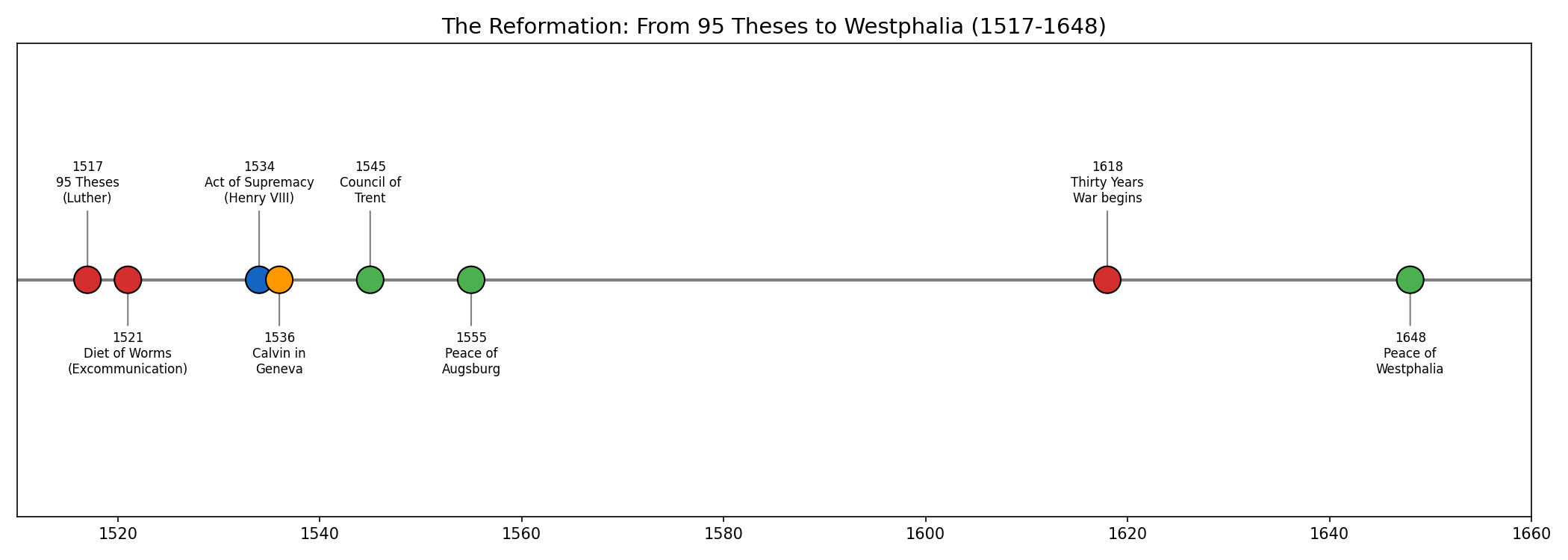
Three years earlier, Luther had nailed 95 theses to the door of the Castle Church. That act alone was not extraordinary — posting academic disputations on church doors was standard practice.
What was extraordinary was what happened next.
Within two weeks, copies of the 95 Theses had spread across the Holy Roman Empire.
The printing press — that invention we explored in Article 06 — had turned a local academic dispute into a continental firestorm.
In this article, we use Python to model how Luther’s ideas cascaded through Europe, simulate the devastating chain reaction that followed, and visualize the territorial reshaping of a continent torn apart by the question Luther forced everyone to ask:
Who has the right to tell you what to believe?
Historical Background: Why Europe Was Ready to Burn
Luther didn’t ignite the Reformation from nothing. The fuel had been accumulating for centuries.
A Church Drowning in Corruption
By 1500, the Catholic Church was less a spiritual institution and more a political empire.
The sale of indulgences had become blatant commerce. Johann Tetzel, a Dominican friar, traveled through Germany with a sales pitch that became infamous: pay money, and your dead relatives escape Purgatory faster. The Church was literally selling salvation.
The Avignon Papacy (1309-1377) had already damaged papal credibility. For seventy years, popes lived in France under French royal influence. Then came the Great Schism (1378-1417), when two — and briefly three — rival popes each claimed to be the true Vicar of Christ.
Clerical abuses were rampant. Priests who couldn’t read Latin. Bishops who never visited their dioceses. Monasteries that functioned as luxury retreats. The gap between Christian ideals and Church practice had become a canyon.
Predecessors Who Paid the Price
Luther was not the first to challenge Rome.
John Wycliffe (1320s-1384) in England argued that scripture, not the Pope, was the ultimate authority. He translated the Bible into English. After his death, the Church dug up his bones and burned them.
Jan Hus (1369-1415) in Bohemia preached similar ideas. The Church promised him safe conduct to the Council of Constance to discuss his views. They burned him alive instead.
Girolamo Savonarola (1452-1498) in Florence railed against Church corruption. He was hanged and burned in the main square.
The pattern was clear: challenge the Church, and the Church destroys you.
So why did Luther survive?
The Shield of Politics
Three factors protected Luther where his predecessors had been killed.
First, the printing press. By the time the Church reacted, Luther’s ideas had already spread too far to suppress. You can burn a man. You cannot burn ten thousand pamphlets.
Second, political protection. Frederick the Wise, Elector of Saxony, shielded Luther — not necessarily out of theological conviction, but because a famous professor brought prestige to his territory and leverage against the Emperor.
Third, the fractured politics of the Holy Roman Empire. Emperor Charles V wanted Luther silenced, but he needed the support of German princes for his wars against France and the Ottoman Empire. He couldn’t afford to alienate them over a theological dispute.
Luther’s survival was not inevitable. It was contingent on a specific alignment of technology, politics, and timing.
Luther’s Three Revolutionary Claims
Luther’s theology can be distilled into three radical propositions. Each one struck at the foundations of Church authority.
Sola Fide — Faith Alone
The Church taught: Salvation requires faith PLUS good works, sacraments, indulgences, pilgrimages, and obedience to the clergy.
Luther argued: Salvation comes through faith alone. No amount of money, ritual, or institutional obedience can earn God’s grace. It is a free gift.
The implication was devastating. If salvation requires nothing the Church sells, then the Church’s entire economic model collapses. Indulgences are fraud. Pilgrimages are optional. The priest’s role in mediating salvation is eliminated.
Sola Scriptura — Scripture Alone
The Church taught: Truth comes from scripture AS INTERPRETED BY the Church, plus Church tradition, papal decrees, and council rulings.
Luther argued: The Bible is the sole authority. Any teaching not grounded in scripture — no matter who proclaims it — has no binding force.
This was a direct assault on the papacy. If a simple priest with a Bible can determine truth for himself, then the Pope has no special authority. Centuries of Church tradition become merely human opinion, not divine law.
Priesthood of All Believers
The Church taught: Clergy are a special caste, uniquely empowered to mediate between God and humanity. Ordination confers supernatural power.
Luther argued: Every Christian is a priest before God. The distinction between clergy and laity is a human invention, not a divine mandate.
This demolished the entire hierarchical structure. If every believer can approach God directly, if every believer can interpret scripture, then the institutional Church is not a necessary gateway to salvation.
It is an optional community.
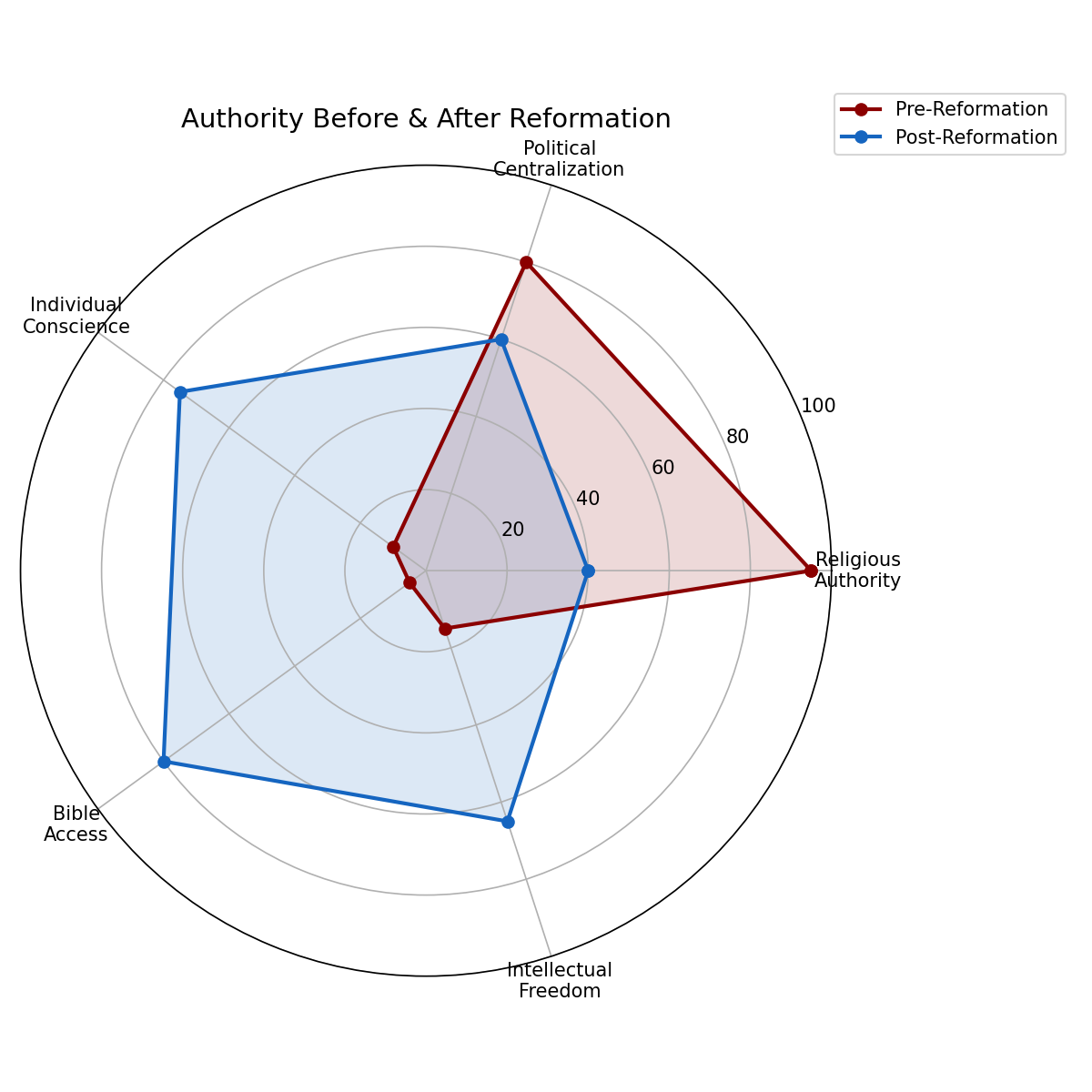
These three ideas, taken together, were not merely theological adjustments. They were a blueprint for dismantling centralized authority.
The Chain Reaction: From Theology to Total War
What Luther unleashed was far more than he intended.
Stage 1: The Pamphlet Explosion (1517-1525)
The numbers tell the story. Between 1518 and 1524, the number of printed works in German increased roughly sixfold. Luther himself authored approximately one-third of all German-language pamphlets published during this period. The printing press gave him an audience no reformer had ever had.
His three great treatises of 1520 — To the Christian Nobility, On the Babylonian Captivity of the Church, On the Freedom of a Christian — sold thousands of copies within weeks.
But ideas, once released, cannot be controlled by their author.
Stage 2: Radical Reformation (1524-1535)
If scripture alone is the authority, and every believer is a priest — then who decides what scripture means?
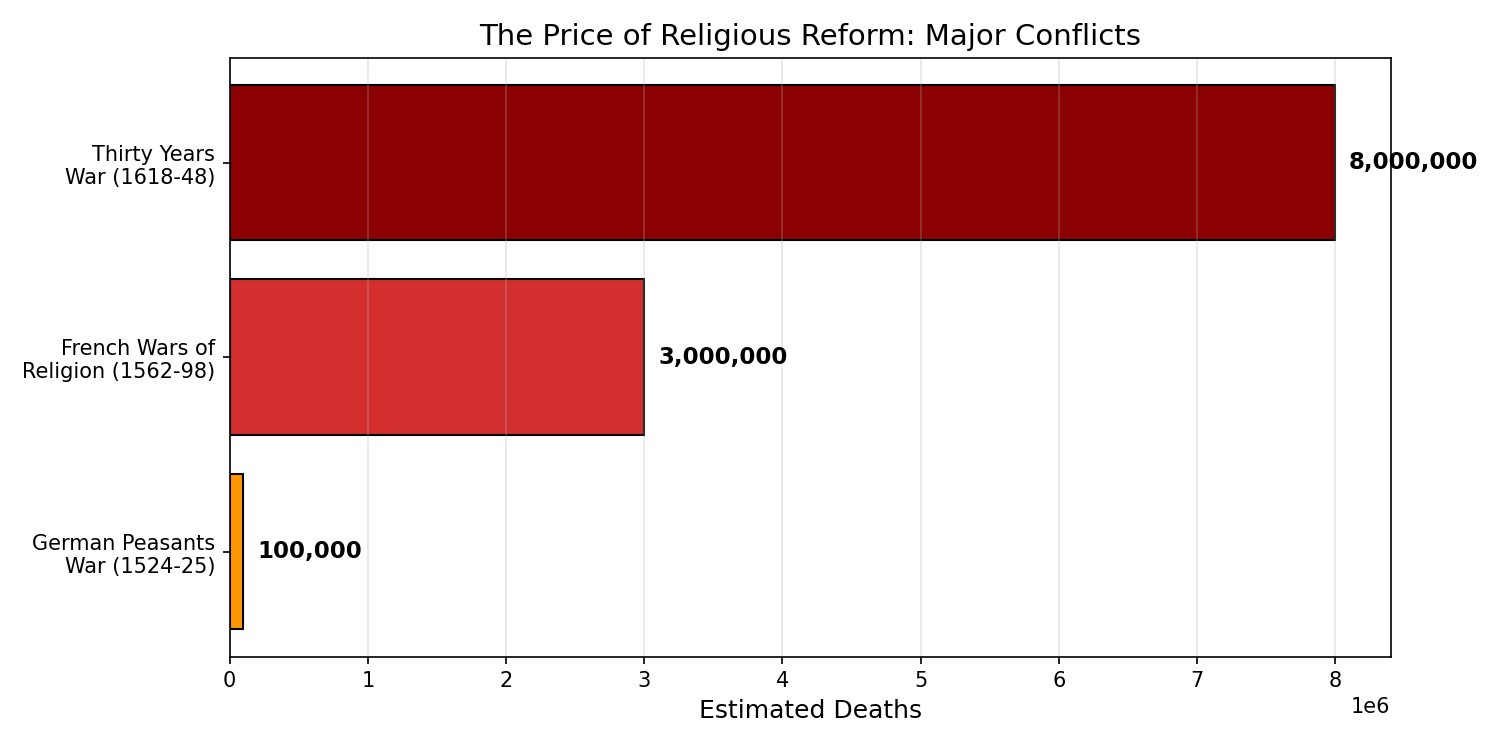
The peasants decided it meant social equality. The German Peasants’ War (1524-1525) saw roughly 300,000 people rise up against feudal lords, citing Luther’s language of Christian liberty. Luther, horrified, wrote Against the Murderous, Thieving Hordes of Peasants, urging the princes to slaughter them without mercy.
An estimated 100,000 peasants died.
The Anabaptists decided it meant total separation from both Catholic and Lutheran churches. They rejected infant baptism, refused to swear oaths, and some established communes. In Munster in 1534, radical Anabaptists seized the city and declared a theocratic kingdom. The siege and recapture were brutal.
Zwingli in Zurich, Calvin in Geneva — each developed their own interpretation of Reformed Christianity, often in bitter disagreement with Luther and with each other.
Luther had opened Pandora’s box. He wanted to reform the Church. Instead, he shattered Christendom.
Stage 3: The Thirty Years’ War (1618-1648)
The theological fracture became a political one.
Europe divided into Catholic and Protestant blocs. Alliances shifted. Tensions escalated for a century until the entire system detonated.
The Thirty Years’ War was the most destructive conflict in European history before the twentieth century.
The numbers are staggering:
- Duration: 30 years of continuous warfare
- German population losses: estimated 30-40% in many territories
- Some regions lost up to two-thirds of their inhabitants
- The city of Magdeburg was sacked in 1631 — an estimated 20,000 civilians killed in a single day
- Total military and civilian deaths: estimated 4.5 to 8 million
The war ended with the Peace of Westphalia (1648), which established principles that still shape international relations: state sovereignty, territorial integrity, and the right of rulers to determine the religion of their territories.
It took 130 years and millions of deaths to resolve the question Luther raised at Wittenberg.
Python Analysis: Modeling the Reformation’s Cascade
Free Code: Pamphlet Diffusion and Cascade Failure Simulation
Let’s model two key dynamics of the Reformation.
Part 1: Pamphlet Diffusion Model
How did Luther’s ideas spread so rapidly? We can model the diffusion of pamphlets as an epidemic-like process — ideas infecting minds through print.
import numpy as np

# SIR-style model for idea diffusion via printed pamphlets
# S = unexposed population, I = actively sharing, R = absorbed/moved on

def pamphlet_diffusion(pop=1_000_000, initial_readers=500,
                       beta_no_press=0.02, beta_with_press=0.35,
                       gamma=0.05, days=180):
    """
    Compare idea spread with and without the printing press.
    beta: transmission rate (how fast ideas spread per contact)
    gamma: recovery rate (how fast people stop actively sharing)
    """
    results = {}
    for label, beta in [("Without Press (Wycliffe era)", beta_no_press),
                        ("With Press (Luther era)", beta_with_press)]:
        S, I, R = pop - initial_readers, initial_readers, 0
        history = {"S": [S], "I": [I], "R": [R]}

        for _ in range(days):
            new_infected = beta * S * I / pop
            new_recovered = gamma * I
            S -= new_infected
            I += new_infected - new_recovered
            R += new_recovered
            history["S"].append(S)
            history["I"].append(I)
            history["R"].append(R)

        results[label] = history

    # Plot comparison
    fig, axes = plt.subplots(1, 2, figsize=(14, 5))
    for ax, (label, hist) in zip(axes, results.items()):
        days_range = range(len(hist["S"]))
        ax.fill_between(days_range, hist["I"], alpha=0.4, label="Actively sharing")
        ax.fill_between(days_range, hist["R"], alpha=0.3, label="Absorbed idea")
        ax.set_title(label, fontsize=13, fontweight="bold")
        ax.set_xlabel("Days")
        ax.set_ylabel("Population")
        ax.legend()
        ax.set_ylim(0, pop)

    plt.suptitle("Pamphlet Diffusion: Why Luther Succeeded Where Wycliffe Failed",
                 fontsize=14, fontweight="bold")
    plt.tight_layout()
    plt.savefig("pamphlet_diffusion.png", dpi=150, bbox_inches="tight")
    plt.show()

pamphlet_diffusion()
The visualization makes the contrast stark. Without the printing press, ideas spread slowly and locally — easily contained by authorities. With the press, ideas reach critical mass before any institution can react.
Wycliffe’s ideas spread at walking speed. Luther’s spread at printing speed.
Part 2: Cascade Failure Simulation
Luther questioned one authority — the Pope’s power to grant indulgences. But questioning one authority weakened confidence in all authority. We can model this as a cascade failure in an interconnected network.
import numpy as np

def cascade_failure_simulation(n_institutions=20, n_simulations=500,
                               connection_density=0.3, failure_threshold=0.4):
    """
    Model how questioning one institution cascades to others.
    Each institution has connections; when enough connected
    institutions fail, it fails too (like dominoes).
    """
    np.random.seed(1517)  # The year it all started

    institutions = [
        "Papal Authority", "Indulgences", "Clerical Celibacy",
        "Monasticism", "Church Courts", "Tithes System",
        "Saint Veneration", "Pilgrimages", "Purgatory Doctrine",
        "Sacramental System", "Episcopal Hierarchy", "Canon Law",
        "Church Land Ownership", "Clerical Tax Exemption",
        "Latin Liturgy", "Ecclesiastical Appointments",
        "Religious Orders", "University Theology", "Church Censorship",
        "Feudal Obligations"
    ]

    # Create random adjacency matrix (symmetric)
    adj = np.random.rand(n_institutions, n_institutions) < connection_density
    np.fill_diagonal(adj, False)
    adj = adj | adj.T

    cascade_sizes = []
    for _ in range(n_simulations):
        failed = np.zeros(n_institutions, dtype=bool)
        failed[0] = True  # Papal Authority questioned first

        changed = True
        while changed:
            changed = False
            for i in range(n_institutions):
                if failed[i]:
                    continue
                neighbors = adj[i]
                if neighbors.sum() == 0:
                    continue
                failed_neighbors = (failed & neighbors).sum()
                if failed_neighbors / neighbors.sum() >= failure_threshold:
                    failed[i] = True
                    changed = True

        cascade_sizes.append(failed.sum())

    # Visualize distribution of cascade sizes
    fig, ax = plt.subplots(figsize=(10, 5))
    ax.hist(cascade_sizes, bins=range(1, n_institutions + 2),
            alpha=0.7, color="#c0392b", edgecolor="black")
    ax.axvline(np.mean(cascade_sizes), color="black", linestyle="--",
               label=f"Mean cascade: {np.mean(cascade_sizes):.1f} institutions")
    ax.set_xlabel("Number of Institutions Affected", fontsize=12)
    ax.set_ylabel("Frequency (out of 500 simulations)", fontsize=12)
    ax.set_title("Cascade Failure: How Questioning One Authority Topples Many",
                 fontsize=13, fontweight="bold")
    ax.legend(fontsize=11)
    plt.tight_layout()
    plt.savefig("cascade_failure.png", dpi=150, bbox_inches="tight")
    plt.show()

    print(f"Average institutions affected: {np.mean(cascade_sizes):.1f} / {n_institutions}")
    print(f"Full cascade probability: {sum(1 for s in cascade_sizes if s == n_institutions) / n_simulations:.1%}")

cascade_failure_simulation()
The simulation reveals a key insight: in tightly connected systems, you cannot question just one node. Once papal authority over indulgences was challenged, the legitimacy of every connected institution — Church courts, tithes, clerical privileges, canon law — came under pressure.
Luther wanted to reform one practice. The network structure of medieval authority made that impossible. Reform one node, and the entire system destabilizes.
Deeper Insights: What the Complete Analysis Reveals
The free code above models two dynamics. The complete analysis goes further: territorial change visualization tracking how the religious map of Europe shifted decade by decade, a network graph of Reformation influence showing how ideas flowed between reformers and cities, and a quantitative analysis of print output correlating pamphlet production with territorial conversion rates.
What’s Inside the Complete Analysis Pack
- Territorial change animation: decade-by-decade map of Catholic vs. Protestant Europe (1517-1648)
- Reformer influence network: graph visualization of connections between Luther, Calvin, Zwingli, Knox, and 30+ lesser-known figures
- Print production analysis: correlating pamphlet output by city with speed of Reformation adoption
- Thirty Years’ War population impact: regional demographic modeling of the catastrophe
- ~500 lines of teaching-grade Python code with detailed English comments
- 12 publication-quality visualizations (300dpi PNG + SVG)
Get the Article 07 Deep Dive Pack →
The Philosophy of Unintended Consequences
Luther opened Pandora’s box.
He wanted to reform the Church. He got the Peasants’ War. He wanted to free Christians from papal tyranny. He got a century of religious warfare. He wanted every believer to read the Bible for themselves. He got a thousand competing interpretations and the fragmentation of Christendom.
This is the paradox of liberation: when you remove a centralized authority, you don’t get harmony. You get conflict. Because the authority, however corrupt, was also providing a framework for agreement.
Without the Pope to settle disputes, every theological question became a potential war. Without a shared interpretive tradition, every Bible verse became ammunition.
Luther understood this late. In his final years, he grew bitter and authoritarian, railing against the very diversity of interpretation his principles had unleashed. He wanted freedom of conscience — but only for consciences that agreed with him.
The lesson is uncomfortable but essential: dismantling authority is far easier than building a replacement.
This is not an argument for preserving corrupt institutions. It is a warning that revolutions consume their children. The French Revolution would learn this lesson again. So would the Russian Revolution. So would every movement that believed that tearing down the old order would automatically produce a better one.
Modern Parallels
Decentralization: Blockchain and the New Reformation
Luther’s sola scriptura — trust the text, not the institution — finds its echo in blockchain technology.
Bitcoin’s whitepaper is a kind of 95 Theses nailed to the door of the financial system: we don’t need banks (the institutional clergy) to mediate transactions. The protocol (the scripture) is sufficient. Trust the code, not the corporation.
The parallel extends further. Just as the Reformation fragmented into competing denominations — Lutheran, Calvinist, Anabaptist, Anglican — cryptocurrency has fragmented into thousands of competing tokens, each claiming to be the true vision of decentralization.
And just as the Reformation produced unexpected violence, crypto has produced unexpected consequences: speculative bubbles, energy consumption, fraud.
Open Source: The Priesthood of All Developers
Luther’s priesthood of all believers maps directly onto the open source movement.
The proprietary software model mirrors the medieval Church: a closed institution controls access to the sacred text (source code). Users must trust the institution. They cannot verify, modify, or redistribute.
Open source says: every developer is a priest. The code is scripture. Anyone can read it, interpret it, fork it. No institution holds a monopoly on truth.
And like the Reformation, open source has produced both liberation and fragmentation — thousands of Linux distributions, competing standards, forked communities locked in theological disputes about tabs versus spaces.
Whistleblowing: The Cost of Challenging Authority
Luther’s act — publicly challenging the most powerful institution of his era — resonates with modern whistleblowers.
Edward Snowden, Daniel Ellsberg, Frances Haugen — each nailed their own theses to a metaphorical door. Each exposed institutional corruption. Each faced consequences.
And each triggered the same paradox: the information they released was both liberating and destabilizing. Transparency is a value, but total transparency can shatter the trust that institutions need to function.
Luther’s story reminds us: speaking truth to power is necessary, noble, and dangerous — not only for the speaker, but for the entire system that truth disrupts.
Next in the Series
The Reformation shattered the old order. But what replaced it?
In the next article, we enter the Age of Enlightenment — when European thinkers tried to rebuild authority on a new foundation: not faith, not tradition, but reason itself.
Voltaire, Rousseau, Kant — they believed reason could illuminate every corner of human life.
They were partly right. And the parts where they were wrong would cost tens of thousands of lives.
References
- MacCulloch, Diarmaid. The Reformation: A History. Penguin, 2005.
- Wilson, Peter H. The Thirty Years War: Europe’s Tragedy. Belknap Press, 2011.
- Pettegree, Andrew. Brand Luther: How an Unheralded Monk Turned His Small Town into a Center of Publishing. Penguin, 2016.
- Gregory, Brad S. The Unintended Reformation: How a Religious Revolution Secularized Society. Belknap Press, 2012.
- Edwards, Mark U. Printing, Propaganda and Martin Luther. Fortress Press, 2004.