Enlightenment — When Reason Becomes the New God
Series: Digital Rebirth of the Renaissance #08/12 | Read time: 28 min | Language: Python
Author: Wina @ Code & Cogito
Dare to Know
- Konigsberg, Prussia.
A small, meticulous man who had never traveled more than ten miles from his birthplace sat down to answer a question posed by a Berlin magazine.
The question was: What is Enlightenment?
His answer became one of the most quoted sentences in the history of philosophy:
“Sapere aude! Dare to know! Have the courage to use your own understanding.”
His name was Immanuel Kant.
He was sixty years old. He weighed barely fifty kilograms. His daily routine was so precise that neighbors set their clocks by his afternoon walk.
And with one essay, he defined an entire era.
The Enlightenment was not a single event. It was a century-long intellectual earthquake that reshaped how humanity understood itself, its governments, its gods, and its rights.
It produced democracy, human rights declarations, and modern science.
It also produced the guillotine.
In this article, we use Python to map the citation network connecting the Enlightenment’s greatest minds, analyze how their ideas fueled revolutions across three continents, and confront the darkest question the Enlightenment forces us to ask:
What happens when reason itself becomes a tyrant?
Historical Background: The Soil That Grew the Enlightenment
The Enlightenment did not appear from nowhere. Three forces prepared the ground.
Post-Reformation Exhaustion
The Thirty Years’ War (1618-1648), which we examined in Article 07, traumatized Europe. Roughly a third of the German population perished in wars fought over whose interpretation of Christianity was correct.
The lesson was brutal but clear: if religious certainty leads to mass slaughter, perhaps certainty itself is the problem.
A generation of thinkers began searching for a foundation of knowledge that didn’t depend on faith, revelation, or church authority. They needed something that Catholics, Protestants, and everyone else could agree on.
They found it in reason.
The Scientific Revolution
Between 1543 and 1687, three men rewrote humanity’s understanding of the physical world.
Copernicus (1543) demonstrated that the Earth revolves around the Sun, not the reverse. He destroyed the geocentric model that had structured both astronomy and theology for over a millennium.
Galileo (1632) provided telescopic evidence for Copernicus and, more importantly, championed the principle that observation and mathematics — not authority — determine truth. The Church forced him to recant. The truth didn’t care.
Newton (1687) published the Principia Mathematica, unifying terrestrial and celestial mechanics under a single set of mathematical laws. Gravity, motion, optics — the universe operated by discoverable, mathematical rules.
The implication was revolutionary: if the physical world follows rational laws, perhaps the social world should too.
Locke’s Foundation
John Locke (1632-1704) translated scientific rationalism into political philosophy.
His Two Treatises of Government (1689) argued that humans possess natural rights — life, liberty, and property — that no government can legitimately violate. Political authority derives not from divine right but from the consent of the governed. A government that fails to protect natural rights forfeits its legitimacy.
These ideas were radical enough on paper. A century later, they would be written into constitutions with gunpowder and blood.
Twelve Thinkers Who Rebuilt the World
The Enlightenment was not one philosophy. It was a conversation — sometimes collaborative, often contentious — among dozens of thinkers across multiple countries and decades.
Here are twelve whose ideas reshaped civilization.
The Empiricists and Scientists
John Locke (1632-1704, England): The mind is a blank slate. Knowledge comes from experience. Government exists to protect natural rights. His influence on the American founding fathers was enormous.
Isaac Newton (1643-1727, England): Demonstrated that the universe operates according to discoverable mathematical laws. Inspired the Enlightenment conviction that reason can unlock all of nature’s secrets.
David Hume (1711-1776, Scotland): The great skeptic. Questioned causation, induction, and the rational foundations of morality. Argued that reason is — and ought to be — the slave of the passions. He was the Enlightenment’s internal critic, the thinker who turned reason against itself.
The French Philosophes
Voltaire (1694-1778, France): The Enlightenment’s sharpest pen. Championed tolerance, free speech, and the separation of church and state. His wit was a weapon against dogma and superstition. Spent time in the Bastille for his writing — and kept writing.
Montesquieu (1689-1755, France): Proposed the separation of powers — legislative, executive, judicial — as a safeguard against tyranny. His Spirit of the Laws directly influenced the United States Constitution.
Jean-Jacques Rousseau (1712-1778, Geneva/France): The Enlightenment’s internal rebel. Argued that civilization corrupts natural human goodness. His concept of the “general will” inspired democrats and dictators alike. His Social Contract opens with one of philosophy’s most famous lines about man being born free but everywhere in chains.
Denis Diderot (1713-1784, France): Editor of the Encyclopedie, the Enlightenment’s greatest collaborative project. Twenty-eight volumes attempting to catalogue all human knowledge. It took over twenty years to complete and was banned twice by the French government.
The System Builders
Adam Smith (1723-1790, Scotland): The Wealth of Nations (1776) argued that free markets, guided by self-interest, produce collective prosperity more efficiently than central planning. He did not worship markets — he warned extensively about monopolies and the exploitation of workers — but his core insight about the coordinating power of prices transformed economics.
Immanuel Kant (1724-1804, Prussia): Synthesized rationalism and empiricism. Argued that the mind actively structures experience. His moral philosophy — the categorical imperative, treating people as ends not means — remains the backbone of modern ethics. He also wrote Perpetual Peace, proposing an international federation of republics — anticipating the United Nations by 150 years.
The Revolutionary Practitioners
Benjamin Franklin (1706-1790, America): Scientist, diplomat, inventor, printer. Embodied the Enlightenment ideal that one person could master multiple domains through reason and curiosity. His role in drafting the Declaration of Independence and securing French support for the American Revolution made him the Enlightenment’s most successful practitioner.
Thomas Jefferson (1743-1826, America): Wrote the Declaration of Independence, encoding Locke’s natural rights philosophy into a founding document. The phrase “all men are created equal” was revolutionary — and its obvious contradiction with Jefferson’s own slaveholding would haunt American history for centuries.
Mary Wollstonecraft (1759-1797, England): Wrote A Vindication of the Rights of Woman (1792), applying Enlightenment logic to its own blind spot. If reason is universal, and rights derive from rational capacity, then denying women education and rights is irrational. She turned the Enlightenment’s own arguments against its practitioners.
The Dark Side: When Reason Devours Its Children
The Enlightenment’s ideas produced the most hopeful political documents in human history.
They also produced the Reign of Terror.
The French Revolution’s Arc
1789: The Revolution begins with Enlightenment ideals — liberty, equality, fraternity. The Declaration of the Rights of Man echoes Locke, Montesquieu, and Rousseau. The world watches in hope.
1792: The monarchy falls. The Republic is declared. But enemies surround France — foreign armies, internal counter-revolutionaries, economic collapse.
1793-1794: The Committee of Public Safety, led by Maximilien Robespierre, launches the Reign of Terror.
The numbers are precise because the revolutionaries kept meticulous records:
12,594 people executed by official sentence in approximately 11 months.
Thousands more died in prison, in mass drownings at Nantes, in military suppression of counter-revolutionary regions.
Robespierre justified every execution in the language of reason and virtue. He called terror “an emanation of virtue” — a necessary tool to build the rational society the philosophes had envisioned.
He was not betraying the Enlightenment. He was applying one version of it with ruthless consistency.
Rousseau’s “general will” — the idea that the true will of the people can be discerned by enlightened leaders, even against the expressed wishes of actual people — became the philosophical license for revolutionary violence.
If you resist the general will, you are not exercising freedom. You are obstructing it. And obstruction must be removed.
The guillotine became the Enlightenment’s most efficient machine.
Python Analysis: Mapping the Enlightenment’s Network
Free Code: Citation Network and Revolution Impact
Part 1: Thinker Citation Network
Enlightenment thinkers did not work in isolation. They read each other, argued with each other, and built on each other’s ideas. We can visualize this as a directed citation network.
import numpy as np

# Define thinkers and their primary intellectual influences
thinkers = {
    "Locke":          {"born": 1632, "country": "England",  "domain": "political"},
    "Newton":         {"born": 1643, "country": "England",  "domain": "science"},
    "Voltaire":       {"born": 1694, "country": "France",   "domain": "political"},
    "Montesquieu":    {"born": 1689, "country": "France",   "domain": "political"},
    "Hume":           {"born": 1711, "country": "Scotland",  "domain": "philosophy"},
    "Rousseau":       {"born": 1712, "country": "France",   "domain": "political"},
    "Diderot":        {"born": 1713, "country": "France",   "domain": "philosophy"},
    "Smith":          {"born": 1723, "country": "Scotland",  "domain": "economics"},
    "Kant":           {"born": 1724, "country": "Prussia",  "domain": "philosophy"},
    "Franklin":       {"born": 1706, "country": "America",  "domain": "political"},
    "Jefferson":      {"born": 1743, "country": "America",  "domain": "political"},
    "Wollstonecraft": {"born": 1759, "country": "England",  "domain": "political"},
}

# Directed edges: (source_of_influence -> influenced_by)
influences = [
    ("Locke", "Voltaire"), ("Locke", "Montesquieu"), ("Locke", "Rousseau"),
    ("Locke", "Jefferson"), ("Locke", "Hume"), ("Locke", "Franklin"),
    ("Newton", "Voltaire"), ("Newton", "Hume"), ("Newton", "Kant"),
    ("Newton", "Smith"), ("Newton", "Diderot"),
    ("Voltaire", "Diderot"), ("Voltaire", "Franklin"),
    ("Montesquieu", "Jefferson"), ("Montesquieu", "Smith"),
    ("Hume", "Kant"), ("Hume", "Smith"),
    ("Rousseau", "Kant"), ("Rousseau", "Wollstonecraft"),
    ("Rousseau", "Jefferson"),
    ("Smith", "Jefferson"),
    ("Locke", "Wollstonecraft"), ("Voltaire", "Wollstonecraft"),
]

# Layout: x = birth year, y = grouped by country
country_y = {"England": 4, "Scotland": 3, "France": 2,
             "Prussia": 1, "America": 0}
domain_colors = {"political": "#e74c3c", "science": "#3498db",
                 "philosophy": "#2ecc71", "economics": "#f39c12"}

# Draw influence arrows
for src, tgt in influences:
    x0, y0 = thinkers[src]["born"], country_y[thinkers[src]["country"]]
    x1, y1 = thinkers[tgt]["born"], country_y[thinkers[tgt]["country"]]
    ax.annotate("", xy=(x1, y1), xytext=(x0, y0),
                arrowprops=dict(arrowstyle="->", color="#bdc3c7",
                                alpha=0.5, connectionstyle="arc3,rad=0.1"))

# Draw thinker nodes
for name, info in thinkers.items():
    x = info["born"]
    y = country_y[info["country"]]
    color = domain_colors[info["domain"]]
    # Count influence connections (in + out degree)
    degree = sum(1 for s, t in influences if s == name or t == name)
    size = 80 + degree * 40
    ax.scatter(x, y, s=size, c=color, edgecolors="black",
               linewidths=1.5, zorder=5)
    ax.annotate(name, (x, y), textcoords="offset points",
                xytext=(0, 12), ha="center", fontsize=9, fontweight="bold")

# Labels and legend

patches = [mpatches.Patch(color=c, label=d.capitalize())
           for d, c in domain_colors.items()]
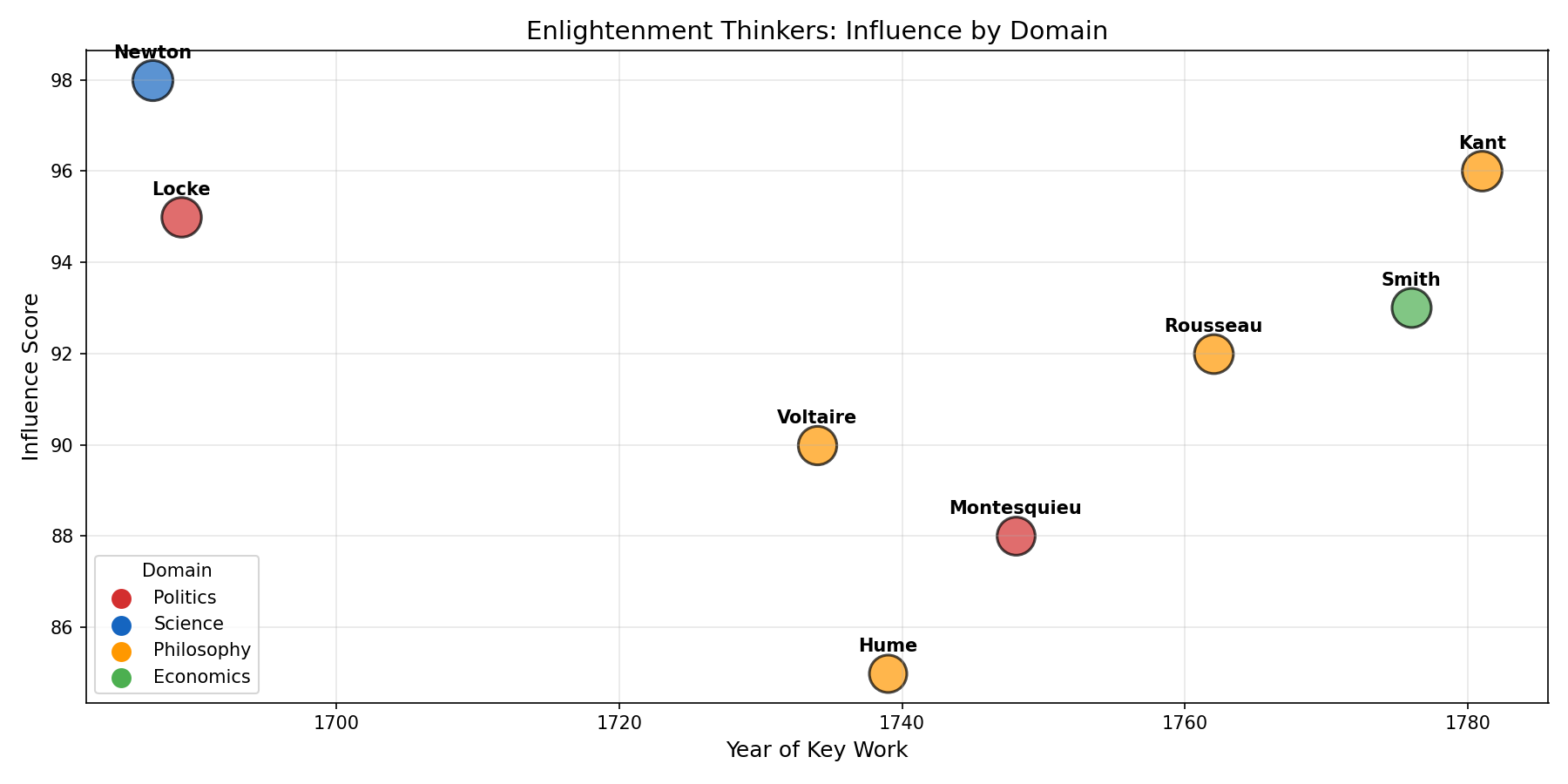
The network reveals several insights. Locke and Newton sit at the root — nearly every later thinker draws on their work. The French philosophes form a dense cluster of mutual influence. And the American founders (Franklin, Jefferson) are receivers, not originators — they took European ideas and tested them in practice.
Part 2: Revolution Impact Analysis
The Enlightenment’s ideas didn’t stay in books. They fueled three major revolutions. We can compare their trajectories.
import numpy as np

# Three revolutions inspired by Enlightenment ideas
revolutions = {
    "American (1775-1783)": {
        "duration_years": 8,
        "deaths_estimate": 37_000,
        "population": 2_500_000,
        "outcome_democracy_years": 248,  # still ongoing
        "key_documents": ["Declaration of Independence", "Constitution",
                          "Bill of Rights"],
        "terror_deaths": 0,
        "color": "#3498db"
    },
    "French (1789-1799)": {
        "duration_years": 10,
        "deaths_estimate": 600_000,
        "population": 28_000_000,
        "outcome_democracy_years": 0,  # ended in Napoleon
        "key_documents": ["Declaration of Rights of Man",
                          "Civil Constitution of the Clergy"],
        "terror_deaths": 16_594,
        "color": "#e74c3c"
    },
    "Haitian (1791-1804)": {
        "duration_years": 13,
        "deaths_estimate": 350_000,
        "population": 500_000,
        "outcome_democracy_years": 0,  # cycles of instability
        "key_documents": ["Declaration of Independence (1804)"],
        "terror_deaths": 5_000,
        "color": "#2ecc71"
    }
}

# Chart 1: Deaths as % of population
names = list(revolutions.keys())
death_pcts = [revolutions[r]["deaths_estimate"] / revolutions[r]["population"] * 100
              for r in names]
colors = [revolutions[r]["color"] for r in names]
axes[0].barh(names, death_pcts, color=colors, edgecolor="black")
axes[0].set_xlabel("Deaths as % of Population")
axes[0].set_title("Human Cost", fontweight="bold")

# Chart 2: Duration
durations = [revolutions[r]["duration_years"] for r in names]
axes[1].barh(names, durations, color=colors, edgecolor="black")
axes[1].set_xlabel("Years")
axes[1].set_title("Duration", fontweight="bold")

# Chart 3: Terror deaths (state-sponsored executions)
terror = [revolutions[r]["terror_deaths"] for r in names]
axes[2].barh(names, terror, color=colors, edgecolor="black")
axes[2].set_xlabel("Executed by Revolutionary Government")
axes[2].set_title("State Terror", fontweight="bold")
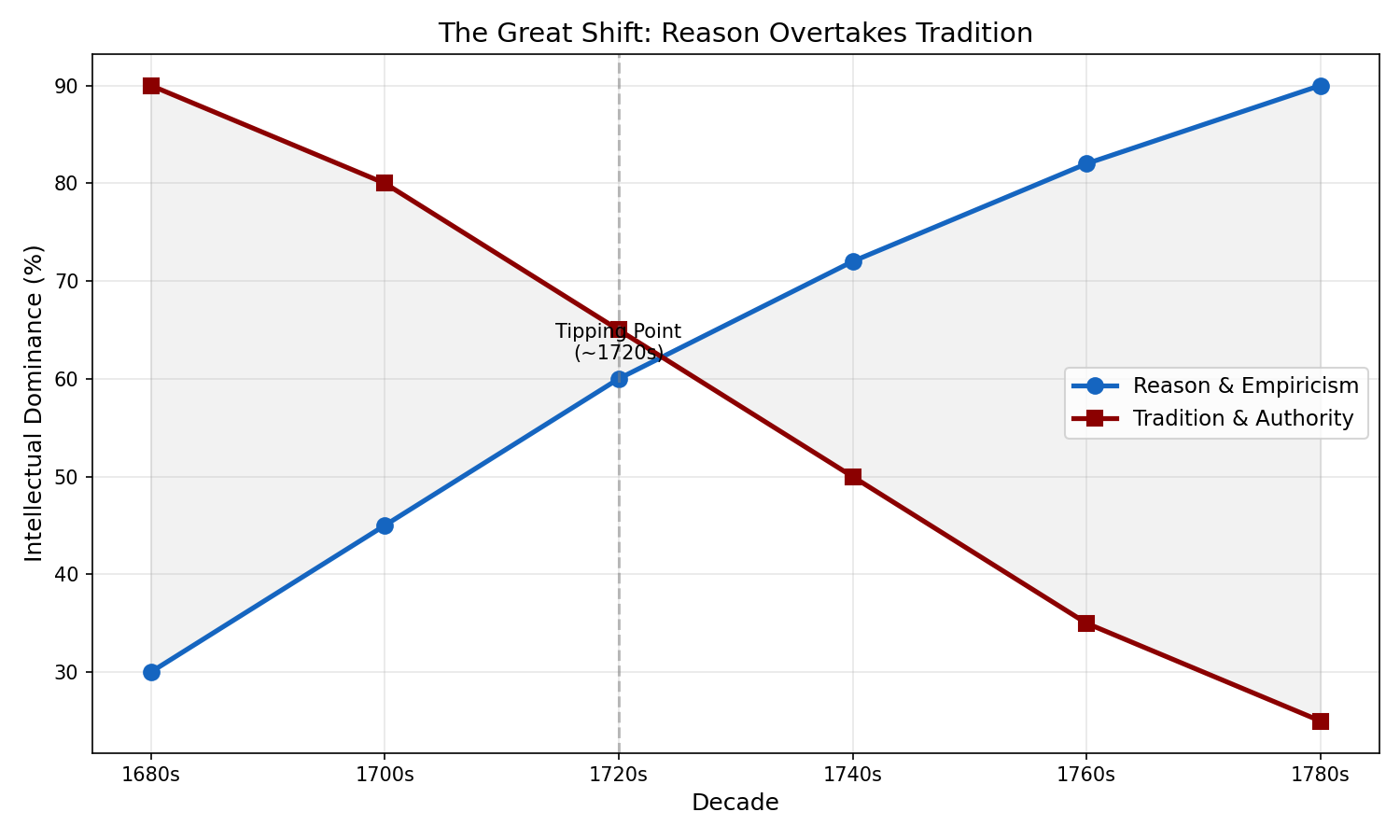
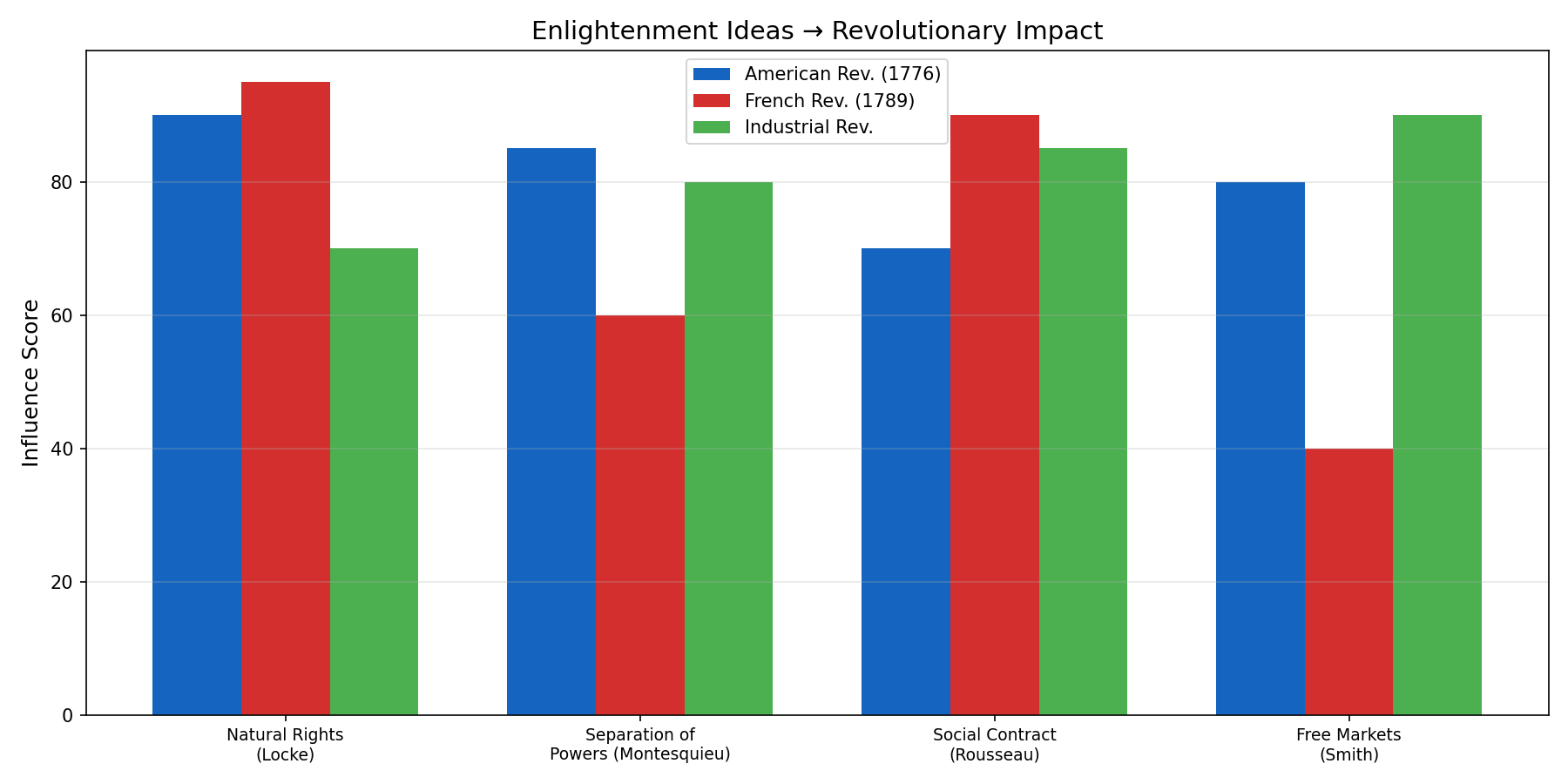
The comparison is instructive. The American Revolution — guided by Locke and Montesquieu — produced a stable constitutional order with minimal internal terror. The French Revolution — shaped more by Rousseau’s general will — devoured itself. The Haitian Revolution — the only slave revolt to produce a nation — faced the highest per-capita cost and the longest road to stability.
Same intellectual roots. Radically different outcomes. Context matters as much as ideas.
Deeper Insights: What the Complete Analysis Reveals
The free code maps influences and compares revolutions at a high level. The complete analysis digs deeper: a philosophical spectrum positioning each thinker along axes of individualism vs. collectivism and empiricism vs. rationalism, a timeline animation of how Enlightenment ideas spread geographically, and a quantitative text analysis of key documents showing which thinkers’ language appears most in revolutionary constitutions.
What’s Inside the Complete Analysis Pack
- Philosophical spectrum: interactive 2D mapping of all 12 thinkers on individualism/collectivism and empiricism/rationalism axes
- Geographic diffusion animation: decade-by-decade spread of Enlightenment publishing centers across Europe and the Americas
- Constitutional text analysis: NLP comparison of the Declaration of Independence, Rights of Man, and Haitian Declaration against source texts by Locke, Montesquieu, and Rousseau
- Reign of Terror statistical breakdown: daily execution rates, regional variation, demographic analysis of victims
- ~550 lines of teaching-grade Python code with detailed English comments
- 14 publication-quality visualizations (300dpi PNG + SVG)
Get the Article 08 Deep Dive Pack →
The Paradox of Reason
The Enlightenment bequeathed us a paradox that remains unresolved.
Reason liberates. It freed humanity from the tyranny of superstition, divine right monarchy, and unchallenged clerical authority. It gave us science, constitutional government, and the idea that every person possesses inherent dignity and rights.
Reason also oppresses. When reason becomes the sole standard of legitimacy, those who define what counts as “rational” hold absolute power. Robespierre’s Terror was rational — ruthlessly, systematically rational. The efficient bureaucratic machinery of modern states, which can process tax returns and deportation orders with equal precision, is reason’s achievement.
The deeper problem is this: reason is a tool, not a value.
A hammer can build a house or crush a skull. Reason can design a constitution or optimize a genocide. The Enlightenment’s greatest thinkers understood this — Hume warned that reason alone cannot generate moral values; Kant tried to ground morality in reason itself but succeeded only by smuggling in assumptions about human dignity that reason alone cannot justify.
The question is not whether to use reason. The question is: reason in service of what?
The Enlightenment answered: in service of human freedom and dignity. But it never fully explained why those values should be paramount. It assumed what it needed to prove.
And when that assumption was dropped — when reason was put in service of the nation, the race, the class, the market — the twentieth century showed what rational systems without moral foundations can produce.
The Enlightenment gave us the tools. It did not give us the wisdom to use them.
That gap — between instrumental reason and moral wisdom — remains the central challenge of modern civilization.
Modern Parallels
AI Ethics: The New Enlightenment Dilemma
Artificial intelligence is the Enlightenment’s ultimate child — pure reason, embodied in silicon.
And it reproduces the Enlightenment’s paradox with alarming precision.
AI systems can diagnose diseases, optimize logistics, and translate languages. They can also entrench bias, enable surveillance, and automate decisions that affect millions of lives without transparency or accountability.
The debate around AI alignment echoes Kant’s question: reason in service of what? An AI system optimizing for engagement produces addictive content. An AI system optimizing for efficiency may eliminate jobs. An AI system optimizing for safety may restrict freedom.
The tool is rational. The question is which values guide it.
Technocracy: Philosopher-Kings in Lab Coats
The Enlightenment dreamed of governance by reason. Modern technocracy — rule by experts, data-driven policy, evidence-based governance — is that dream realized.
And it faces the same tensions. Expert consensus can be wrong. Data can be manipulated. “Evidence-based” is sometimes a rhetorical weapon used to shut down legitimate democratic debate.
The COVID-19 pandemic illustrated the paradox vividly: public health experts recommended lockdowns based on rational epidemiological models. Those models were necessary and valuable. But they could not, by themselves, resolve the trade-offs between health, economic survival, education, and mental well-being. Those are value judgments, not scientific ones.
Reason can inform decisions. It cannot make them for us.
Data-Driven Governance: Measuring What Matters
GDP. Test scores. Crime statistics. Vaccination rates.
Modern governments measure everything. The Enlightenment’s faith in quantification — if we can measure it, we can improve it — has become the operating system of governance.
But as the saying goes: not everything that counts can be counted. Social cohesion, trust, meaning, belonging — these resist quantification. And what gets measured gets optimized, often at the expense of what cannot be measured.
The Enlightenment taught us to count. It did not teach us what counts.
Next in the Series
Reason conquered Europe. But not everyone was satisfied.
In the next article, we enter the age of Romanticism — when poets, painters, and musicians rebelled against the Enlightenment’s cold rationality.
Wordsworth wandered lonely as a cloud. Beethoven raged against fate. Mary Shelley created Frankenstein — a monster born of science without wisdom.
They asked: what does reason leave out?
The answer: everything that makes us human.
References
- Israel, Jonathan. Radical Enlightenment: Philosophy and the Making of Modernity 1650-1750. Oxford University Press, 2001.
- Robertson, Ritchie. The Enlightenment: The Pursuit of Happiness 1680-1790. Harper, 2021.
- Outram, Dorinda. The Enlightenment. 4th ed. Cambridge University Press, 2019.
- Scurr, Ruth. Fatal Purity: Robespierre and the French Revolution. Vintage, 2007.
- Wollstonecraft, Mary. A Vindication of the Rights of Woman. 1792. (Multiple modern editions)
- Kant, Immanuel. “An Answer to the Question: What Is Enlightenment?” 1784.