
The Industrial Revolution: When Machines Changed Everything
Series: Digital Rebirth of the Renaissance #10/12 | Read time: 30 min | Language: Python
Author: Wina @ Code & Cogito
When the Steam Engine Began to Turn
- Manchester, England.
A new textile mill came to life. Its machines, driven by a steam engine, roared around the clock, twenty-four hours a day.
A single textile worker could now operate 200 spindles. In the age of hand-spinning, the number had been one or two.
Productivity exploded.
But the workers soon discovered something: they were no longer craftsmen. They were appendages of the machine.
Working hours: 14-16 hours a day
Working conditions: noise, dust, danger
Wages: barely enough to survive
Skill required: none — anyone could operate the machine
One old craftsman grieved: “I spent twenty years mastering my trade. Now an eight-year-old child at a machine produces in one day what took me a week.”
This was the duality of the Industrial Revolution:
It created unprecedented wealth — and unprecedented inequality.
It unleashed human productivity — and enslaved the bodies and souls of workers.
It built thriving cities — and spawned wretched slums.
Why Britain? Five Decisive Advantages
1. Abundant Coal and Iron
- Coal –> steam engines –> mechanical power
- Coal –> smelting –> steel manufacturing
- Coal –> railways –> transport networks
2. A Colonial Empire
- Raw materials: Indian cotton, American tobacco
- Markets: 200 million colonial subjects
- Capital: wealth accumulated through colonial trade
3. The Agricultural Revolution
- Enclosure movement: farmers lost their land –> migrated to cities –> became factory labor
- Large-scale farming: increased food production
- Created urban consumer markets
4. Political Stability and the Rule of Law
- Patent law (1624) protected inventors
- After the Glorious Revolution (1688), property rights were secured
- Entrepreneurs dared to invest in long-term ventures
5. A Culture of Science
- The Royal Society (1660) promoted research
- Pragmatism: theory –> practice –> commercialization
- James Watt improved the steam engine (quadrupling its efficiency)
Python Analysis: The Productivity Explosion (1700-1900)
Per capita GDP growth:
1700: 100 --> 1900: 650
Growth: 6.5x
Textile production:
1700: 50,000 tons/year
1900: 50,000,000 tons/year
Growth: 1,000x!
Coal output:
1700: 3 million tons
1900: 225 million tons
Growth: 75x
Iron output:
1700: 20,000 tons
1900: 14,000,000 tons
Growth: 700x
The Urbanization Explosion (1750-1901)
Britain’s urbanization rate:
1750: 17%
1851: 54% (crossed the halfway mark for the first time!)
1901: 77%
Manchester’s population:
1750: 18,000
1901: 645,000
Growth: 36x
A critical milestone:
In 1851, Britain became the first country in which a majority of the population lived in cities.
This was a revolutionary shift in how human beings lived on the earth.
The Workers’ Ordeal (1780-1850)
Working hours:
– Agricultural era: 50 hours/week
– Early industrial: 84 hours/week (+68%)
– After reform: 60 hours/week
Life expectancy:
– Agricultural era: 35 years
– Early industrial: 22 years (-37%!)
– After reform: 42 years
Child labor:
– 1830s: 25% of the workforce
– Children as young as 5-6 years old
– Wages: 1/10 of an adult’s
– Small bodies were useful for crawling under machinery (many were crushed to death)
Working conditions:
– Noise: deafening machines caused permanent hearing loss
– Dust: cotton fibers in textile mills caused lung disease
– Danger: unguarded machinery led to frequent amputations
– Temperature: 40 degrees C, 80% humidity
Manchester in the 1840s:
– Average worker life expectancy: 17 years
– Average middle-class life expectancy: 38 years
– Infant mortality rate: 50%
Rising Inequality
Gini coefficient over time:
1750: 0.45
1850: 0.64 (+42%, the peak)
1900: 0.58
Income distribution in 1850:
Top 10%: 55%
Bottom 50%: 10%
Ratio: 5.5x
Why inequality worsened:
– Capitalists controlled the means of production
– Workers had almost no bargaining power
– No unions to provide protection
– Child labor drove wages down further
The Productivity vs. Quality of Life Paradox
1780-1850 (the paradox period):
Productivity: 200 --> 600 (+200%)
Quality of life: 90 --> 80 (-11%)
Decoupling ratio: 2.2 --> 7.5x
Why did quality of life fall even as productivity soared?
– Working hours surged (50 –> 84 hours/week)
– Health deteriorated (life expectancy: 35 –> 22 years)
– Environmental pollution (urban slums)
– Social dislocation (traditional communities destroyed)
Improvement only began after 1850:
– Factory Acts restricted child labor
– Unions fought for workers’ rights
– Public health measures improved
– Education became widespread
Python Analysis: The Industrial Revolution in Data
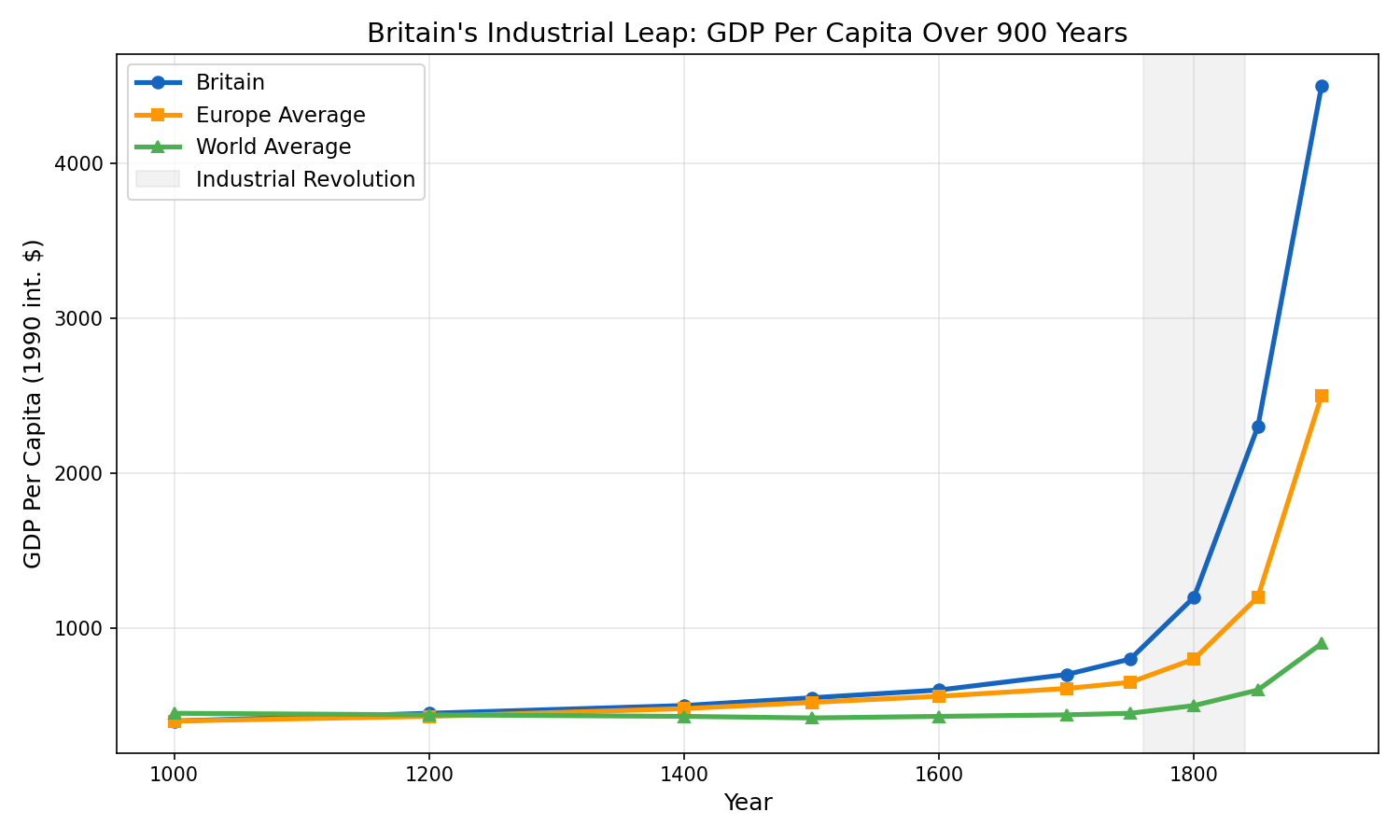
Free Code: The GDP Hockey Stick
Per capita GDP barely differed across regions for centuries — then Britain pulled dramatically ahead. The power of industrialization, in one chart.
import numpy as np

# --- 1. GDP Per Capita: Britain's Industrial Leap ---
# Data based on Maddison Project estimates (1990 international dollars)

years = [1000, 1200, 1400, 1500, 1600, 1700, 1750, 1800, 1850, 1900]
gdp_uk =     [400, 450,  500,  550,  600,  700,  800, 1200, 2300, 4500]
gdp_europe = [400, 430,  480,  520,  560,  610,  650,  800, 1200, 2500]
gdp_world =  [450, 440,  430,  420,  430,  440,  450,  500,  600,  900]
Finding: Britain’s GDP grew 462% from 1750 to 1900, while the European average grew 285% and the world average just 100%. Britain didn’t just lead the world — it left even its European neighbors far behind.
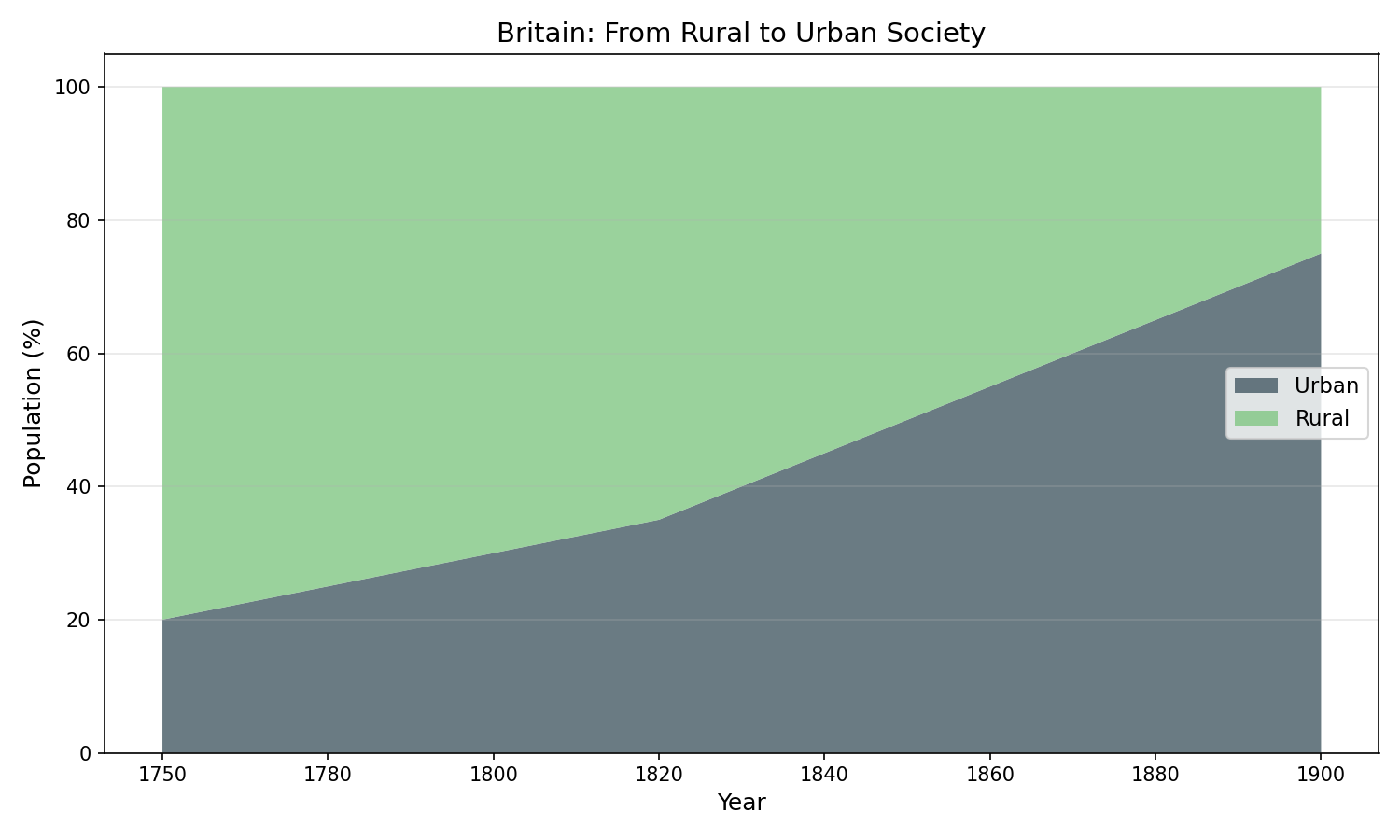
Free Code: The Urbanization Shift
# --- 2. Urbanization Rate ---

decades = ['1750', '1780', '1800', '1820', '1840', '1860', '1880', '1900']
urban_pct = [20, 25, 30, 35, 45, 55, 65, 75]
rural_pct = [80, 75, 70, 65, 55, 45, 35, 25]
Free Code: The Human Cost — Labor Conditions Across Three Eras
# --- 3. Working Conditions: The Human Cost ---

metrics = ['Work Hours\n(per day)', 'Child Labor\n(%)', 'Life Expectancy\n(years)', 'Literacy\n(%)', 'Real Wages\n(index)']
pre_industrial = [10, 20, 40, 30, 100]
peak_industrial = [16, 50, 28, 45, 80]
late_industrial = [10, 5, 50, 85, 200]

x = np.arange(len(metrics))
width = 0.25

print("\n=== Industrial Revolution Summary ===")
print(f"UK GDP growth 1750-1900: {(gdp_uk[-1]/gdp_uk[6]-1)*100:.0f}%")
print(f"Urbanization 1750-1900: {urban_pct[0]}% -> {urban_pct[-1]}%")
print(f"Life expectancy drop at peak: {pre_industrial[2]} -> {peak_industrial[2]} years")
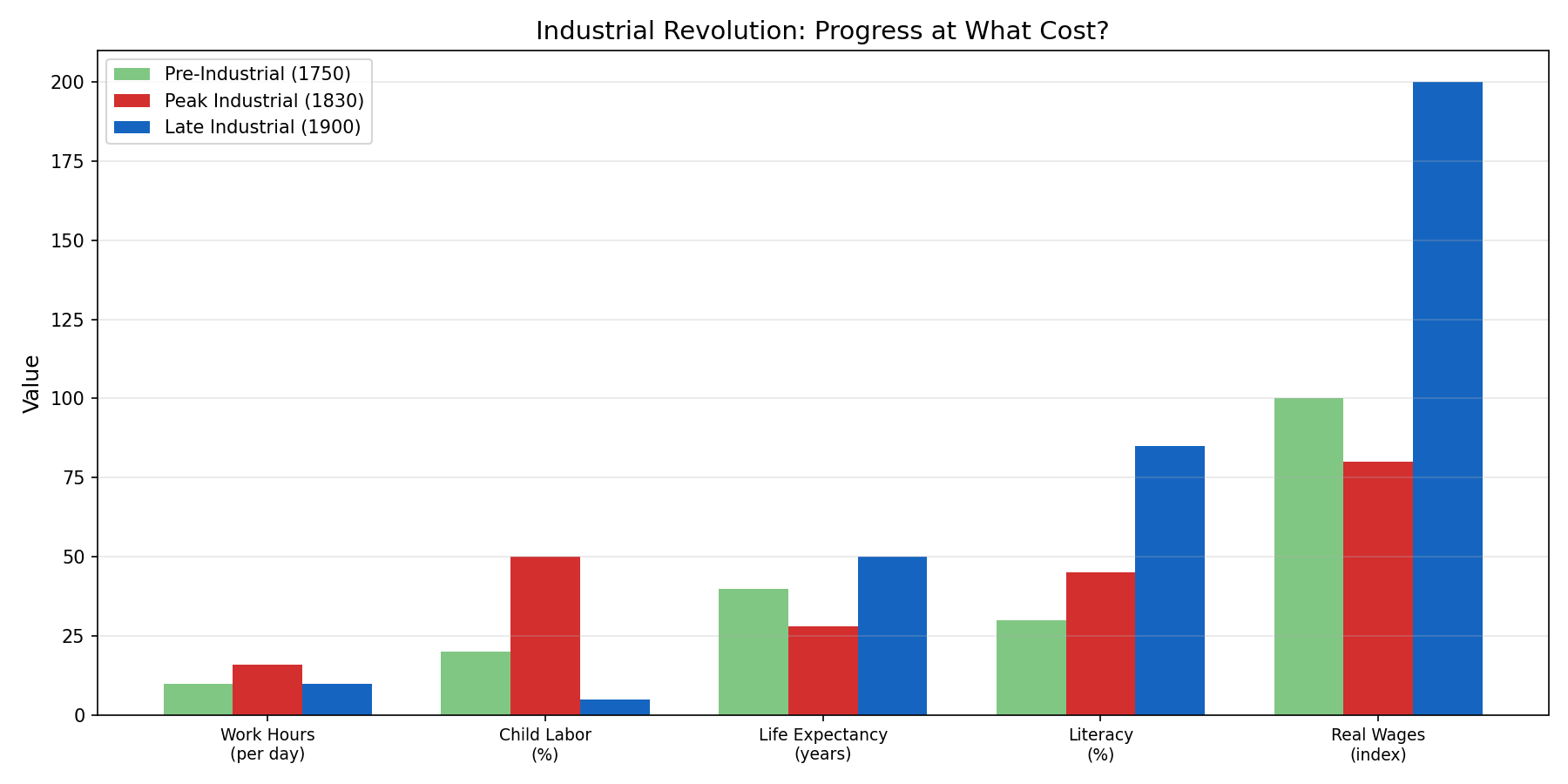
Key finding: At peak industrialization (1830), workers endured 16-hour days, 50% child labor rates, and life expectancy dropped to 28 years. Progress came at an astonishing human cost — only improving after 1900.
Deep Dive: Complete Analysis Pack
This article explores the historical paradox of an Industrial Revolution that unleashed extraordinary productivity while crushing the quality of life for workers. The complete analysis pack goes further:
- 1700-1900 British economic indicators, full time series: GDP, textile output, coal, iron production — log-scale growth analysis and inflection point detection
- Multi-dimensional labor conditions model: cross-analysis and causal inference across working hours, life expectancy, child labor share, and Gini coefficient
- Interactive Jupyter Notebook: adjust time period parameters and city selection, generate real-time productivity-quality of life decoupling charts
- Complete CSV dataset: urbanization rates, population growth, income distribution, and labor conditions raw data
- Publication-ready charts: 300dpi, ready for papers or reports
Get the Article 10 Deep Dive Pack –>
The Two Faces of the Industrial Revolution
The Positive Legacy
- Productivity explosion: goods became abundant, prices fell
- Long-term life expectancy gains: from 22 years to 78 years (modern era)
- Technological progress: steam engine –> electricity –> computers
- Rising living standards: eventually, everyone benefited
The Negative Legacy
- Short-term decline in quality of life: from 1780-1850, people were poorer, more exhausted, and died younger
- Deepening inequality: Gini coefficient from 0.45 to 0.64
- Environmental destruction: pollution and resource depletion
- Labor exploitation: child labor, crushing hours, lethal working conditions
Modern Parallels: The AI Revolution
We face strikingly similar questions today.
AI:
– Productivity rises (AI can write code, generate images, draft articles)
– Will jobs disappear? (Mass unemployment?)
– Who benefits? (Tech companies vs. workers)
Automation:
– Efficiency climbs
– Jobs vanish?
– Universal basic income?
The lessons of the Industrial Revolution:
1. Technological progress does not automatically produce happiness
2. Social institutions must adapt (unions, legislation, welfare systems)
3. The transition period will be painful
4. In the long run, most people may benefit — but it is not guaranteed
Reflection: Does Technological Progress Equal Human Happiness?
Short-Term vs. Long-Term
Short-term (1780-1850):
– Productivity exploded
– Quality of life declined
– Workers were poorer, more exhausted, and died younger
Long-term (1850-present):
– Goods became abundant, prices fell
– Working hours dropped (84 –> 40 hours/week)
– Life expectancy rose (22 –> 78 years)
The answer depends on your time horizon.
Who Benefits?
Early Industrial Revolution:
– Capitalists: spectacularly wealthy
– Workers: lives became harder
– Artisans: destroyed
Late Industrial Revolution:
– Everyone benefited (relative to the agricultural era)
– But inequality persisted
Conclusion: Machines Changed Everything, but Human Nature Did Not
The Industrial Revolution was a watershed in human history.
Before:
– The way people lived had barely changed for millennia
– Agrarian societies, handcraft production, a slow pace of life
After:
– Everything accelerated
– Urban societies, machine production, relentless change
But human nature stayed the same:
– The greed for wealth (capitalist exploitation)
– The hunger for fairness (workers’ resistance)
– The search for meaning (Romantic rebellion)
– The fear of the future (Luddites smashing machines)
We are still living with the consequences of the Industrial Revolution:
– Capitalism vs. socialism
– Economic growth vs. environmental protection
– Efficiency vs. humanity
– Technology vs. tradition
What the Industrial Revolution tells us:
Progress is inevitable. But happiness must be fought for.
Next in the Series: Darwin and Evolution
The Industrial Revolution changed how human beings live.
Darwin set out to change something deeper: how human beings understand themselves.
On the Origin of Species (1859) declared:
– Humanity is not a special creation of God
– Humans descend from apes
– We are nothing more than an accident of evolution
Copernicus said: the Earth is not the center of the universe.
Darwin said: humanity is not the crown of creation.
References
- Allen, R.C. The British Industrial Revolution in Global Perspective, 2009
- Hobsbawm, E. The Age of Revolution: 1789-1848, 1962
- Thompson, E.P. The Making of the English Working Class, 1963
- Mokyr, J. The Enlightened Economy: An Economic History of Britain 1700-1850, 2009
- Clark, G. A Farewell to Alms: A Brief Economic History of the World, 2007