The Copenhagen Interpretation vs. the Kyoto School — A Dialogue Between Two Wisdoms
Series: Quantum Mechanics Meets Eastern Philosophy #02/12 | Reading time: 28 min | Python tools
Author: Wina @ Code & Cogito
An Afternoon in Copenhagen
1954, Copenhagen, Denmark. Autumn sunlight streams through the windows of Niels Bohr’s office.
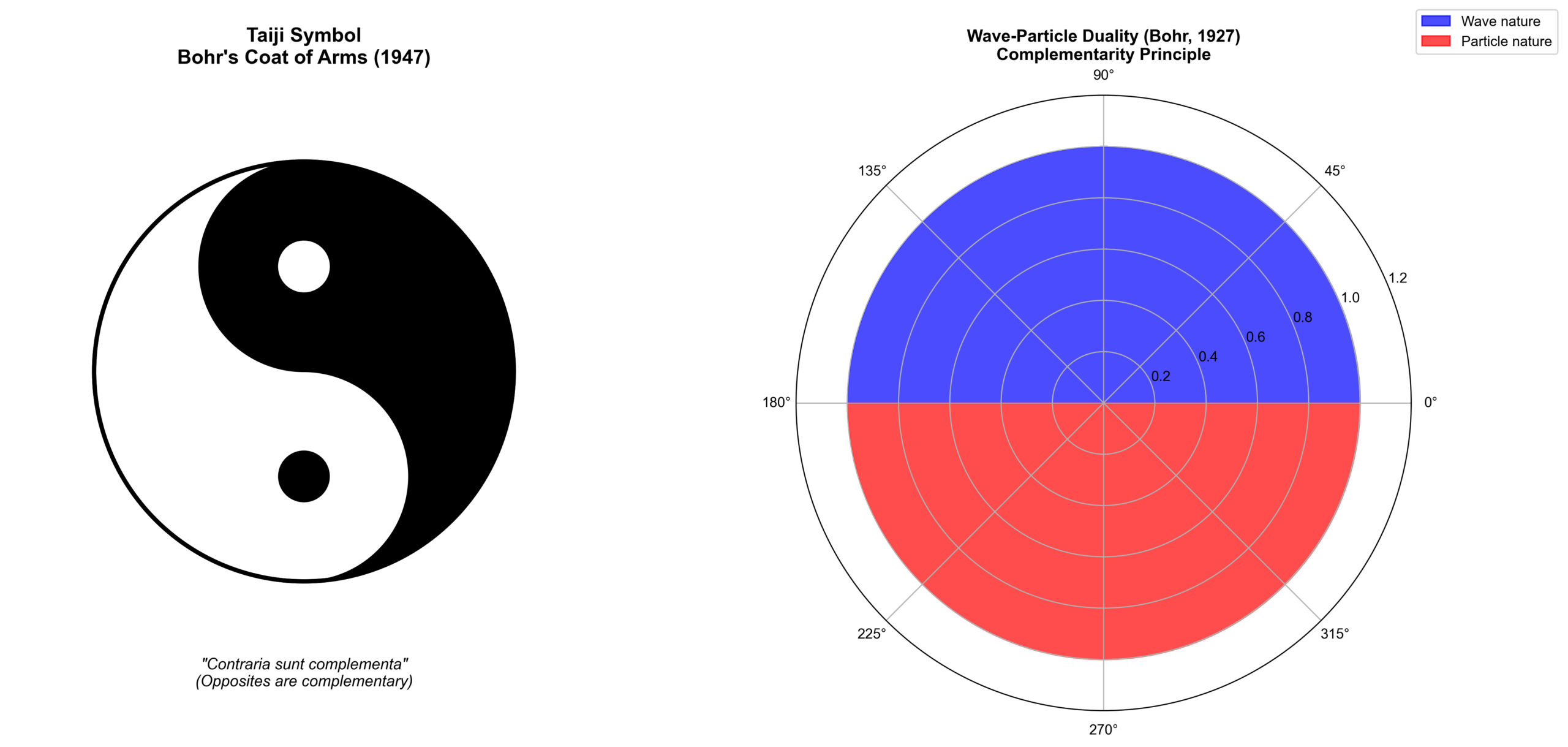
On the wall hangs a taijitu — the yin-yang symbol, black and white intertwined, opposites in perpetual embrace. Bohr had chosen this ancient Chinese symbol for his coat of arms in 1947 when he was awarded Denmark’s Order of the Elephant, the nation’s highest honor. Beneath the symbol, he inscribed the Latin motto: Contraria sunt complementa — “Opposites are complementary.”
At this moment, the architect of quantum mechanics sits across from an elderly Japanese visitor.
Daisetsu Teitaro Suzuki, 94 years old, the world’s most celebrated Zen scholar. He had spent his entire life introducing Zen Buddhism to Western audiences, influencing countless philosophers, psychologists, and artists — from Carl Jung to John Cage.
Between them, a pot of hot tea.
Bohr gestures toward the yin-yang symbol on the wall, speaking in English tinged with a Danish accent:
“It took me 30 years to understand ‘complementarity’ — that contradictory things can both be true. Then I discovered that your ancestors understood this 2,000 years ago.”
Suzuki smiles, the wrinkles at his eyes deepening like the folds of a lotus:
“No, Professor Bohr. We did not ‘understand’ it. We are it. Zen does not discuss truth. Zen lives truth.”
Bohr falls silent for a moment, then slowly nods:
“Perhaps that is the difference. We in the West spent 300 years building science, then 50 years tearing it down, only to ‘discover’ that the world is not what we thought. And you knew from the start: separation is illusion, subject and object are one.”
Suzuki lifts his teacup and speaks words that would become a touchstone in the dialogue between quantum physics and Zen:
“When you measure an electron, you are astonished to find that observation changes the electron.
When we practice zazen, we are never astonished: the ‘I’ and the ‘observed’ were always one.
What you discovered with instruments, we knew long ago with the mind.”
No complete transcript of this conversation survives, but it symbolizes a profound truth:
The quantum world that Western science “discovered” in the 20th century bears a striking resemblance to the nature of reality that Eastern philosophy “realized” two millennia earlier.
The Copenhagen Interpretation: Quantum Mechanics’ “Official Story”
1927: The Solvay Conference Showdown
October 1927, Brussels. The Fifth Solvay Conference assembled the most brilliant physicists alive.
In the front row of the now-famous photograph sat:
– Albert Einstein
– Marie Curie
– Max Planck
– Hendrik Lorentz
Standing behind them, the young revolutionaries:
– Werner Heisenberg
– Wolfgang Pauli
– Paul Dirac
– Niels Bohr
The topic: the interpretation of quantum mechanics.
Over the preceding two years (1925–1927), the mathematical framework of quantum mechanics had been completed:
– Heisenberg’s matrix mechanics (1925)
– Schrödinger’s wave mechanics (1926)
– Dirac’s transformation theory (1927)
– Heisenberg’s uncertainty principle (1927)
These theories were mathematically elegant and experimentally precise. But the question remained:
What were they actually describing?
Is an electron “really” a wave? Or a particle?
Does the wave function ψ “really” exist? Or is it just a mathematical tool?
Does measurement “really” change reality? Or does it merely reveal pre-existing properties?
Bohr’s Answer: The Copenhagen Interpretation
Niels Bohr, together with his student Heisenberg, proposed a framework that came to be known as the Copenhagen Interpretation.
Its core claims:
1. The wave function ψ is real
Before measurement, a particle is not “in a definite position that we simply don’t know” — it is “genuinely in a superposition” of all possible positions simultaneously.
The wave function ψ(x,t) describes not “our knowledge” but “physical reality.”
Mathematical expression:
|ψ⟩ = Σ cᵢ|φᵢ⟩
The particle’s state is a superposition of all possible states |φᵢ⟩, with coefficients cᵢ determining probabilities.
2. Measurement causes wave function collapse
When you measure position, the wave function “instantaneously” collapses to a single definite state.
Before measurement: |ψ⟩ = α|0⟩ + β|1⟩ (superposition)
After measurement: |ψ⟩ = |0⟩ or |1⟩ (definite state)
Probabilities are determined by |α|² and |β|².
The hard question: What counts as a “measurement”? Who measures? When does collapse occur?
Bohr’s answer: These questions are meaningless. A measurement is simply “an irreversible interaction between a macroscopic instrument and a quantum system.” Don’t ask further.
3. The Complementarity Principle
Certain properties are “complementary” — you cannot measure both precisely at the same time.
The most famous example: position vs. momentum
Heisenberg’s uncertainty principle:
Δx · Δp ≥ ℏ/2
This is not a limitation of our measuring technology — it is a law of nature.
Bohr went further: wave-like and particle-like behavior are complementary.
– Observe wave behavior, and you cannot see particle behavior
– Observe particle behavior, and you cannot see wave behavior
– Both are “real,” but they cannot be observed simultaneously
This is precisely the logic of the yin-yang symbol: opposites that are complementary and inseparable.
4. No “objective reality”
Classical physics assumes the world exists independently of the observer. The moon is still there when no one is looking at it.
The Copenhagen Interpretation says: not necessarily.
For quantum systems, the “observer” and the “observed” cannot be separated. Measurement does not “discover” a pre-existing property — it “creates” that property.
Bohr’s famous remark:
“If quantum mechanics hasn’t profoundly shocked you, you haven’t understood it yet.”
Einstein’s Rebellion
Einstein could not accept this.
At the 1927 Solvay Conference, he launched a fierce debate with Bohr — a debate that would continue for 25 years, until Einstein’s death in 1955.
Einstein’s core conviction:
“God does not play dice.”
He believed:
– The universe has objective reality
– Causality is absolute
– Uncertainty merely reflects the incompleteness of our knowledge, not the nature of things
In 1935, Einstein, Podolsky, and Rosen published the famous “EPR paper,” attempting to prove that quantum mechanics was “incomplete” — that there must be “hidden variables” we hadn’t yet discovered.
Bohr’s response was characteristically pithy:
“Einstein, stop telling God what to do.”
Who was right?
In 1964, John Bell formulated “Bell’s inequalities,” which could be tested experimentally.
In 1982, Alain Aspect performed the decisive experiment.
Result: Einstein was wrong. Bohr was right.
The universe really does “play dice.” Hidden variables do not exist. Quantum entanglement is real.
In 2022, Aspect, Clauser, and Zeilinger received the Nobel Prize in Physics for their experiments on quantum entanglement.
Zen Wisdom: The Kyoto School
While Bohr was building the quantum mechanical interpretation in Copenhagen, on the other side of the globe in Kyoto, Japan, a group of philosophers was engaged in a remarkably similar inquiry — though by entirely different means.
The Rise of the Kyoto School
The Kyoto School was the most significant philosophical movement in 20th-century Japan, founded by Nishida Kitaro.
If you are unfamiliar with it, think of the Kyoto School as Japan’s answer to European existentialism — but rooted in Zen Buddhist practice rather than Western anxiety. Where Heidegger asked “What is Being?”, Nishida asked the same question through the lens of meditative experience.
Core members:
– Nishida Kitaro (1870–1945): Founder
– Tanabe Hajime (1885–1962): Logician
– Nishitani Keiji (1900–1990): Zen philosophy specialist
– D. T. Suzuki (1870–1966): Zen master (not a formal member, but profoundly influential)
Their mission: to express Eastern Zen wisdom in the language of Western philosophy.
D. T. Suzuki’s Zen Evangelism
D. T. Suzuki was the 20th century’s most important ambassador of Zen to the West.
Writing fluently in English, he published over 100 books introducing Zen Buddhism to Western readers. His influence reached:
– Psychology: Carl Jung
– Philosophy: Martin Heidegger
– Music: John Cage
– Physics: Niels Bohr, Werner Heisenberg, Erwin Schrödinger
According to Suzuki, the essence of Zen is:
1. Direct Pointing — Beyond Words and Letters
Truth cannot be conveyed through language. The moment language appears, division begins.
Zen koans — those famously paradoxical riddles — are not “puzzles” to be solved. They are tools designed to shatter logical thinking, the way a hammer breaks glass. When your rational mind gives up, something deeper can emerge.
Famous koans:
– “What is Buddha?” — “Three pounds of flax.”
– “Does a dog have Buddha-nature?” — “Mu” (No/Nothing). (But Buddhism teaches that all beings have Buddha-nature!)
– “All things return to the One. Where does the One return to?”
These “answers” defy logic because logic itself is a product of the discriminating mind — the very thing Zen seeks to transcend.
2. No Separation of Subject and Object
The goal of Zen practice is to transcend the duality between “subject” (the one who sees) and “object” (what is seen).
In the moment of awakening (satori):
– There is no “I” looking at “a flower”
– There is only the event of “flower-seeing” itself
– Observer and observed merge into one
A famous story from Huineng, the Sixth Patriarch of Zen:
Two monks were watching a flag fluttering in the wind.
One said, “The flag is moving.”
The other said, “The wind is moving.”
Huineng said, “Neither the flag nor the wind is moving. It is your mind that moves.”
This is not mystical hand-waving — it is a radical claim about the nature of perception itself. Compare it to the Copenhagen Interpretation’s insistence that the observer cannot be separated from the observed system.
3. Emptiness: No Inherent Nature, No Fixed Categories
“Emptiness” (sunyata) — perhaps the most misunderstood concept in Eastern philosophy — does not mean “nothingness” or “the void.” It means “the absence of independent, self-existing essence.”
All things:
– Have no fixed, unchanging nature
– Exist only in relation to other things
– Are categorized by the mind’s projections, not by objective reality
The Heart Sutra, one of Buddhism’s most important texts, puts it this way:
“Form is emptiness; emptiness is form.
Form is not different from emptiness; emptiness is not different from form.”
In modern terms: material phenomena and emptiness are the same thing. Matter does not “become” empty — matter “already is” empty. Things exist, but not in the solid, independent way we habitually assume.
The Astonishing Parallels: Quantum Mechanics vs. Zen
Let us place them side by side:
| Quantum Mechanics (Copenhagen) | Zen Buddhism |
|---|---|
| No definite state before measurement | No fixed categories before naming |
| An electron before measurement is not “in a position we don’t know” | All things before discrimination are not “having a nature we can’t see” |
| It “genuinely has no definite position” | They “genuinely have no fixed nature” |
| Observer effect | No subject-object split |
| Observation changes the observed | Observation and the observed are originally one |
| Instrument and system are inseparable | Mind and world are inseparable |
| Complementarity principle | Non-duality |
| Wave and particle nature are complementary | Being and non-being, life and death are non-dual |
| Both real, but not simultaneously observable | Opposites unified, transcending duality |
| Probabilistic interpretation | Dependent origination |
| We can only predict probabilities, not certainties | Everything arises from conditions, nothing is absolute |
| No objective reality | No inherent nature |
| The moon may not be there when no one looks | All things “exist” because the discriminating mind constructs them |
Structural Correspondence, Not Superficial Analogy
A crucial distinction: this is not metaphor — it is structural correspondence.
Bohr was not saying “quantum mechanics is like Zen.” He was saying:
“The structure of the universe that we discovered in the laboratory with instruments, and the structure of the universe that Eastern sages realized through meditation, point to the same truth.”
Heisenberg, after visiting India in 1929 and conversing with Rabindranath Tagore, wrote:
“I am deeply convinced that there is a profound connection between the Eastern philosophers’ understanding of the world and the philosophical foundations of quantum theory.”
Schrödinger, who studied the Vedas and the Upanishads, wrote:
“These Eastern ideas may be the wellspring from which our own future thinking will develop.”
Python Models: Seeing the Invisible Truth
Let us use code to “see” these abstract concepts.
Model 1: The Double-Slit Experiment — Visualizing the Observer Effect
First, we set up the simulation environment and define a class for the double-slit experiment. This class will simulate two scenarios — “observed” and “unobserved” — letting us see directly how observation changes quantum behavior.
import numpy as np
import matplotlib.pyplot as plt
from matplotlib.widgets import Button

# Font configuration
plt.rcParams['font.sans-serif'] = ['Arial', 'Helvetica']
plt.rcParams['axes.unicode_minus'] = False

class DoubleSlit:
    """
    Double-slit experiment simulation.
    Demonstrates the dramatic difference between observed and unobserved behavior.
    """

    def __init__(self):
        self.observed = False
        self.screen_resolution = 500
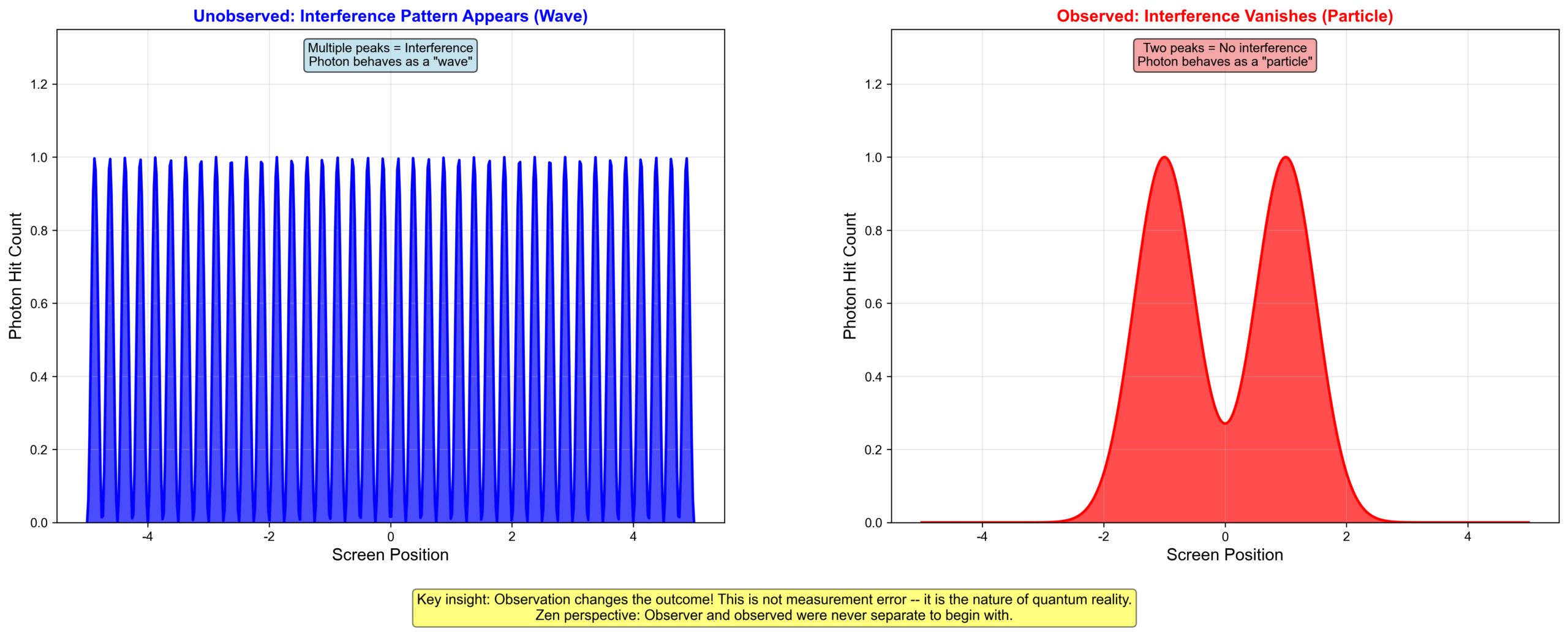
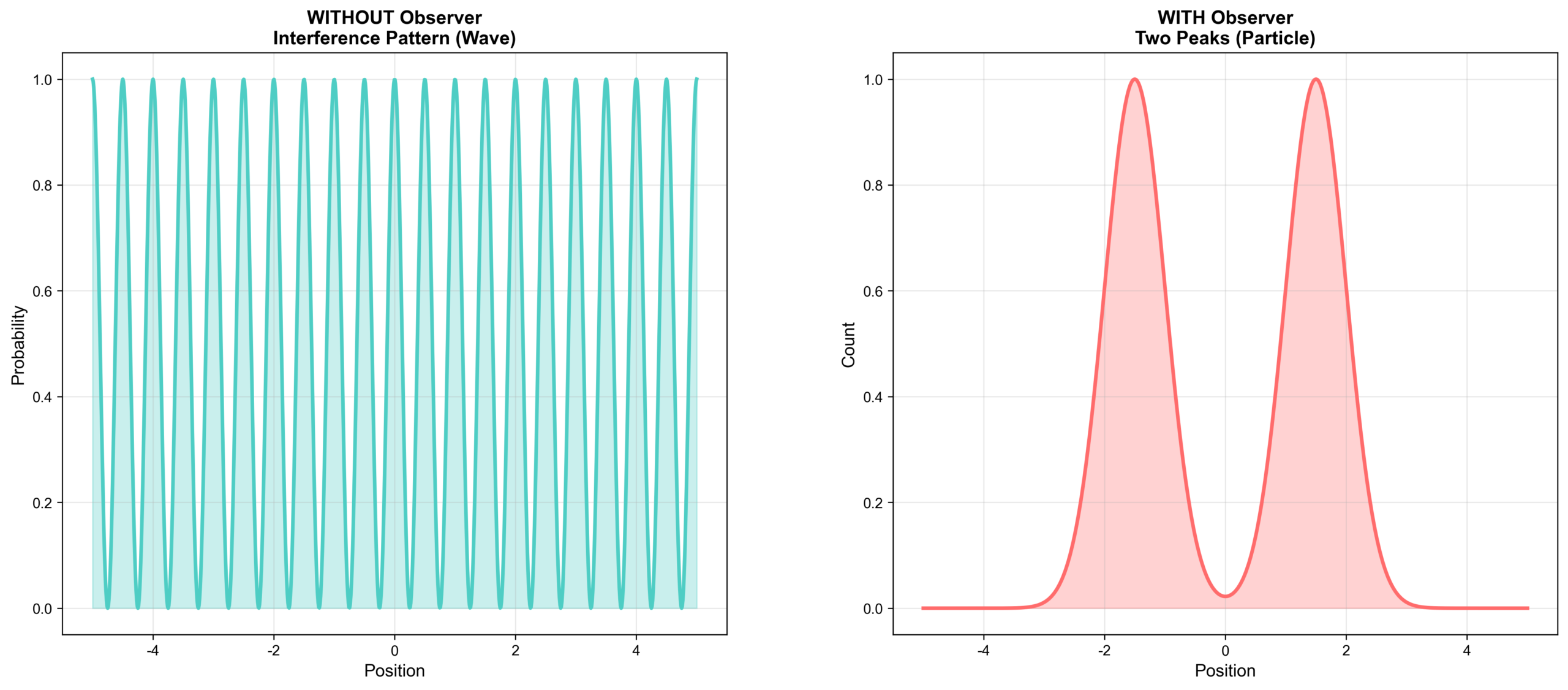
Next comes the key physics simulation. When we do not observe which slit the photon passes through, the two waves superpose and produce an interference pattern — unmistakable evidence of wave-like behavior. Bohr would say: before measurement, the photon passes through both slits simultaneously.
    def simulate_unobserved(self):
        """Unobserved: photon behaves as a wave, producing interference fringes"""
        y = np.linspace(-5, 5, self.screen_resolution)

        # Two slit sources
        slit1_pos = -1.0
        slit2_pos = 1.0
        wavelength = 0.5

        # Waves from each slit
        wave1 = np.sin(2 * np.pi * (y - slit1_pos) / wavelength)
        wave2 = np.sin(2 * np.pi * (y - slit2_pos) / wavelength)

        # Superposition (interference)
        total_wave = wave1 + wave2
        intensity = np.abs(total_wave)**2
        intensity = intensity / np.max(intensity)

        return y, intensity
But the moment we “peek” — placing a detector to determine which slit the photon actually passes through — the interference pattern vanishes. The photon suddenly behaves like a well-behaved particle, obediently choosing one path. This is the core shock of the Copenhagen Interpretation: observation itself changes physical reality.
    def simulate_observed(self):
        """Observed: measuring which slit each photon passes through destroys interference"""
        y = np.linspace(-5, 5, self.screen_resolution)

        # After observation, each photon passes through only one slit
        slit1_pattern = np.exp(-(y - (-1.0))**2 / 0.5)
        slit2_pattern = np.exp(-(y - (1.0))**2 / 0.5)

        # Simple addition (no interference)
        intensity = slit1_pattern + slit2_pattern
        intensity = intensity / np.max(intensity)

        return y, intensity
Finally, we plot both scenarios side by side. The multiple peaks on the left represent interference fringes (wave behavior); the two smooth peaks on the right represent particle behavior. The annotation at the bottom connects this experiment to Zen’s teaching that observer and observed are inseparable.
    def visualize_comparison(self):
        """Side-by-side comparison: observed vs. unobserved"""
        fig, (ax1, ax2) = plt.subplots(1, 2, figsize=(16, 6))

        # Left panel: unobserved (wave behavior)
        y_unobs, intensity_unobs = self.simulate_unobserved()
        ax1.fill_between(y_unobs, 0, intensity_unobs, alpha=0.7, color='blue')
        ax1.plot(y_unobs, intensity_unobs, 'b-', linewidth=2)
        ax1.set_xlabel('Screen Position', fontsize=13)
        ax1.set_ylabel('Photon Hit Count', fontsize=13)
        ax1.set_title('Unobserved: Interference Pattern Appears (Wave)',
                     fontsize=14, fontweight='bold', color='blue')
        ax1.grid(True, alpha=0.3)
        ax1.set_ylim(0, 1.2)
        ax1.text(0, 1.1, 'Multiple peaks = Interference\nPhoton behaves as a "wave"',
                ha='center', fontsize=11,
                bbox=dict(boxstyle='round', facecolor='lightblue', alpha=0.7))

        # Right panel: observed (particle behavior)
        y_obs, intensity_obs = self.simulate_observed()
        ax2.fill_between(y_obs, 0, intensity_obs, alpha=0.7, color='red')
        ax2.plot(y_obs, intensity_obs, 'r-', linewidth=2)
        ax2.set_xlabel('Screen Position', fontsize=13)
        ax2.set_ylabel('Photon Hit Count', fontsize=13)
        ax2.set_title('Observed: Interference Vanishes (Particle)',
                     fontsize=14, fontweight='bold', color='red')
        ax2.grid(True, alpha=0.3)
        ax2.set_ylim(0, 1.2)
        ax2.text(0, 1.1, 'Two peaks = No interference\nPhoton behaves as a "particle"',
                ha='center', fontsize=11,
                bbox=dict(boxstyle='round', facecolor='lightcoral', alpha=0.7))

        fig.text(0.5, 0.02,
                'Key insight: Observation changes the outcome! This is not measurement error — it is the nature of quantum reality.\n'
                'Zen perspective: Observer and observed were never separate to begin with.',
                ha='center', fontsize=12,
                bbox=dict(boxstyle='round', facecolor='yellow', alpha=0.5))

        plt.tight_layout()
        plt.subplots_adjust(bottom=0.12)
        plt.savefig('double_slit_observer_effect.png', dpi=300, bbox_inches='tight')
        plt.show()

# Run
experiment = DoubleSlit()
experiment.visualize_comparison()

print("\n" + "="*70)
print("[ Double-Slit Experiment: The Observer Effect ]")
print("="*70)
print("Quantum mechanics: Observation changes reality")
print("Zen Buddhism:      Observer and observed were never separate")
Results:
– Left panel: Clear interference fringes (multiple peaks)
– Right panel: Only two peaks, no interference
Philosophical significance:
This is not “measurement error” or “instrument disturbance.”
It is your act of observation itself that changes the photon’s behavior.
Model 2: The Mathematical Structure of the Yin-Yang — Visualizing Complementarity
We build a three-panel figure placing the ancient yin-yang diagram, Bohr’s complementarity principle, and the quantum state Bloch sphere side by side. We start with the yin-yang — a mathematical reconstruction of the symbol Bohr chose for his coat of arms.
def taiji_and_complementarity():
    """Yin-yang diagram and the complementarity principle"""
    fig = plt.figure(figsize=(16, 6))

    # Left panel: Classical yin-yang (taijitu)
    ax1 = fig.add_subplot(131)
    theta = np.linspace(0, 2*np.pi, 1000)

    # S-curve boundary
    r_yin = 1 + 0.5 * np.sin(theta)
    r_yang = 1 - 0.5 * np.sin(theta)

    # Draw yin and yang
    ax1.fill(r_yin * np.cos(theta), r_yin * np.sin(theta),
            color='black', alpha=0.8)
    ax1.fill(r_yang * np.cos(theta + np.pi), r_yang * np.sin(theta + np.pi),
            color='white', edgecolor='black', linewidth=2)

    # Yang within yin (white dot)
    circle_yang = plt.Circle((0, 0.5), 0.15, color='white', ec='black', linewidth=1.5)
    ax1.add_patch(circle_yang)

    # Yin within yang (black dot)
    circle_yin = plt.Circle((0, -0.5), 0.15, color='black', ec='black', linewidth=1.5)
    ax1.add_patch(circle_yin)

    # Outer circle
    circle_outer = plt.Circle((0, 0), 1.5, fill=False, edgecolor='black', linewidth=3)
    ax1.add_patch(circle_outer)

    ax1.set_xlim(-2, 2)
    ax1.set_ylim(-2, 2)
    ax1.set_aspect('equal')
    ax1.axis('off')
    ax1.set_title('Taijitu (c. 700 BCE)\nUnity of Opposites',
                 fontsize=13, fontweight='bold')

    ax1.text(0, -2.3, 'Yang contains yin; yin contains yang\nOpposites are interdependent',
            ha='center', fontsize=10,
            bbox=dict(boxstyle='round', facecolor='lightyellow', alpha=0.7))
Notice the “yin within yang, yang within yin” structure — this is exactly what Bohr recognized as the geometric expression of complementarity. The middle panel uses a polar plot to present wave nature (blue) and particle nature (red) as complementary halves, like the black and white fish of the yin-yang.
    # Middle panel: Wave-particle duality
    ax2 = fig.add_subplot(132, projection='polar')

    theta_wave = np.linspace(0, np.pi, 100)
    r_wave = np.ones_like(theta_wave)
    ax2.fill_between(theta_wave, 0, r_wave, alpha=0.7, color='blue', label='Wave nature')

    theta_particle = np.linspace(np.pi, 2*np.pi, 100)
    r_particle = np.ones_like(theta_particle)
    ax2.fill_between(theta_particle, 0, r_particle, alpha=0.7, color='red', label='Particle nature')

    ax2.set_ylim(0, 1.2)
    ax2.set_title('Wave-Particle Duality (Bohr, 1927)\nComplementarity Principle',
                 fontsize=13, fontweight='bold', pad=20)
    ax2.legend(loc='upper right')
The right panel draws the Bloch sphere — the complete geometric space of quantum states. The north pole represents |0⟩, the south pole |1⟩, and every point on the equator is some kind of superposition. The sphere itself is a three-dimensional yin-yang: all opposing quantum states are unified on a single surface.
    # Right panel: Bloch sphere
    ax3 = fig.add_subplot(133, projection='3d')

    u = np.linspace(0, 2 * np.pi, 50)
    v = np.linspace(0, np.pi, 50)
    x = np.outer(np.cos(u), np.sin(v))
    y = np.outer(np.sin(u), np.sin(v))
    z = np.outer(np.ones(np.size(u)), np.cos(v))

    ax3.plot_surface(x, y, z, alpha=0.2, color='gray')

    # Mark special states
    ax3.scatter([0], [0], [1], c='blue', s=200, label='|0⟩')
    ax3.scatter([0], [0], [-1], c='red', s=200, label='|1⟩')
    ax3.scatter([1], [0], [0], c='purple', s=200, label='Superposition')

    ax3.set_xlabel('X')
    ax3.set_ylabel('Y')
    ax3.set_zlabel('Z')
    ax3.set_title('Bloch Sphere: Quantum State Space', fontsize=13, fontweight='bold')
    ax3.legend()

    plt.tight_layout()
    plt.savefig('taiji_complementarity.png', dpi=300, bbox_inches='tight')
    plt.show()

    print("\n" + "="*70)
    print("[ Mathematical Correspondence: Yin-Yang and Complementarity ]")
    print("="*70)
    print("Yin-Yang       <-> |0> and |1>")
    print("Unity of Opp.  <-> Superposition alpha|0>+beta|1>")
    print("Complementarity<-> Non-commuting observables [x,p]=ihbar")
    print("="*70)

# Run
taiji_and_complementarity()
Results:
Three panels displayed side by side, revealing the shared structure of “unity of opposites.”
Key insight:
Bohr did not choose the yin-yang symbol as exotic decoration. He believed it precisely expressed the mathematical structure of complementarity.
Model 3: Wave Function Collapse vs. Zen Awakening
This model uses a 2×3 grid to present two kinds of “instantaneous transformation” in parallel: the top row shows quantum mechanical wave function collapse, and the bottom row shows the Zen process of enlightenment. We begin by setting up the canvas.
def wave_function_collapse_zen():
    """Wave function collapse vs. Zen awakening (satori)"""
    fig, axes = plt.subplots(2, 3, figsize=(16, 10))

    times = ['Before Measurement', 'During Measurement', 'After Measurement']
    x = np.linspace(-5, 5, 1000)
The top row depicts the dramatic transformation in the quantum world. Before measurement, the wave function spreads out as an elegant wave packet — the particle simultaneously exists at all possible positions. At the instant of measurement, this sea of possibilities collapses to a single definite point — not gradually, but instantaneously.
    # Top row: Quantum mechanics
    for i, (ax, time_label) in enumerate(zip(axes[0], times)):
        if i < 2:
            # Before measurement: wave packet
            psi_real = np.exp(-x**2/2) * np.cos(3*x)
            prob = np.exp(-x**2)

            ax.plot(x, psi_real, 'b-', label='Re(psi)', linewidth=1.5)
            ax.fill_between(x, 0, prob, alpha=0.3, color='purple', label='Probability density')
            ax.set_title(f'{time_label}\nInfinite Possibilities', fontsize=12, fontweight='bold')
            ax.text(0, 1.3, 'Particle is "here AND there"',
                   ha='center', fontsize=10,
                   bbox=dict(boxstyle='round', facecolor='lightblue', alpha=0.7))
        else:
            # After measurement: collapse
            measured_pos = 1.5
            collapsed = np.zeros_like(x)
            collapsed[np.abs(x - measured_pos) < 0.1] = 10

            ax.bar(x[np.abs(x - measured_pos) < 0.1],
                  collapsed[np.abs(x - measured_pos) < 0.1],
                  width=0.1, color='red', alpha=0.8)
            ax.set_title(f'{time_label}\nDefinite Position', fontsize=12, fontweight='bold', color='red')
            ax.text(0, 11, f'Particle found at x={measured_pos}',
                   ha='center', fontsize=10,
                   bbox=dict(boxstyle='round', facecolor='lightcoral', alpha=0.7))

        ax.set_xlabel('Position x')
        ax.set_ylabel('Wave Function')
        ax.grid(True, alpha=0.3)
        ax.set_ylim(-1.5, 12)
The bottom row uses scatter plots and circles to visualize the Zen process of awakening. Before enlightenment, thoughts scatter like random dots — the “monkey mind” of Buddhist psychology. As awareness deepens, the chaos begins to find direction. At the instant of satori, everything resolves into clarity — as Huineng taught, “From the beginning, not a thing exists.” This creates a striking structural parallel with wave function collapse above.
    # Bottom row: Zen Buddhism
    zen_states = [
        ('Delusion', 'blue', 'Before awakening'),
        ('Seeking', 'purple', 'Awareness arising'),
        ('Satori', 'red', 'Awakening')
    ]

    for i, (ax, (state, color, desc)) in enumerate(zip(axes[1], zen_states)):
        if i < 2:
            # Before awakening: scattered mind
            np.random.seed(42 + i)
            n_thoughts = 50
            thoughts_x = np.random.randn(n_thoughts) * 2
            thoughts_y = np.random.randn(n_thoughts) * 2

            ax.scatter(thoughts_x, thoughts_y, s=100, alpha=0.6, c=color)
            ax.set_title(f'{state}\n{desc}', fontsize=12, fontweight='bold', color=color)
            ax.text(0, 5, 'Scattered thoughts',
                   ha='center', fontsize=10,
                   bbox=dict(boxstyle='round', facecolor='lightblue', alpha=0.7))
        else:
            # After awakening: clear mind
            circle = plt.Circle((0, 0), 2, color=color, alpha=0.5)
            ax.add_patch(circle)
            ax.plot(0, 0, 'o', markersize=30, color='gold',
                   markeredgecolor='red', markeredgewidth=3)
            ax.set_title(f'{state}\n{desc}', fontsize=12, fontweight='bold', color=color)
            ax.text(0, 4, 'Satori! "From the beginning,\nnot a thing exists"',
                   ha='center', fontsize=10,
                   bbox=dict(boxstyle='round', facecolor='lightyellow', alpha=0.7))

        ax.set_xlim(-5, 5)
        ax.set_ylim(-5, 5)
        ax.set_aspect('equal')
        ax.axis('off')

    fig.text(0.5, 0.98,
            'Wave Function Collapse vs. Zen Awakening: The Moment of Observation',
            ha='center', fontsize=16, fontweight='bold')

    fig.text(0.5, 0.02,
            'Quantum: At the instant of measurement, possibility becomes reality\n'
            'Zen: At the instant of awareness, delusion becomes true nature',
            ha='center', fontsize=11,
            bbox=dict(boxstyle='round', facecolor='yellow', alpha=0.5))

    plt.tight_layout()
    plt.subplots_adjust(top=0.95, bottom=0.12)
    plt.savefig('collapse_vs_enlightenment.png', dpi=300, bbox_inches='tight')
    plt.show()

# Run
wave_function_collapse_zen()
Results:
A parallel display of two kinds of “observation/awareness” and their instantaneous transformative power.
Why Did the West Take 300 Years to “Discover” What the East Already Knew?
Different Paths of Exploration
The Western scientific path:
1. Observe natural phenomena
2. Build mathematical models
3. Verify through experiment
4. Revise the theory
Strengths: Verifiable, repeatable, predictive
Limitations: Slow, requires instruments, can only study what is “measurable”
The Eastern contemplative path:
1. Turn attention inward to observe the mind
2. Transcend conceptual thinking
3. Arrive at direct realization
4. Personal practice and transmission
Strengths: Direct, requires no instruments
Limitations: Difficult to communicate, impossible to “prove” to others
The Complementarity of Both Paths
The greatness of quantum mechanics lies in this: it used objective, repeatable experiments to corroborate the intuitions of Eastern philosophy.
But quantum mechanics did not prove Eastern philosophy “right.”
What it demonstrated is that two entirely different modes of inquiry arrived at remarkably similar conclusions.
And that suggests: these conclusions may touch the fundamental nature of reality itself.
Contemporary Echoes: Quantum Technology and the Mindfulness Renaissance
This cross-cultural dialogue continues in new forms in the 21st century:
Quantum computing: IBM and Google’s quantum computers exploit superposition and entanglement — precisely those “counterintuitive” phenomena described by the Copenhagen Interpretation — to perform computation. Bohr, if he could see this, would say: “I told you so.”
The mindfulness revolution: Silicon Valley engineers practice meditation; Google launched its Search Inside Yourself program. Suzuki, if he could see this, would smile: “You are finally looking inward.”
Quantum biology: Quantum effects in photosynthesis hint that life itself exploits superposition states. The Eastern philosophical vision of “all things are one” may be more than metaphor.
Silence in the Copenhagen Office
Let us return to 1954.
Bohr and Suzuki’s conversation continued through the entire afternoon.
At last, Suzuki asked:
“Professor Bohr, what does your quantum mechanics tell you the universe is?”
Bohr reflected for a long time:
“I don’t know. I only know that every time we try to observe the universe, we change it. Perhaps… the universe is not a ‘thing’ but a ‘process.’”
Suzuki smiled:
“The Buddha would agree. He said: ‘All conditioned things are impermanent.’ Everything is process. There are no fixed, unchanging ‘things.’”
Then both men fell into silence.
Not an awkward silence, but a deep, understanding silence.
The kind of silence that Zen calls mokurai — “silent thunder.”
The kind of silence that says more than a thousand words.
Next Article Preview
Article 3: Superposition and the Dao — The Quantum Dance Between Being and Non-Being
Schrödinger proposed in 1935:
A cat is sealed in a box. Until we open the box, the cat is both dead and alive.
Laozi wrote in the 4th century BCE:
“Being and non-being give birth to each other; difficulty and ease complete each other.”
“The Dao that can be spoken is not the eternal Dao.”
Before measurement, before naming — what does existence look like?
In the next article, we will explore:
– A full simulation of Schrödinger’s cat
– Why Laozi’s “Dao” is “unspeakable”
– Zhuangzi’s butterfly dream and quantum superposition
– Decoherence: why the macroscopic world has no superposition
References
- Bohr, N. (1928). “The Quantum Postulate and the Recent Development of Atomic Theory”. Nature, 121, 580-590.
- Suzuki, D. T. (1959). Zen and Japanese Culture. Princeton University Press.
- Heisenberg, W. (1958). Physics and Philosophy. Harper & Row.
- Capra, F. (1975). The Tao of Physics. Shambhala Publications.
- Wheeler, J. A. (1983). “Law Without Law”. In Quantum Theory and Measurement.
- Aspect, A., et al. (1982). “Experimental Test of Bell’s Inequalities”. Physical Review Letters, 49(25), 1804-1807.
- Nishida, K. (1911). An Inquiry into the Good (Zen no Kenkyu). Iwanami Shoten.
- Huineng (c. 8th century). The Platform Sutra of the Sixth Patriarch.