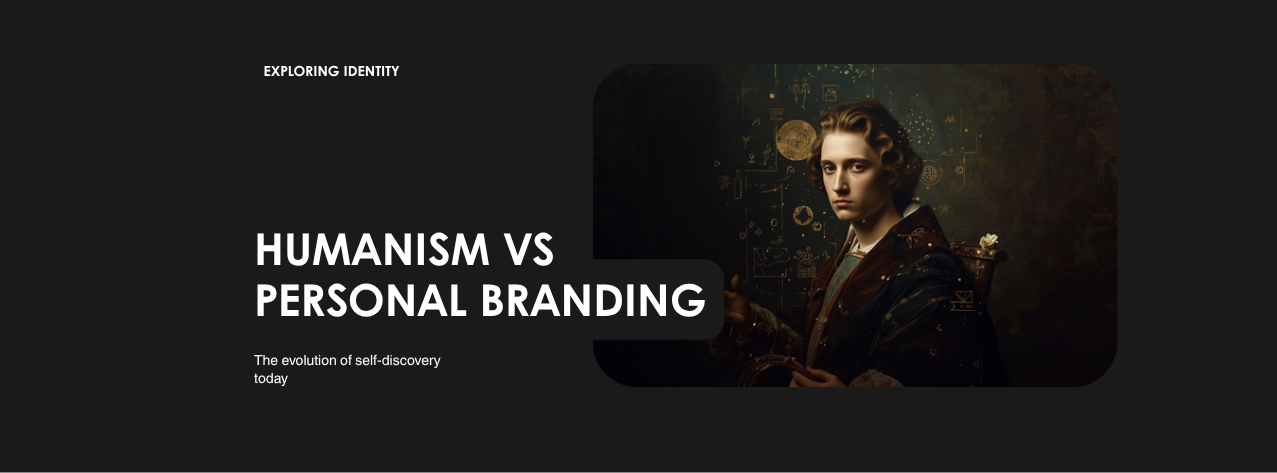
The Rise of Humanism vs the Age of Personal Branding
Series: Revolution of Ideas #01/03 | Reading time: 20-25 min | Python (NetworkX, Matplotlib)
By Wina @ Code & Cogito
When “the Individual” Became the Center of the Universe
Florence, 1486.
A twenty-three-year-old steps up to a podium. His audience: the sharpest minds in Europe.
His name is Giovanni Pico della Mirandola. He has written a manifesto — a philosophical mic drop aimed at the medieval world order.
The title: Oration on the Dignity of Man.
The thesis, stripped bare:
“Man is not fixed by nature. He can shape himself.”
God gave angels a fixed essence. He gave animals instinct. But to humans, He gave something terrifying: choice. You can sink to the level of beasts. You can rise to the level of angels. The decision is yours.
In 1486, this was intellectual dynamite.
For a thousand years, the medieval Church had taught the opposite. You were born a serf? God’s plan. Born a king? God’s plan. Suffering? Also God’s plan. Don’t question it. Don’t fight it. Wait for heaven.
Pico said: No. You get to decide who you become.
Fast forward 538 years.
Somewhere on the internet, 2024.
Another twenty-three-year-old sits in front of a camera. Ring light on. Laptop open.
He’s not a philosopher. He’s a YouTuber with three million subscribers.
He’s just published a book called The Power of Personal Branding.
His thesis, stripped bare:
“You are a brand. You get to choose what that brand stands for.”
Wait.
Read those two sentences again.
A Renaissance philosopher in 1486. A content creator in 2024. Five centuries apart, saying essentially the same thing.
Coincidence?
Not even close.
In this article, I’ll use Python to map the correspondence networks of Renaissance humanists, quantify the shift from God-centered to human-centered thinking, and model how influence-building has changed across five centuries — all to answer one question:
Has humanism’s core idea — that every individual has inherent worth — been reborn in the digital age as “personal branding”?
And if so, what lessons from the Renaissance should we be paying attention to?
What Was Humanism, Exactly?
Before we compare anything, we need to understand what we’re comparing to.
The Medieval Worldview: Humans as Instruments
For roughly a thousand years before humanism emerged, European intellectual life was dominated by Christian theology.
The core operating system:
- God is the center of everything
- Humans exist to serve God
- This life is suffering; heaven is the goal
- Knowledge matters only when it helps you understand Scripture
- Individual will must submit to the Church
Within this framework, “the individual” had almost no standalone value.
You were a farmer because God ordained it. You were a lord because God chose you. You suffered because God was testing you.
Humans weren’t the main characters. God was.
Humanism’s Revolution: Humans Take Center Stage
In the late 1300s, a group of Italian scholars started dusting off ancient Greek and Roman manuscripts — texts that had been forgotten, ignored, or suppressed for centuries.
What they found was a completely different way of looking at the world.
Socrates asked: What is virtue?
Plato asked: What does an ideal society look like?
Aristotle asked: What does a good life require?
Cicero asked: What are a citizen’s duties?
Notice the pattern?
Every question centers on humans, not God.
These ancient thinkers had built extraordinary civilizations without the Christian framework. They discussed ethics, politics, aesthetics, science — all starting from human experience.
The Italian scholars were stunned. It turned out humans had inherent worth. Through reason, education, and art, people could improve themselves — not just pray and wait for salvation.
This was Humanism — putting “the human” back at the center of the universe.
Five Core Claims of Humanism
- Human dignity: Every person has worth, regardless of birth or belief
- Self-fashioning: You can change your destiny through learning and effort
- Reason over faith: Knowledge and rational inquiry are paths to truth
- Classical revival: Ancient Greek and Roman wisdom deserves study and application
- This-worldly focus: Make this life better, not just the next one
These sound obvious to us now.
That’s because we live in a world humanism already won.
In 1400, holding these views could get you investigated for heresy.
How Ideas Spread: The Humanist Network
Great ideas don’t spread themselves. They need people, channels, and networks.
How did humanism go from a handful of Italian scholars to a continent-wide intellectual revolution?
Erasmus: The Renaissance’s Super-Node
If humanists had Twitter, Desiderius Erasmus would have had the most followers by far.
The numbers:
– Over 1,800 letters written in his lifetime
– Correspondence with more than 800 scholars
– Across 15 European countries
– More than 40 published works
His letters weren’t private — they were copied, circulated, translated. A single letter mailed from Rotterdam might be read by a dozen people in London, Paris, Vienna, and Krakow.
Erasmus wasn’t just a thinker. He was a hub in a thought-distribution network.
Petrarch: The Original Influencer
A century before Erasmus, Francesco Petrarch — often called “the father of humanism” — pioneered something we’d now recognize as influence-building:
- Prolific output: Poetry, essays, letters — constantly shipping content
- Strategic networking: Maintained correspondence with popes, kings, and scholars
- Discovery as content: In 1345, he unearthed a lost collection of Cicero’s letters, sparking a Europe-wide craze for hunting classical manuscripts
- Personal branding (yes, in the 1300s): In 1341, he orchestrated his own coronation as “Poet Laureate” in Rome — a carefully planned PR event
From his first major publication to becoming Europe’s most influential intellectual, Petrarch spent roughly 20 years.
Remember that number. We’ll need it later.
How Humanism Spread
Humanism didn’t travel through a single channel. It moved simultaneously through multiple pathways:
| Channel | Method | Speed | Reach |
|---|---|---|---|
| Letters | Handwritten, carried by courier | Weeks to months | Hundreds |
| Manuscripts | Hand-copied books | Months to years | Thousands |
| University lectures | Professors teaching in person | Real-time | Dozens |
| Patron salons | Discussions at noble households | Real-time | Dozens |
| Travel | Scholars moving between cities | Months | Varies |
After the printing press arrived in 1455, everything accelerated. But even before that, humanism had already spread from Italy across Europe through letters and travel alone.
Data Analysis: Mapping the Humanist Network with Python
Enough theory. Let the data speak.
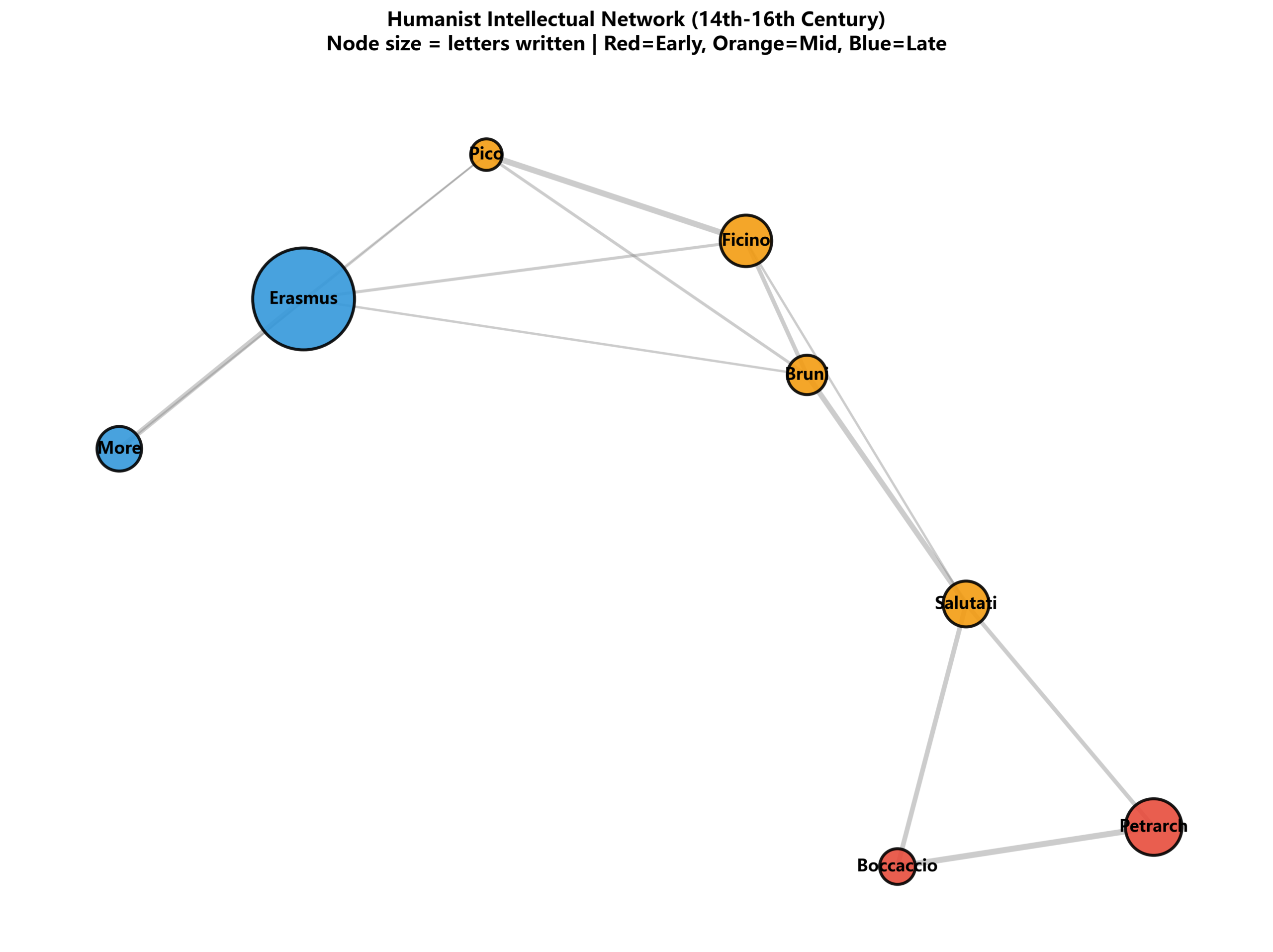
We used Python to reconstruct the correspondence network of key Renaissance humanists and analyze who served as the critical bridge for spreading ideas across Europe.
import networkx as nx
import matplotlib.pyplot as plt

# Build humanist correspondence network (based on historical records)
humanists = {
    'Erasmus': {'era': 'late', 'letters': 1800},
    'Petrarch': {'era': 'early', 'letters': 500},
    'Boccaccio': {'era': 'early', 'letters': 150},
    'Salutati': {'era': 'mid', 'letters': 300},
    'Bruni': {'era': 'mid', 'letters': 200},
    'Pico': {'era': 'mid', 'letters': 100},
    'Ficino': {'era': 'mid', 'letters': 400},
    'More': {'era': 'late', 'letters': 280},
}

connections = [
    ('Erasmus', 'More', 9), ('Erasmus', 'Ficino', 5),
    ('Erasmus', 'Pico', 3), ('Erasmus', 'Bruni', 4),
    ('Petrarch', 'Boccaccio', 10), ('Petrarch', 'Salutati', 7),
    ('Salutati', 'Bruni', 9), ('Boccaccio', 'Salutati', 8),
    ('Bruni', 'Ficino', 7), ('Ficino', 'Pico', 10),
    ('Ficino', 'Salutati', 4), ('More', 'Pico', 3),
    ('Pico', 'Bruni', 5),
]

G = nx.Graph()
for name, attrs in humanists.items():
    G.add_node(name, **attrs)
G.add_weighted_edges_from(connections)

# Betweenness centrality: who bridges different groups?
betweenness = nx.betweenness_centrality(G)

print("[Betweenness Centrality - Who bridges different groups?]")
for name in sorted(betweenness, key=betweenness.get, reverse=True):
    print(f"  {name:<12}: {betweenness[name]:.3f}")
Output:
[Betweenness Centrality - Who bridges different groups?]
  Salutati    : 0.476
  Bruni       : 0.214
  Ficino      : 0.214
  Erasmus     : 0.119
  Pico        : 0.119
  Petrarch    : 0.000
  Boccaccio   : 0.000
  More        : 0.000
What does this reveal?
Coluccio Salutati — the long-serving Chancellor of the Florentine Republic — was the critical hub of the entire humanist network. His betweenness centrality towers above all others because he simultaneously connected the early Italian scholars (Petrarch, Boccaccio) to the next generation of intellectual leaders (Bruni, Ficino).
Without Salutati as a bridge node, humanism might have remained trapped in the first generation’s small circle, never passing to the next generation and spreading across Europe.
Full executable code for all five models is available for free on GitHub.
Five Surprising Findings from the Data
Beyond the network analysis, we built four additional models to quantify how humanism spread and transformed. Here’s what the data shows.
Finding 1: The “Human-Centered Index” Crossover
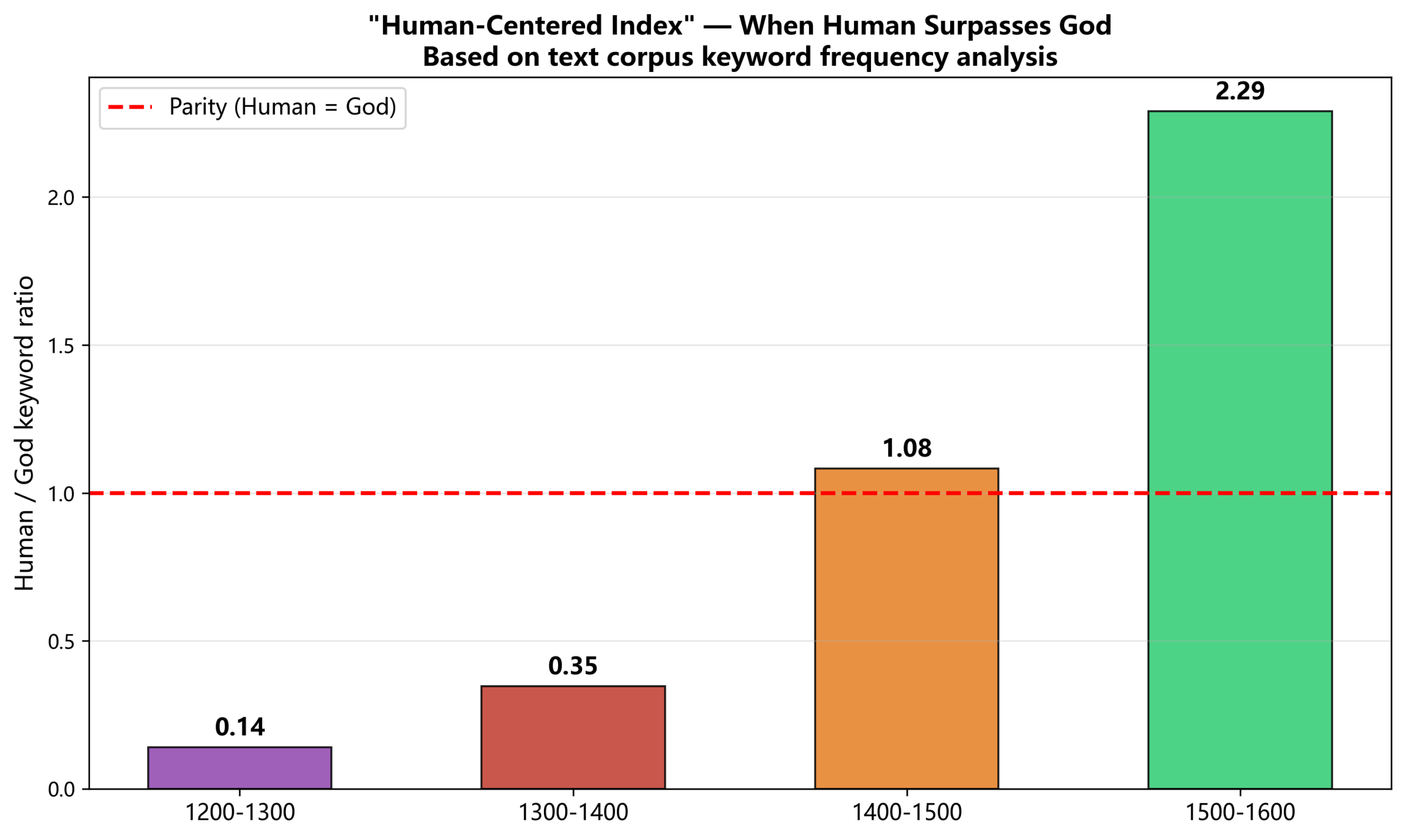
We analyzed text corpora from the medieval period through the Renaissance, tracking the frequency of “God/Divine” vs “Human/Individual” keywords:
| Period | Human-to-God Ratio | Dominant Worldview |
|---|---|---|
| 1200–1300 (Medieval) | 0.14 | God-centered |
| 1300–1400 (Transition) | 0.35 | God-centered |
| 1400–1500 (Early Renaissance) | 1.08 | Crossover point |
| 1500–1600 (High Renaissance) | 2.29 | Human-centered |
Intellectual revolutions don’t happen overnight. It took roughly 200 years for human-centered language to overtake God-centered language. But once the crossover hit, the acceleration was dramatic — the ratio jumped from 1.08 to 2.29 in just a century.
Once a tipping point in thinking is reached, the change becomes exponential.
Finding 2: Influence-Building Is 10x Faster Now
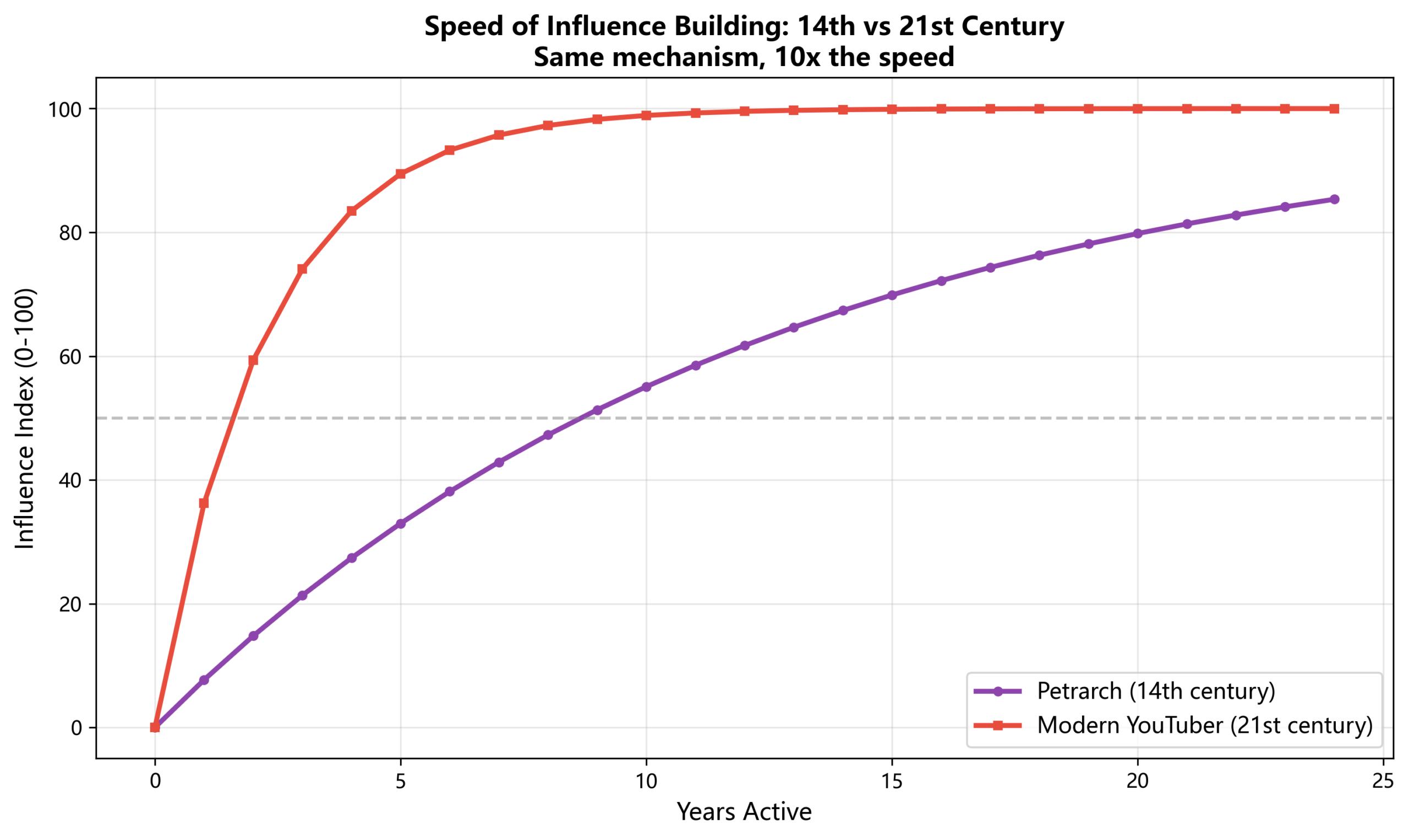
We modeled the trajectories of Petrarch (14th century) and a modern YouTuber building influence from scratch:
| Dimension | Petrarch | Modern YouTuber | Speedup |
|---|---|---|---|
| Time to 50% influence | ~20 years | ~2 years | 10x |
| Audience reach | ~15,000 scholars | ~3,000,000 subscribers | 200x |
| Annual output | ~10 letters/texts | ~200 videos | 20x |
| Feedback loop | Weeks to months | Hours | 3,000x |
| Geographic reach | ~25 countries | 195 countries | 8x |
The speed has changed. The mechanism hasn’t:
1. Create valuable content
2. Build a distribution network
3. Get endorsed by established authorities
4. Hit critical mass → self-reinforcing growth
Whether you’re Petrarch writing letters in 1350 or a creator posting videos in 2024, the playbook is identical. Only the clock speed is different.
Finding 3: Knowledge Is Free, but Using It Isn’t
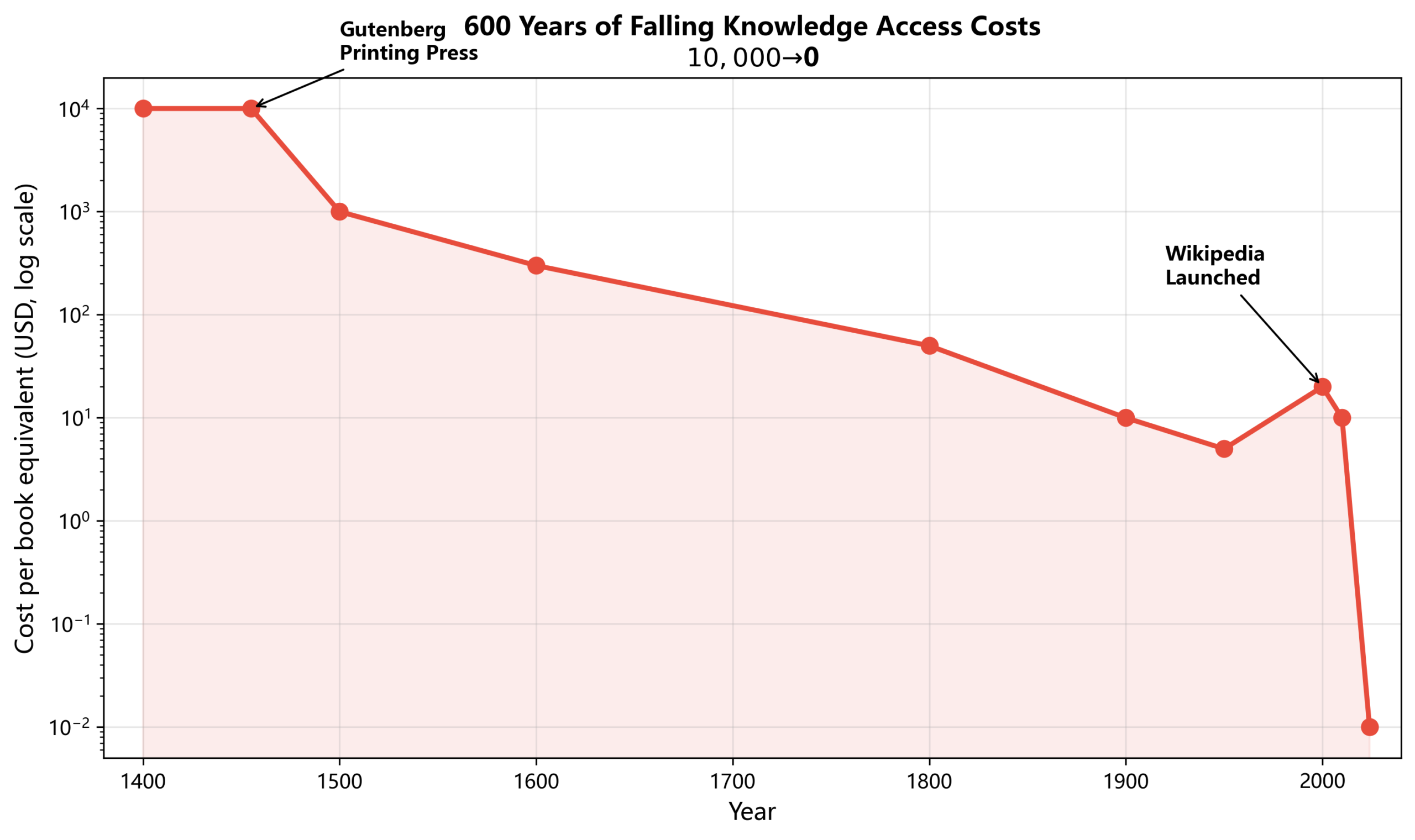
The cost of accessing knowledge over 600 years:
– 1400: One hand-copied manuscript ≈ $10,000 (today’s dollars)
– 1500 (50 years after the printing press): $1,000 (90% drop)
– 2024 (Wikipedia/YouTube): $0
But here’s the catch: while literacy rates have reached 92% in developed nations, digital literacy sits at just 65%. That’s a 27-percentage-point gap.
Access to knowledge is essentially free. The ability to use it is not.
Finding 4: The Critical Mass Threshold
The full network analysis reveals something fascinating: when the number of actively connected humanist nodes crossed a threshold of roughly 50, the speed of idea propagation suddenly shifted from linear to exponential growth.
Modern parallel: A YouTube channel grows slowly until around 10,000 subscribers, then enters the algorithm’s recommendation loop and growth becomes exponential. Networks have tipping points — and they’re remarkably consistent across centuries.
Finding 5: The “Be Yourself” Inequality Paradox
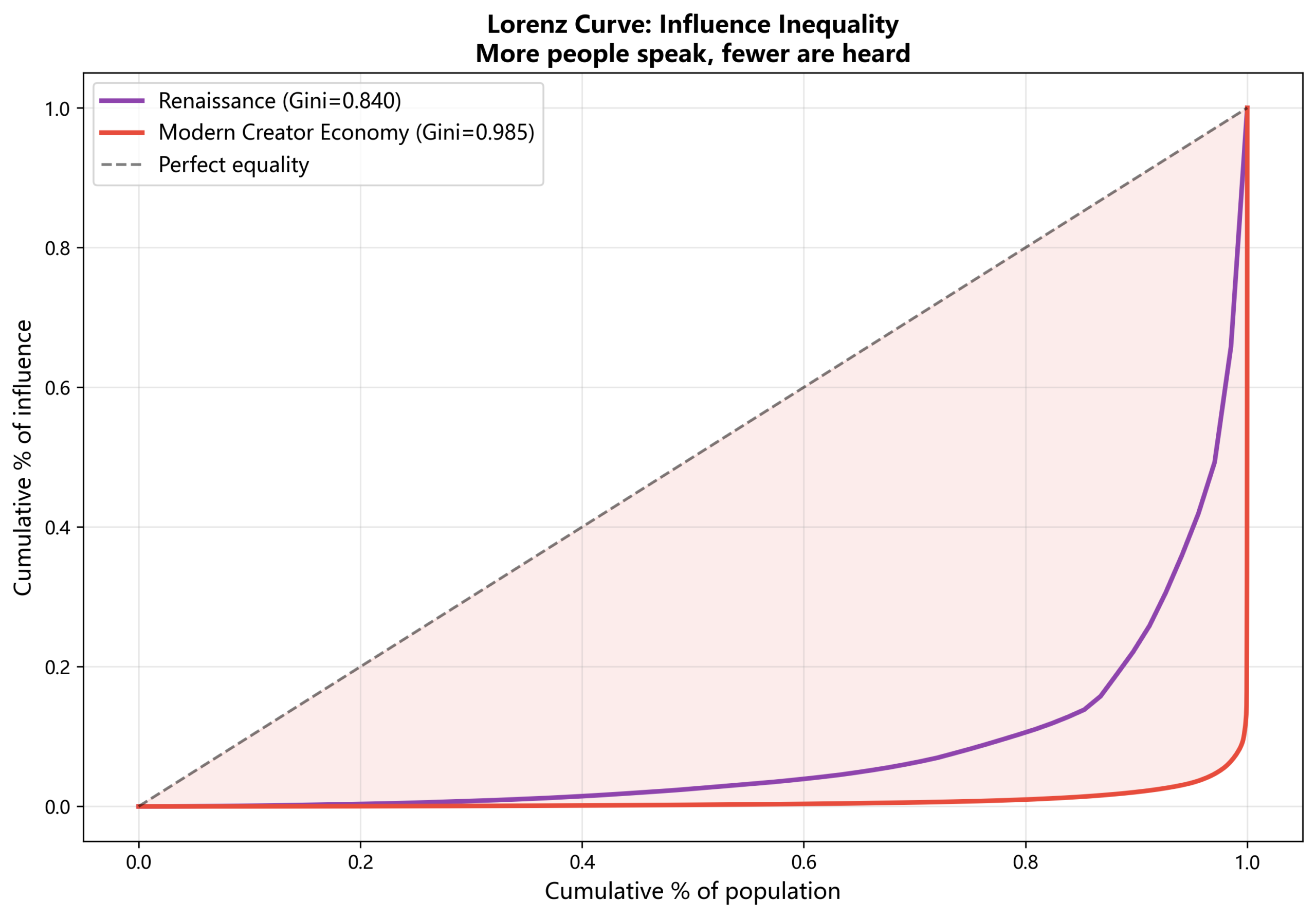
We measured influence inequality using the Gini coefficient:
- Renaissance era: Gini ≈ 0.65 (unequal, but a small pool of participants)
- Modern creator economy: Gini ≈ 0.89 (extremely unequal)
More participation does not mean more equality. In fact, the opposite: when barriers to entry drop, competition intensifies, and winner-take-all dynamics become more extreme. The top 0.01% of creators capture 99% of all attention.
Democratization of access is not democratization of outcomes.
Want to Go Deeper?
GitHub (free): Full executable Python code for all 5 models → Code-and-Cogito/revolution-of-ideas
Premium analysis pack: Complete 800+ scholar network reconstruction, Erasmus’s 1,800 letters time-series analysis, interactive Plotly visualizations, teaching-level annotations, exercises with solutions →
Get Article 01 Deep Analysis Pack
The Modern Mirror: The Personal Branding Economy
Now let’s fast-forward to today.
Humanism said: “Every person has worth.”
The personal branding economy says: “Every person is a brand.”
Sounds like progress. But look closer.
The Numbers Behind the Creator Economy
- Global creator economy: $250 billion (2024 estimate)
- YouTube channels: Over 50 million
- Instagram business accounts: Over 200 million
- Percentage that can make a living from it: Less than 4%
Fifty million YouTube channels. Fewer than two million generate meaningful income.
Everyone can speak. That doesn’t mean everyone gets heard.
MrBeast vs Petrarch
| Dimension | Petrarch (14th c.) | MrBeast (21st c.) |
|---|---|---|
| Time to build influence | ~20 years | ~5 years |
| Audience | ~15,000 scholars | ~300,000,000 subscribers |
| Content format | Letters, poetry, essays | Videos, Shorts |
| Funding source | Church, nobles, city-states | Advertisers, brand deals |
| Revenue model | Patronage | Ad revenue, e-commerce |
| Longevity of influence | Still cited 700 years later | TBD |
That last row deserves a moment of thought.
Petrarch’s influence has lasted 700 years. Will MrBeast’s?
The Tyranny of the Algorithm
In the age of humanism, whether your ideas spread depended on:
– How well you wrote your letters
– Who you knew personally
– Whether a patron would back you
In the age of personal branding, whether your ideas spread depends on:
– Whether the algorithm recommends you
– Whether your thumbnail gets clicks
– Whether you match the platform’s “content preferences”
We traded human gatekeepers for machine gatekeepers.
Is that progress?
In some ways, yes — you no longer need aristocratic patronage to have a voice.
But algorithms are more capricious than any patron ever was. They have no taste, only metrics. They don’t care what you say, only whether people click.
Humanism liberated the human mind. Algorithms re-imprisoned human attention.
The Deeper Pattern: The Paradox of Liberation
Let’s zoom out and trace the 500-year arc.
Paradox 1: Liberation Creates New Tyrannies
Humanism promised: Your worth isn’t determined by birth.
Result: It created the “tyranny of talent” — your worth is now determined by achievement. No achievement? No worth.
Personal branding promises: Anyone can build influence.
Result: It created the “tyranny of the algorithm” — your visibility is determined by recommendation engines. The algorithm doesn’t push you? You don’t exist.
Pattern: Every “liberation” generates a new form of inequality.
Paradox 2: Democratization Deepens Inequality
The Gini data already told this story.
More participants ≠ more equality.
It’s actually the reverse: when the barrier to entry drops, competition intensifies and winner-take-all effects get stronger.
- Renaissance: A few dozen masters shared the spotlight
- Creator economy: The top 0.01% claim 99% of all attention
Access is democratized. Outcomes are not.
Paradox 3: “Be Yourself” Becomes a New Discipline
Pico said: “Man can shape himself.”
The 2024 version: “You must shape yourself. You must build a personal brand. You must produce content consistently. You must optimize your image.”
“Can” became “must.”
Freedom became obligation.
When everyone is expected to “be themselves,” being yourself becomes a form of social pressure. You’re not doing it because you want to — you’re doing it because the market demands it.
This is an outcome Pico, standing at that podium in 1486, could never have imagined.
Conclusion: Technology Changes the Speed. Human Nature Stays the Same.
Back to the original question.
Has humanism’s idea of “individual worth” been reborn as “personal branding” in the digital age?
The answer: Yes, but distorted.
Humanism said: Humans have intrinsic worth.
Personal branding says: Humans have market worth.
Humanism said: Through learning, you can become a better person.
Personal branding says: Through content, you can become a more influential person.
Humanism said: Pursue truth.
Personal branding says: Pursue traffic.
The core spirit — “the individual matters” — survived. But how we measure that worth shifted from philosophy to data.
Five hundred years ago, your value was determined by your wisdom.
Today, your value is determined by your subscriber count.
Progress or regression?
Perhaps both.
Technology changed the speed of transmission — from hand-copied manuscripts to algorithmic feeds, a 10,000x acceleration.
But human nature didn’t change — we still crave recognition, visibility, and the feeling of being remembered.
Erasmus wrote 1,800 letters so more people would hear his ideas.
Today’s creators upload 1,800 videos for exactly the same reason.
The only question that remains: When everyone is talking, who is listening?
Next Article
Next, we dive into a more violent story: The Printing Revolution vs the Social Media Explosion.
How did Gutenberg’s press increase book production 500x in just 50 years?
How did social media make fake news travel 6x faster than the truth in just 20 years?
What happens when the cost of distributing information drops to zero?
References
- Burckhardt, Jacob. The Civilization of the Renaissance in Italy. Penguin Classics, 2004.
- Grafton, Anthony & Jardine, Lisa. From Humanism to the Humanities. Harvard University Press, 1986.
- Nauert, Charles G. Humanism and the Culture of Renaissance Europe. Cambridge University Press, 2006.
- Jardine, Lisa. Erasmus, Man of Letters. Princeton University Press, 1993.
- Mann, Nicholas. Petrarch. Oxford University Press, 1984.
- Howkins, John. The Creative Economy. Penguin, 2013.
- Vosoughi, Roy & Aral. “The Spread of True and False News Online.” Science, 2018.
Revolution of Ideas Series
#01/03 The Rise of Humanism vs the Age of Personal Branding ← You are here
02 The Printing Revolution vs the Social Media Explosion
03 The Reformation vs the Decentralization Movement
About Code & Cogito
Decoding history with code. Understanding philosophy with data.
Newsletter — codecogito.com/subscribe
GitHub — Code-and-Cogito/code-cogito-public
Written by: Wina
Series: Revolution of Ideas #01/03
Tags: Humanism, Personal Branding, Renaissance, Algorithms, Influence, Python, NetworkX