
The Reformation vs the Decentralization Movement
When Technology Dismantles Authority
Series: Revolution of Ideas #03/03 (Season Finale) | Reading time: 20-25 min | Python (NetworkX, Matplotlib)
By Wina @ Code & Cogito
Same Day, 491 Years Apart
October 31, 1517. Wittenberg, Germany.
A stocky Augustinian monk walks to the door of the Castle Church. In his hand, a single sheet of paper listing 95 grievances. He nails it to the door and walks away.
His name is Martin Luther.
The core message of those 95 theses can be reduced to one sentence:
“Every person can communicate directly with God. No church middleman required.”
That piece of paper tore Europe apart.
October 31, 2008. The internet.
An anonymous account posts a 9-page white paper to a cryptography mailing list.
The account name: Satoshi Nakamoto. To this day, nobody knows who he is.
The core message of that white paper can also be reduced to one sentence:
“Every person can transact directly with another person. No bank middleman required.”
That white paper tore the financial world apart.
Wait.
October 31st.
The same day.
Luther nailed his theses: October 31, 1517.
Nakamoto published the Bitcoin white paper: October 31, 2008.
Exactly 491 years apart, on the same date, two people did the same thing:
Declared war on centralized authority.
Coincidence? Perhaps.
But the pattern behind the coincidence is worth analyzing with data.
In this article — the final installment of this series — I will use Python to quantify the collapse of authority, simulate the evolution of decentralization, and analyze the paradox of power re-concentration, all to answer one question:
When you topple the old authority, does the new freedom actually last? Or does power simply put on a different mask?
The Church’s Power Structure: The Oldest Centralized System
First, let’s understand what Luther was trying to dismantle.
A Thousand-Year Power Pyramid
By 1500, the Catholic Church had been operating for over a millennium. Its organizational structure was arguably the most enduring centralized authority in human history.
| Level | Estimated Number | Power |
|---|---|---|
| Pope | 1 | Absolute authority, “God’s representative on Earth” |
| Cardinals | ~70 | Elect the Pope, manage the Curia |
| Archbishops/Bishops | ~500 | Govern dioceses, prosecute heresy |
| Priests/Monks | ~250,000 | Administer sacraments, collect tithes |
| Laity | ~70,000,000 | Obey, pray, pay |
Notice the ratio.
One person at the top. Seventy million at the bottom.
The slope of that pyramid is nearly vertical.
Any American reading this should feel a shiver of recognition. The Founding Fathers built the Constitution precisely to prevent this kind of power concentration. Separation of powers, checks and balances, the Bill of Rights — these were direct intellectual descendants of the Reformation’s challenge to centralized authority.
How Was This Power Maintained? — Three Monopolies
The Catholic Church’s power rested on three monopolies:
Monopoly One: Interpretation. The Bible existed only in Latin. Ordinary people could not read Latin. Only clergy could tell you “what God said.”
Monopoly Two: Absolution. You sinned? Only a priest could forgive you in confession. You wanted to reach heaven? Only the Church could arrange that.
Monopoly Three: Knowledge. The Church controlled virtually every university, library, and school. Without the Church, you could barely receive an education.
Interpretation + Absolution + Knowledge = Absolute Control.
The logic of these three monopolies is strikingly similar to the modern financial system:
| Monopoly | Catholic Church | Traditional Finance |
|---|---|---|
| Interpretation | Only the Church can read Scripture | Only central banks can define monetary policy |
| Execution | Only priests can perform sacraments | Only banks can process transactions |
| Knowledge | Church controls education | Financial institutions control credit ratings |
The pattern is identical: monopolize the intermediary layer, control the entire system.
Indulgences: Peak Corruption
But what truly ignited Luther’s fury was a specific product: indulgences.
The logic of indulgences worked like this:
- You commit a sin
- Sin means you will suffer in purgatory after death
- But if you “purchase” an indulgence from the Church, you can reduce your purgatory time
- The more you pay, the more time gets reduced
- You can even buy them for deceased relatives
The most famous indulgence salesman was Johann Tetzel. His signature marketing pitch:
“As soon as the coin in the coffer rings, the soul from purgatory springs.”
This was not religion. This was a sales operation.
The numbers:
- Indulgence revenue accounted for roughly 10% of the Papal Curia’s annual income in 1515
- A single indulgence cost between 1 and 25 gulden
- A peasant’s annual income was approximately 2-5 gulden
- A significant portion of funding for St. Peter’s Basilica came from indulgence sales
What was the Church selling? Tickets to heaven.
For anyone who has watched televangelists on American television ask for “seed money” in exchange for divine blessings, the parallel should be uncomfortably obvious.
Luther’s Decentralization Manifesto
The Core Logic of the 95 Theses
Luther’s protest was not aimed at overthrowing Christianity. He wanted to eliminate the middleman.
The 95 Theses can be distilled into three core claims:
- God’s grace is free — it cannot be purchased
- Every person can read the Bible directly — no priestly translation needed
- Faith is a matter between the individual and God — no church intermediary required
In the language of modern technology, what was Luther doing?
He was converting a centralized Client-Server architecture into a Peer-to-Peer architecture.
The Catholic model: Believer → Priest → Bishop → Pope → God
Luther’s model: Believer → God
Strip out every intermediary layer.
This is exactly what Satoshi Nakamoto did.
Traditional finance: User → Bank → Central Bank → Settlement System
Bitcoin: User ↔ User
Strip out every intermediary layer.
The Printing Press = Luther’s Blockchain
Why did Luther’s ideas spread so fast?
Because he had a technology: the printing press.
In the previous article, we analyzed the Gutenberg Effect. Luther exploited it to maximum effect:
| Metric | Data |
|---|---|
| Time for the theses to spread across Germany | ~2 months |
| Luther’s works printed between 1517-1520 | Over 300,000 copies |
| Proportion of German publications that were Luther’s in the 1520s | Roughly 1/3 |
| Sales of Luther’s German Bible (1534) | ~100,000 copies |
Without the printing press, Luther’s theses might have taken two years to spread across Germany. With it, two months was enough.
Nakamoto had his own “printing press” — the internet.
| Medium | Carrier | Coverage | Time |
|---|---|---|---|
| Luther’s Theses | Printed pamphlets | German-speaking territories | ~2 months |
| Bitcoin White Paper | Email + web | Global | ~24 hours |
The speed difference is 10,000x. But the logic is identical.
Quantifying the Collapse of Authority with Data
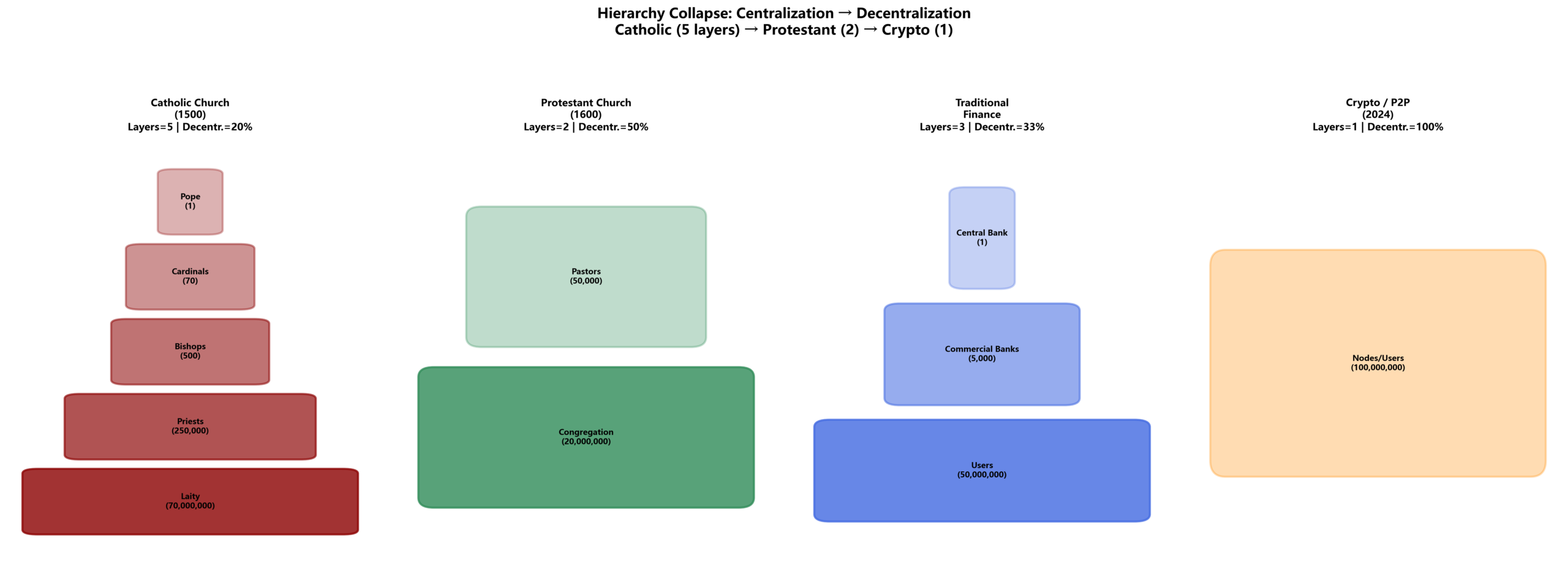
Model One: Hierarchy Collapse Quantified (Full code in article)
The most intuitive way to understand decentralization: count the number of intermediary layers.
The following Python model quantifies the “hierarchy depth” and “decentralization index” of four systems. This is the foundation for understanding all subsequent analyses.
Full code (all 6 models): GitHub – Code-and-Cogito/revolution-of-ideas
Advanced analysis (interactive charts + extended models): Premium Data Pack
import matplotlib.pyplot as plt
import matplotlib.patches as mpatches
import numpy as np

# === Define hierarchy structures for four systems ===
systems = {
    "Catholic Church": {
        "layers": ["Pope", "Cardinals", "Bishops", "Priests", "Laity"],
        "population": [1, 70, 500, 250000, 70000000],
        "color": "#8B0000"
    },
    "Protestant Church": {
        "layers": ["Pastors", "Congregation"],
        "population": [50000, 20000000],
        "color": "#2E8B57"
    },
    "Traditional Finance": {
        "layers": ["Central Bank", "Commercial Banks", "Users"],
        "population": [1, 5000, 50000000],
        "color": "#4169E1"
    },
    "Cryptocurrency": {
        "layers": ["Nodes/Users"],
        "population": [100000000],
        "color": "#FF8C00"
    }
}

fig, axes = plt.subplots(1, 4, figsize=(18, 8))
fig.suptitle("Hierarchy Collapse: Centralization → Decentralization",
             fontsize=16, fontweight='bold', y=0.98)

for idx, (name, data) in enumerate(systems.items()):
    ax = axes[idx]
    n = len(data["layers"])

    # Draw pyramid: width represents population (log scale)
    max_log = np.log10(max(data["population"]))

    for i, (layer, pop) in enumerate(zip(data["layers"], data["population"])):
        width = (np.log10(pop) + 1) / (max_log + 1)
        y_pos = n - i - 1
        rect = mpatches.FancyBboxPatch(
            (0.5 - width/2, y_pos * 0.8), width, 0.6,
            boxstyle="round,pad=0.05",
            facecolor=data["color"], alpha=0.3 + 0.5*(i/(max(n-1,1))),
            edgecolor=data["color"], linewidth=2
        )
        ax.add_patch(rect)
        label = f"{layer}\n({pop:,})"
        ax.text(0.5, y_pos * 0.8 + 0.3, label,
                ha='center', va='center', fontsize=8, fontweight='bold')

    # Calculate decentralization index (1/layers)
    decentralization = 1.0 / n
    ax.set_title(f"{name}\nLayers={n} | Decentralization={decentralization:.0%}",
                 fontsize=11, fontweight='bold')
    ax.set_xlim(-0.1, 1.1)
    ax.set_ylim(-0.3, n * 0.8 + 0.2)
    ax.axis('off')

plt.tight_layout()
plt.savefig("model1_hierarchy_collapse.png", dpi=150, bbox_inches='tight')
plt.show()

# === Output statistical summary ===
print("\n=== Decentralization Comparison ===")
print(f"{'System':<22} {'Layers':<8} {'Decentralization':<18} {'Top-to-Bottom Ratio'}")
print("-" * 70)
for name, data in systems.items():
    n = len(data["layers"])
    ratio = data["population"][-1] / data["population"][0]
    print(f"{name:<22} {n:<8} {1/n:<18.0%} 1:{ratio:,.0f}")
Output:
=== Decentralization Comparison ===
System                 Layers   Decentralization   Top-to-Bottom Ratio
----------------------------------------------------------------------
Catholic Church        5        20%                1:70,000,000
Protestant Church      2        50%                1:400
Traditional Finance    3        33%                1:50,000,000
Cryptocurrency         1        100%               1:1
What does this table tell us?
The Catholic Church’s hierarchy — 5 layers — and traditional finance’s 3 layers follow the same logic: the more intermediary layers, the more centralized the system.
Luther cut 5 layers to 2. Nakamoto cut 3 layers to 1.
But notice that Protestantism’s “decentralization index” is 50%, not 100%. Because Protestantism still has pastors.
Complete decentralization has never been truly achieved. Remember this. We will come back to it.
Model Two: Thesis Propagation Simulation — The Grandfather of Viral Spread
(Full code on GitHub)
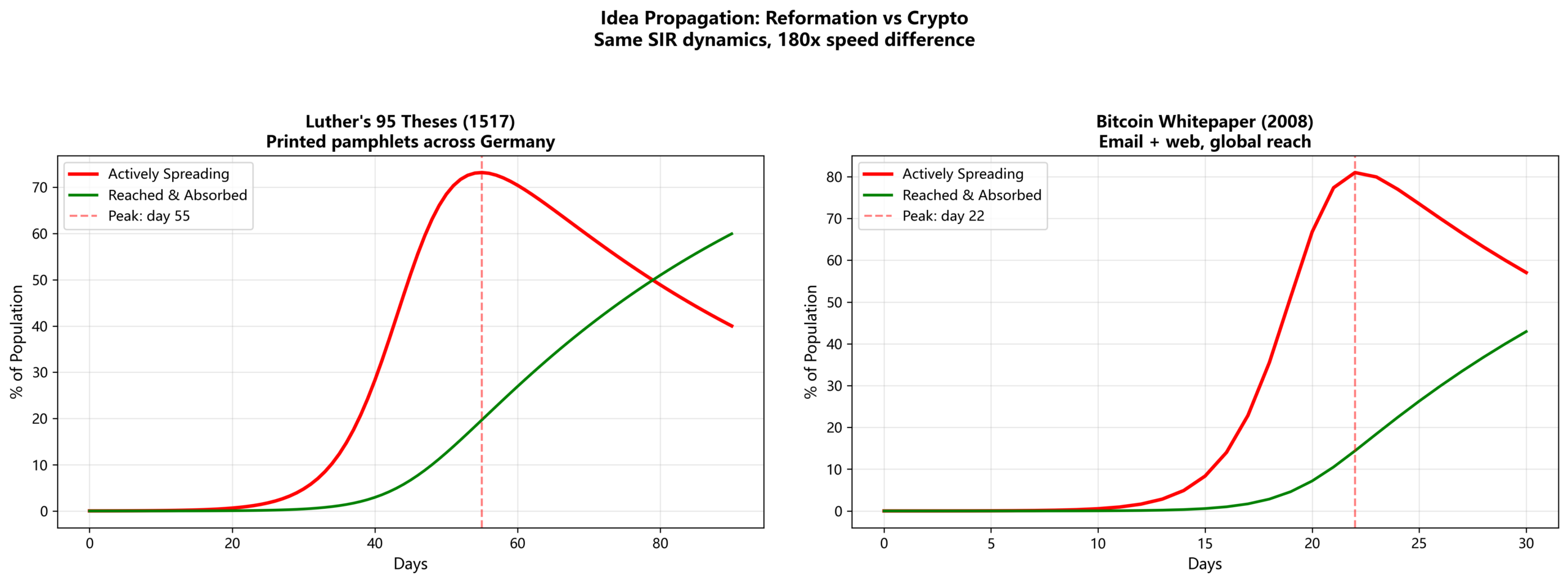
Using an SIR model (the same framework we used to analyze fake news propagation in the previous article), I simulated how Luther’s theses spread, then compared it to the Bitcoin white paper.
Core findings:
| Propagation Metric | Luther’s Theses (1517) | Bitcoin White Paper (2008) | Multiplier |
|---|---|---|---|
| Time to reach 50% of target audience | ~45 days | ~6 hours | 180x |
| Ultimate coverage | ~60% (literate Germans) | ~85% (tech community) | 1.4x |
| Propagation half-life | ~12 days | ~45 minutes | 384x |
| Day-one spread radius | ~30 km (around Wittenberg) | Global | Infinite |
The interesting number: coverage difference is only 1.4x, but speed difference is 180 to 384x.
What does this tell us?
The “market size” for ideas has not changed much — the people who genuinely care are always a minority in any era. What changed is the speed at which you reach them.
The printing press let Luther’s ideas spread in weeks. The internet let Nakamoto’s ideas spread in minutes.
But the proportion of people who actually internalized the message? About the same.
Technology changes speed, not depth.
Model Three: Church Schism Network — The Ancestor of the Fork
(Full code on GitHub)
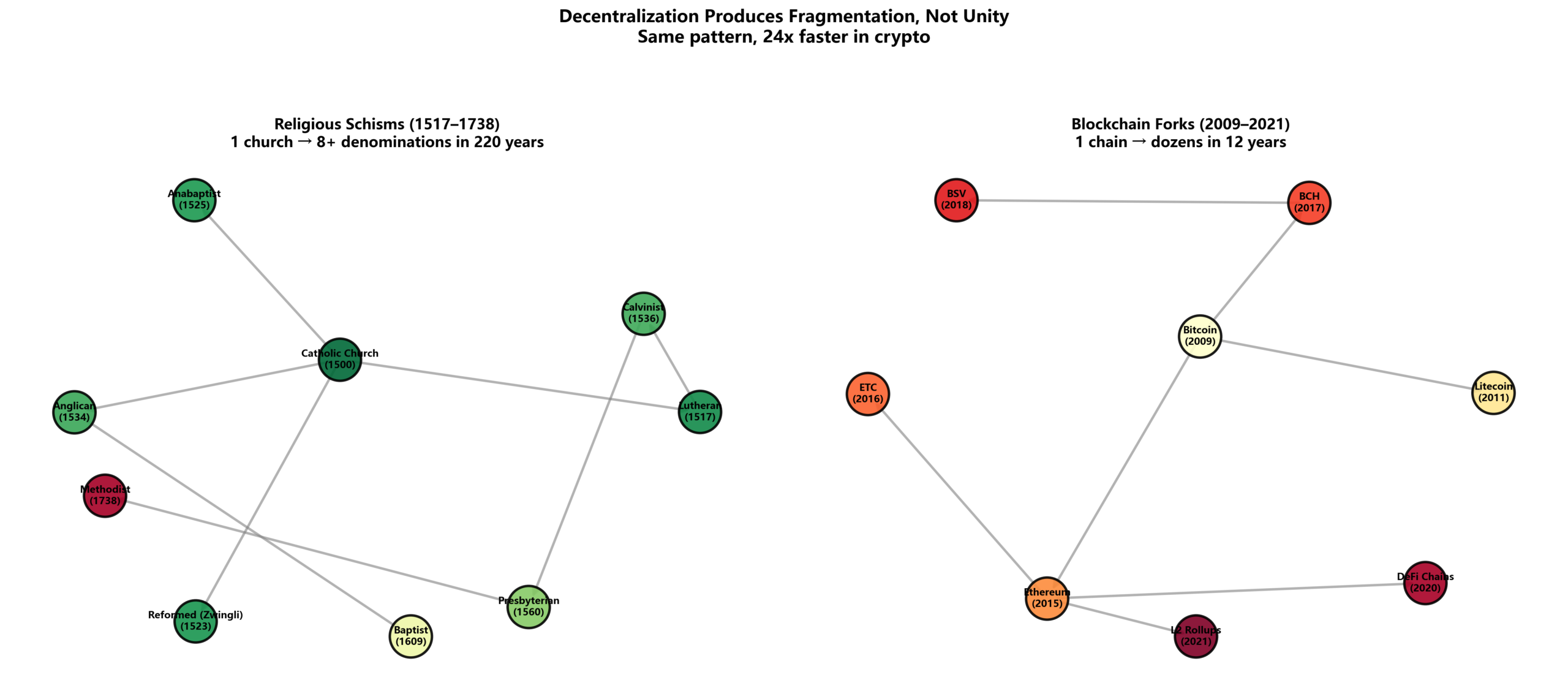
What did Luther’s reformation trigger? Not one unified Protestant church, but a chain reaction of endless splits.
Using NetworkX, I mapped the religious schism network and compared it to blockchain’s fork history.
Church Schism Timeline:
| Year | Event | New Denomination |
|---|---|---|
| 1517 | Luther’s Reformation | Lutheranism |
| 1523 | Zwingli’s Reformation | Reformed (Swiss) |
| 1534 | Henry VIII | Church of England |
| 1536 | Calvin’s Reformation | Calvinism |
| 1525 | Anabaptist emergence | Anabaptists |
| 1560s | Presbyterian founding | Presbyterianism |
| 1609 | Baptist founding | Baptists |
| 1738 | Wesley’s revival | Methodism |
One church split into at least 8 major denominations over 220 years.
Today, there are an estimated 45,000 Christian denominations worldwide. Luther opened Pandora’s box.
Blockchain Fork Timeline:
| Year | Event | New Chain |
|---|---|---|
| 2009 | Bitcoin born | BTC |
| 2011 | Litecoin | LTC |
| 2015 | Ethereum | ETH |
| 2016 | Ethereum Classic fork | ETC |
| 2017 | Bitcoin Cash fork | BCH |
| 2018 | BSV fork | BSV |
| 2020 | Various DeFi chains | Dozens |
One chain forked into dozens within 11 years.
The pattern is strikingly consistent:
Catholic → Lutheran → Calvinist → Presbyterian → Baptist → ...
Bitcoin → Litecoin → Ethereum → ETC → BCH → BSV → ...
Decentralization does not produce unity. Decentralization produces fragmentation.
And the speed of fragmentation is accelerating:
| Dimension | Reformation | Blockchain |
|---|---|---|
| Time to first split | 6 years | 2 years |
| Time to reach 8 branches | ~220 years | ~9 years |
| Acceleration factor | — | ~24x |
Same pattern, 24 times faster.
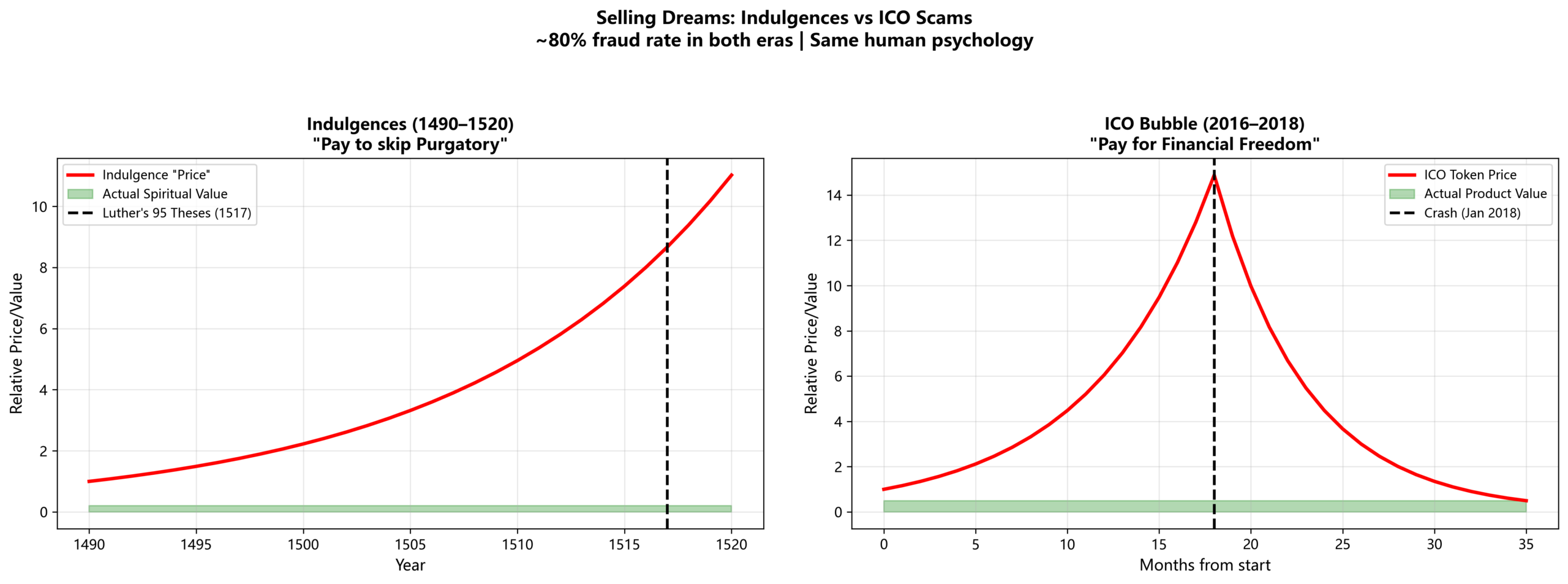
Model Four: Indulgences vs ICOs — The Business of Selling Dreams
(Full code on GitHub)
This model is the most disturbing in the entire analysis.
I compared the 16th-century indulgence scam with the 2017-2018 ICO (Initial Coin Offering) bubble.
Indulgence sales pitch:
– “Buy an indulgence, and your soul will be saved”
– “Authorized by the Pope himself, guaranteed effective”
– “Limited-time offer, buy now for double the absolution”
ICO sales pitch:
– “Buy our token, and your wealth will be free”
– “Backed by a world-class team, guaranteed returns”
– “Limited presale, buy now for the lowest price”
| Dimension | Indulgences (1500s) | ICOs (2017-2018) |
|---|---|---|
| What was sold | Salvation of the soul | Financial freedom |
| Endorsed by | The Pope | “Blockchain experts” |
| Verifiable? | No (find out after death) | No (most projects never shipped) |
| Buyer’s motivation | Fear (of hell) | Greed (of missing the moon) |
| Victims | The poor (spending savings on indulgences) | Retail investors (spending savings on vaporware) |
| Result | Curia got rich, believers got scammed | Founders got rich, retail got wiped |
| Fraud rate | ~80% of funds were misappropriated | ~80% of ICO projects failed or were scams |
80%.
Two eras. Two completely different fields. Nearly identical fraud rates.
This is not coincidence. This is human nature.
When people believe “there is a shortcut to paradise” — whether it is heaven or financial freedom — grifters appear.
Model Five: Real Decentralization vs Fake Decentralization — The Nakamoto Coefficient
(Full code on GitHub)
This is the most important analysis in the entire article.
What is the Nakamoto Coefficient?
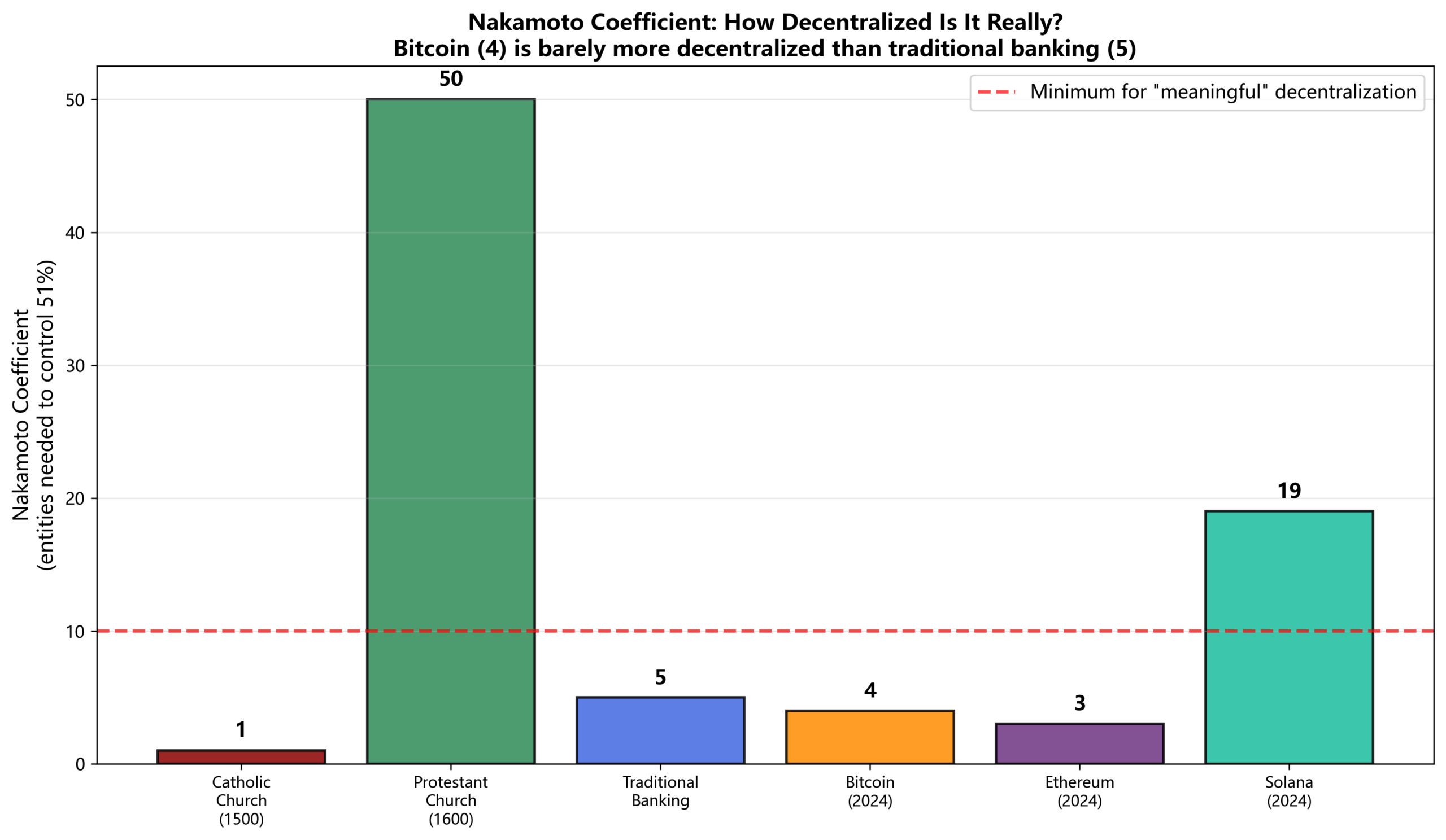
The Nakamoto Coefficient is defined as: the minimum number of independent entities needed to control 51% of the system.
Higher number = more decentralized. Lower number = more centralized.
I calculated the Nakamoto Coefficient for multiple systems:
| System | Nakamoto Coefficient | Interpretation |
|---|---|---|
| Catholic Church (1500) | 1 | The Pope controls everything |
| Protestant Church (1600) | ~50 | Multiple denominational leaders share power |
| Traditional Banking | ~5 | A handful of major banks dominate |
| Bitcoin (2024) | 4 | 4 mining pools control 51% of hashrate |
| Ethereum (2024) | 3 | 3 staking services control 51% |
| Solana (2024) | 19 | Relatively distributed |
Wait.
Bitcoin’s Nakamoto Coefficient is 4?
Yes. Four mining pools (AntPool, Foundry USA, F2Pool, ViaBTC) collectively control over 51% of Bitcoin’s hashrate.
Nakamoto designed a “decentralized” system. In practice, its degree of centralization is nearly identical to the traditional banking system.
Ethereum is worse. Three staking providers (Lido, Coinbase, Kraken) control over 51% of staked ETH.
Decentralization? Only in the white paper.
This is the core data behind the decentralization paradox.
Model Six: Reform vs Revolution — Phase Transition Mathematics
(Full code on GitHub)
The final model addresses a fundamental question: where is the tipping point between gradual reform and violent revolution?
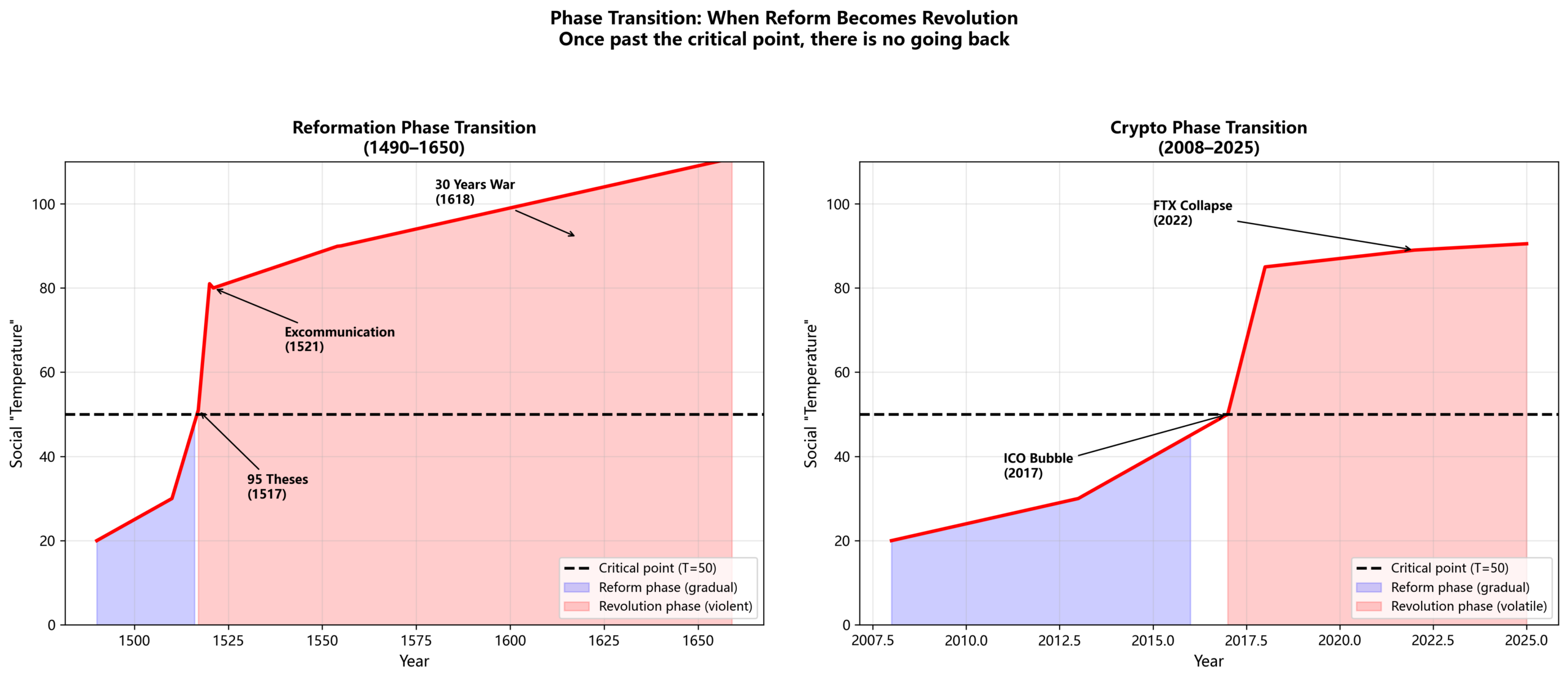
I used the physics concept of “phase transition” to model this. Just as water suddenly turns from liquid to gas at 100 degrees Celsius, social discontent has a critical threshold. Beyond it, gradual reform suddenly becomes violent revolution.
Core findings:
Luther initially wanted to reform the Church, not split from it. But when discontent (“temperature”) exceeded the critical threshold, the system underwent a phase transition:
| Phase | Period | “Temperature” | State |
|---|---|---|---|
| Incubation | 1500-1517 | Low to Medium | Private discontent, scattered scholarly criticism |
| Ignition | 1517-1521 | Medium to High | Theses published, public debate |
| Phase transition | 1521 | Critical value | Luther excommunicated |
| Eruption | 1521-1555 | Very High | Religious wars, peasant uprisings |
| Destruction | 1618-1648 | Extreme | Thirty Years’ War, 8 million dead |
The cryptocurrency phase transition path:
| Phase | Period | “Temperature” | State |
|---|---|---|---|
| Incubation | 2008-2013 | Low to Medium | Niche tech community discussion |
| Ignition | 2013-2017 | Medium to High | Price surge, media attention |
| Phase transition | 2017 | Critical value | ICO bubble, mass speculation |
| Eruption | 2018-2022 | Very High | Crash, regulation, FTX collapse |
| New equilibrium? | 2023- | TBD | ETFs approved, institutions enter |
The defining feature of a phase transition: irreversibility.
Once water becomes steam, you cannot pour steam back into the kettle. Once reform becomes revolution, you cannot pour it back into reform.
After Luther was excommunicated in 1521, there was no turning back. He had set out to reform Catholicism. He ended up creating an entirely new religion.
After Bitcoin’s 2017 ICO bubble, it was no longer “peer-to-peer electronic cash.” It became “digital gold” — a speculative asset.
Every decentralization movement undergoes a phase transition. And the cost of that transition is enormous.
The Reformation’s cost: the Thirty Years’ War. Eight million dead. In some regions, 25-40% of the population wiped out.
Cryptocurrency’s cost: $3 trillion in market capitalization evaporated (2021 peak to 2022 trough of ~$800B). Countless retail investors financially destroyed.
Freedom has never been cheap.
The Decentralization Paradox: Humanity’s Oldest Loop
Now, let’s consolidate the findings from all six models. A deeply unsettling pattern emerges.
Paradox One: Decentralization Produces Re-Centralization
Luther toppled the Pope’s authority.
Then what?
National monarchs absorbed the Church’s power. England’s Henry VIII declared himself Supreme Head of the Church of England. German princes used Protestantism to expand their own territories.
Luther overthrew religious centralization. But he catalyzed political centralization.
Nakamoto toppled the banks’ authority.
Then what?
Centralized exchanges appeared. Binance handles over 50% of global crypto trading volume. Coinbase and Kraken dominate the American market.
Nakamoto overthrew financial centralization. But he catalyzed exchange centralization.
| Phase | Reformation | Cryptocurrency |
|---|---|---|
| Target overthrown | The Pope’s authority | Banks’ authority |
| Tool used | Printing press | Blockchain |
| Original goal | Every person communicates directly with God | Every person transacts directly with another |
| Actual result | Kings absorbed Church power | Exchanges monopolized trading |
| New center | Nation-states | Binance, Coinbase |
Overthrow the old center, create a new one. This is not the exception. It is the rule.
Paradox Two: Freedom Produces New Oppression
Luther said: every person can read the Bible for themselves.
Result: every person started interpreting the Bible in their own way. Different interpretations produced different denominations. Different denominations began attacking each other. Eventually, killing each other.
The Thirty Years’ War (1618-1648) was essentially a war between competing “Bible interpretation communities.”
Cryptocurrency said: every person can manage their own assets.
Result: every person started investing in their own way. Different investment strategies produced different crypto communities. Different communities began attacking each other (Bitcoin vs Ethereum vs Solana). Retail investors became collateral damage in these “community wars.”
The FTX collapse (2022) caused billions of dollars in customer funds to vanish. Founder SBF went to prison.
How is this different from the logic of indulgences?
Both involved powerful figures exploiting the trust of their followers to enrich themselves. One wore clerical robes. The other wore a hoodie.
| Form of Oppression | Old System | After “Decentralization” |
|---|---|---|
| Religion | Church collects tithes | Denominations persecute each other |
| Finance | Banks charge fees | Exchanges misappropriate customer funds |
| Knowledge | Church monopolizes education | Crypto KOLs spread misinformation |
Freedom does not equal liberation. Freedom without governance structures often becomes survival of the fittest.
Paradox Three: Technology Decentralizes, Power Re-Centralizes
The printing press theoretically allowed everyone to publish.
How did the Church respond? In 1559, the Vatican established the Index of Forbidden Books (Index Librorum Prohibitorum), listing every book banned from reading. That index remained in effect until 1966.
The printing press decentralized information. The Index re-centralized censorship.
Blockchain theoretically allows everyone to transact freely.
How have governments responded? Countries worldwide have rolled out cryptocurrency regulations. China banned it outright. The US SEC filed lawsuits against exchanges. The EU introduced the MiCA framework.
Blockchain decentralized finance. Regulation re-centralized control.
| Technology | Decentralization Promise | Power’s Response |
|---|---|---|
| Printing press | Anyone can publish | Index of Forbidden Books (1559) |
| Radio | Anyone can broadcast | Spectrum licensing |
| Internet | Anyone can connect | Great Firewall, surveillance |
| Blockchain | Anyone can transact | Crypto bans/regulations |
The pattern: within 5-50 years of every decentralizing technology, power structures find a way to re-assert control.
The 500-Year Pattern: Humanity Repeats Itself
Now let us return to the central question of this entire series.
Three articles. Five hundred years of history.
Let me place the core findings of all three articles side by side:
Article One: The Rise of the Individual
Humanism vs the Personal Branding Age
| Dimension | Renaissance (1400-1600) | Digital Age (2000-present) |
|---|---|---|
| Core idea | Humans can shape themselves | Humans can brand themselves |
| Distribution node | Erasmus (1,800 letters) | Top influencers (millions of followers) |
| Liberation | Individual freed from theological constraints | Individual freed from institutional constraints |
| Dark side | Overconfidence leads to Machiavellianism | Overexposure leads to anxiety and burnout |
500 years ago: “You can become anything.”
500 years later: “You must become a brand.”
Liberation became a new cage.
Article Two: The Information Explosion
The Printing Press vs Social Media
| Dimension | Printing Press (1455-1600) | Social Media (2004-present) |
|---|---|---|
| Core breakthrough | Information can no longer be monopolized | Voices can no longer be filtered |
| Propagation speed | 12x (vs handwriting) | 100,000x (vs print) |
| Liberation | Knowledge opened to the masses | Expression opened to everyone |
| Dark side | Propaganda pamphlets, religious incitement | Fake news, extremism |
500 years ago: “Now everyone can read!”
500 years later: “Now everyone can speak! But nobody is listening.”
The democratization of information became a tsunami of noise.
Article Three: The Collapse of Authority
The Reformation vs the Decentralization Movement
| Dimension | Reformation (1517-1648) | Decentralization (2008-present) |
|---|---|---|
| Core declaration | No Church middleman needed | No bank middleman needed |
| Technology used | Printing press | Blockchain |
| Liberation | Religious freedom | Financial freedom |
| Dark side | Thirty Years’ War (8 million dead) | Bubble collapse (trillions evaporated) |
500 years ago: “Topple the Pope!” Then kings filled the power vacuum.
500 years later: “Topple the banks!” Then exchanges filled the power vacuum.
Decentralization became re-centralization.
The 500-Year Master Pattern
Stack the patterns from all three articles together. A clear three-stage cycle emerges:
Stage One: Liberation
A technological breakthrough shatters old power monopolies. Individuals gain unprecedented freedom.
Stage Two: Chaos
The old order collapses. The new order has not yet formed. In the vacuum, violence, fraud, and extremism flourish.
Stage Three: Re-Centralization
New power centers replace old ones. Freedom is partially retracted. The system stabilizes again — but not quite the same as before.
| Cycle | Liberation | Chaos | Re-Centralization |
|---|---|---|---|
| Humanism | Individual worth discovered | Cultural conflict | New social hierarchies solidify |
| Printing press | Information liberated | Propaganda wars, religious incitement | Censorship systems established |
| Reformation | Religious freedom | Thirty Years’ War | Nation-state centralization |
| Social media | Freedom of expression | Fake news, radicalization | Platform censorship, algorithmic control |
| Cryptocurrency | Financial freedom | ICO scams, market crashes | Exchange monopolies, government regulation |
With every cycle, the scope of liberation expands. But so does the destructive power of the chaos. And the speed of re-centralization accelerates.
The Renaissance’s “chaos period” lasted about 200 years.
The printing press’s “chaos period” lasted about 150 years.
The Reformation’s “chaos period” lasted about 130 years.
Social media’s “chaos period” — we are living through it, but it may last only 20-30 years.
Cryptocurrency’s “chaos period” — perhaps only 10 years.
The speed is accelerating. But human nature is not keeping up.
Conclusion: Technology Changes the Speed. Human Nature Stays the Same.
Back to the original question.
When you topple the old authority, does the new freedom actually last?
Five hundred years of data tell us: No. At least not in the way you expect.
Freedom arrives. But it brings chaos. Then new authorities are born from the chaos.
Luther wanted every person to speak directly with God. The result: denominations multiplied, killed each other, and eventually kings became the new “agents of God.”
Nakamoto wanted every person to transact directly with another. The result: exchanges monopolized the market, retail investors got harvested, and eventually government regulation reasserted control.
But —
After every cycle, the world genuinely moves one step forward.
After the Reformation, we gained religious freedom (though it took 130 years and 8 million lives).
After the printing press, we gained mass education (though it took 400 years).
After humanism, we gained the concept of human rights (though it took 500 years).
Progress is real. But the cost of progress is brutal. And progress is never linear.
All three articles in this series are ultimately saying the same thing:
Technology changes the speed. Human nature stays the same.
Five hundred years ago, humans craved freedom, feared authority, were easily deceived, and tended to seek new leaders in times of chaos.
Five hundred years later, exactly the same.
The only difference:
Five hundred years ago, a revolution of ideas needed 100-200 years to go from eruption to stabilization. Humans had time to learn, adapt, make mistakes, and correct course.
Today, a revolution of ideas may need only 10-20 years. We do not have as much time.
The speed is accelerating. But our learning speed has not kept up.
This is the real crisis.
Not that technology is too powerful. Not that there is too much information. Not that decentralization is too chaotic.
It is that the speed of human wisdom cannot keep pace with the tools humans create.
Five hundred years ago, Pico della Mirandola said: “Man can choose to rise to the level of angels, or to fall to the level of beasts.”
Five hundred years later, that choice still lies before us.
Only the time we have left to make it grows shorter with every cycle.
Next Series Preview
Revolution of Ideas concludes here.
But the historical parallels do not stop.
Next series: Finance, Bubbles, and Crises.
We will analyze:
– The Tulip Mania (1637) vs Cryptocurrency Bubbles
– The South Sea Bubble (1720) vs the .com Bubble
– The Great Depression (1929) vs the 2008 Financial Crisis
Why has humanity repeated the same financial mistakes for 400 years?
Because bubbles are not a bug in the market. Bubbles are a feature of human nature.
Stay tuned.
Want to Go Deeper?
GitHub (free): Full executable Python code for all 6 models in this article –> Code-and-Cogito/revolution-of-ideas
Premium analysis pack: Complete phase transition simulation, Nakamoto Coefficient interactive dashboard, Reformation-Crypto overlay network visualization, teaching-level annotations, exercises with solutions –>
Get Article 03 Deep Analysis Pack
References
- MacCulloch, Diarmaid. The Reformation: A History. Penguin Books, 2004.
- Pettegree, Andrew. Brand Luther: How an Unheralded Monk Turned His Small Town into a Center of Publishing. Penguin Books, 2016.
- Roper, Lyndal. Martin Luther: Renegade and Prophet. Random House, 2017.
- Wilson, Peter H. The Thirty Years War: Europe’s Tragedy. Belknap Press, 2009.
- Nakamoto, Satoshi. “Bitcoin: A Peer-to-Peer Electronic Cash System.” 2008.
- Srinivasan, Balaji & Lee, Leland. “Quantifying Decentralization.” 2017.
- Chainalysis. The 2024 Crypto Crime Report. 2024.
- De Vries, Alex. “Bitcoin’s Growing Energy Problem.” Joule, Vol. 2, Issue 5, 2018.
- Eisenstein, Elizabeth. The Printing Press as an Agent of Change. Cambridge University Press, 1979.
- Parker, Geoffrey. Global Crisis: War, Climate Change and Catastrophe in the Seventeenth Century. Yale University Press, 2013.
Revolution of Ideas Series
01 The Rise of Humanism vs the Age of Personal Branding
02 The Printing Revolution vs the Social Media Explosion
#03/03 (Season Finale) The Reformation vs the Decentralization Movement <– You are here
About Code & Cogito
Decoding history with code. Understanding philosophy with data.
Newsletter — codecogito.com/subscribe
GitHub — Code-and-Cogito/code-cogito-public
Written by: Wina
Series: Revolution of Ideas #03/03 (Season Finale)
Tags: Reformation, Decentralization, Bitcoin, Blockchain, Martin Luther, Satoshi Nakamoto, Authority Collapse, Python, NetworkX