The Mathematics of Labor Alienation: From Marx to Algorithms
Series: Industrial Revolution & Data Revolution #03/05 | Read time: 40 min | Python (NumPy, Pandas, Matplotlib)
Author: Wina @ Code & Cogito
When Work Loses Its Meaning
- Paris.
Karl Marx was twenty-six years old, living in exile, writing furiously in a cramped apartment on the Rue Vaneau. The manuscripts he produced that year would not be published for nearly a century — they were found in a Moscow archive in 1927, almost forgotten. But the concept he articulated in those pages would outlast every political movement that claimed his name.
He called it alienated labor (entfremdete Arbeit).
The idea was deceptively simple. Consider a cabinetmaker in a pre-industrial workshop. She designs a chair — an act of imagination. She selects the wood — an exercise of judgment. She shapes it with her hands — a demonstration of skill. She owns the finished product — a source of livelihood. She takes pride in the work — a foundation of identity.
Now consider a factory worker in Manchester, circa 1840. She feeds a machine that produces chair legs. She does not design the chair. She does not choose the materials. She has no craft to demonstrate. She does not own what she produces. She feels nothing about the work except relief when the bell signals the end of her shift.
The first woman is a human being engaged in creative labor. The second is a biological component in a mechanical system.
That gap — between work as self-expression and work as compulsion — is what Marx called alienation.
- Chicago.
A DoorDash driver stares at a notification on his phone:
“Your rating has dropped to 4.5. Continued low ratings may affect your access to orders.”
He does not know which customer gave the low rating. He does not know why. He does not know how to appeal. He does not know the algorithm’s threshold for deactivation.
He only knows: lower rating = fewer orders = less income.
He drives faster. Takes riskier routes. Delivers in the rain without complaint.
But he still does not understand the rules that govern his working life.
This, too, is alienation.
The driver is estranged from the system that controls him. He cannot comprehend the forces that determine his income, his status, his economic survival.
The phenomenon Marx described in 1844 has reappeared in 2024, wearing new clothes.
In this article, I use Python to build a mathematical model of alienation, deploy NLP to analyze the emotional language of workers across two centuries, quantify the loss of autonomy, and confront a question that Guy Standing, in The Precariat, has made urgently contemporary: When algorithms replace capitalists, does alienation diminish — or intensify?
Marx’s Four Dimensions of Alienation
Before we build models, we need to understand the theory.
Marx argued that workers under capitalism experience four forms of alienation. The framework has been refined by subsequent scholars — Rahel Jaeggi’s Alienation (2014) provides the most rigorous contemporary treatment — but Marx’s original categories remain the analytical foundation.
Alienation 1: Estrangement from the Product
The artisan era:
– A carpenter builds a table. The table belongs to him
– He can sell it, give it away, or use it himself
– The table is an embodiment of his skill
The industrial era:
– A factory worker produces table legs. The table does not belong to her
– The table belongs to the factory owner
– The worker receives only a wage
– The product becomes an alien force, confronting the worker
Why “confronting”?
Because: the more tables the worker produces, the wealthier the factory owner becomes, and the greater the owner’s power to exploit the worker.
The worker’s own output becomes the instrument of her oppression.
Alienation 2: Estrangement from the Labor Process
The artisan era:
– Work is a creative process
– The cabinetmaker enjoys designing, sanding, assembling
– The work itself is the reward
The industrial era:
– Work is torment
– The worker repeats a single motion, devoid of creativity
– Work is “forced,” not “voluntary”
– The worker feels free only when she is not working
Marx wrote:
“The worker feels himself at home only during his leisure time, whereas at work he feels homeless.”
E.P. Thompson, in The Making of the English Working Class, documented this transformation with devastating specificity — the way industrial discipline destroyed not just craft traditions but the entire temporal rhythm of pre-industrial life. Workers who had once organized their days around task completion were forced into the regime of the factory bell and the time clock.
Alienation 3: Estrangement from Species-Being
What is “species-being” (Gattungswesen)? It is an awkward term, but the idea is powerful.
Marx believed that what distinguishes humans from animals is free, conscious, creative labor. A bee builds a hive by instinct. A human builds a house by imagination. Humans can envision, design, and improve. Labor should be the expression of our humanity.
But capitalism transforms labor into:
– Mechanical repetition
– Devoid of creativity
– Pursued for survival, not self-realization
The human being is reduced to a tool. The defining characteristic of the species is suppressed.
Alienation 4: Estrangement from Others
The artisan era:
– Master-apprentice relationships (mentorship)
– Guild fellowship (collaboration)
– Direct service to customers (social bonds)
The industrial era:
– Workers compete against each other (who is efficient enough to keep their job?)
– Owners exploit workers (class antagonism)
– Social relationships become instrumental — everyone is a means to someone else’s end
Human connection fractures.
Building a Mathematical Model of Alienation with Python
Marx’s theory is profound, but can it be quantified?
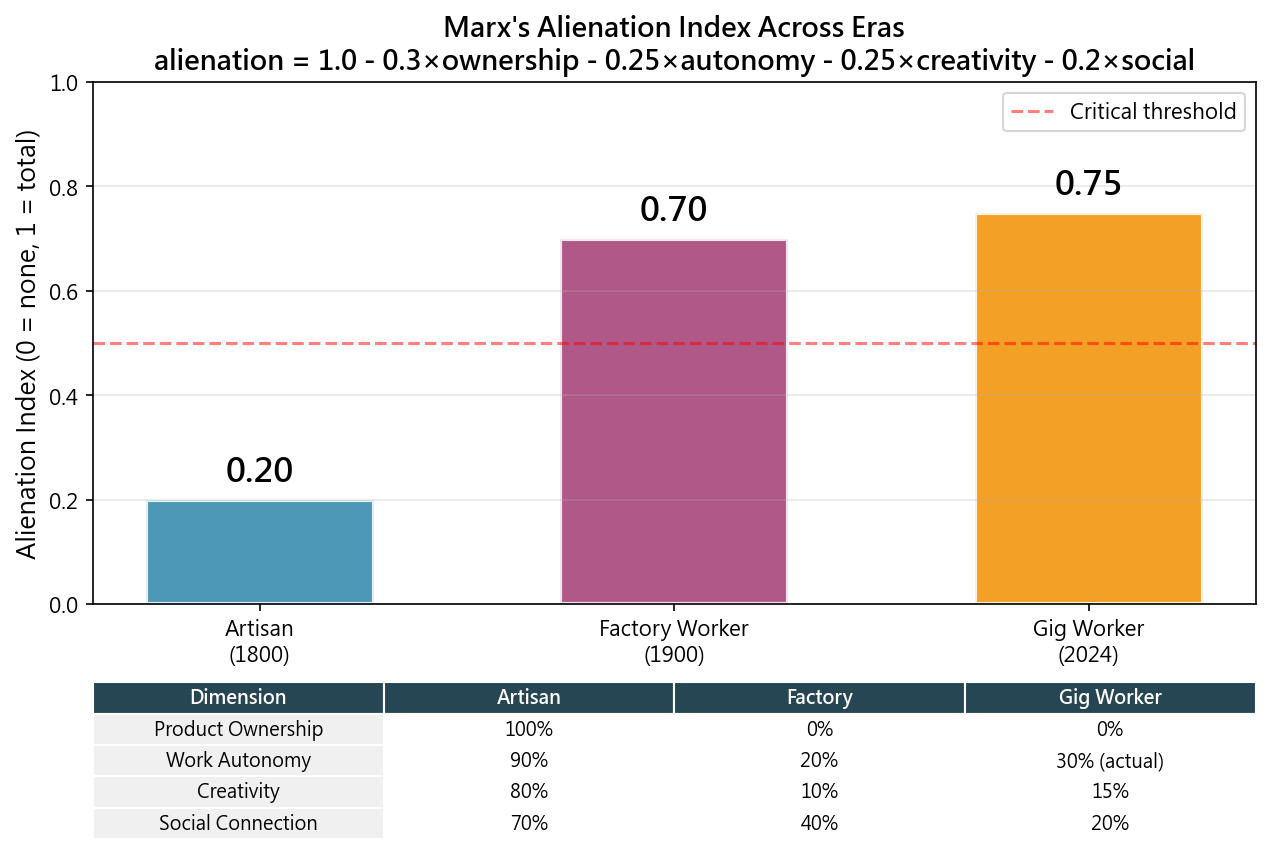
Let us construct an Alienation Index. The core approach: decompose alienation into four dimensions — ownership, autonomy, creativity, and social connection — score each from 0 to 1 (where 0 = total alienation, 1 = no alienation), then compute a weighted average to produce an overall alienation index.
class AlienationModel:
    """
    Mathematical model of Marx's alienation theory
    Alienation = f(ownership, autonomy, creativity, social_connection)
    Each dimension: 0-1 (0 = total alienation, 1 = no alienation)
    """
    def __init__(self):
        self.weights = {
            'ownership': 0.30,          # Product ownership
            'autonomy': 0.25,           # Labor autonomy
            'creativity': 0.25,         # Creative engagement
            'social_connection': 0.20   # Social bonds
        }

    def calculate_alienation(self, ownership, autonomy,
                             creativity, social_connection):
        weighted_sum = (
            self.weights['ownership'] * ownership +
            self.weights['autonomy'] * autonomy +
            self.weights['creativity'] * creativity +
            self.weights['social_connection'] * social_connection
        )
        return 1 - weighted_sum   # Alienation index: 1 - positive indicators
Full code available on GitHub (free version with base analysis): View complete code ->
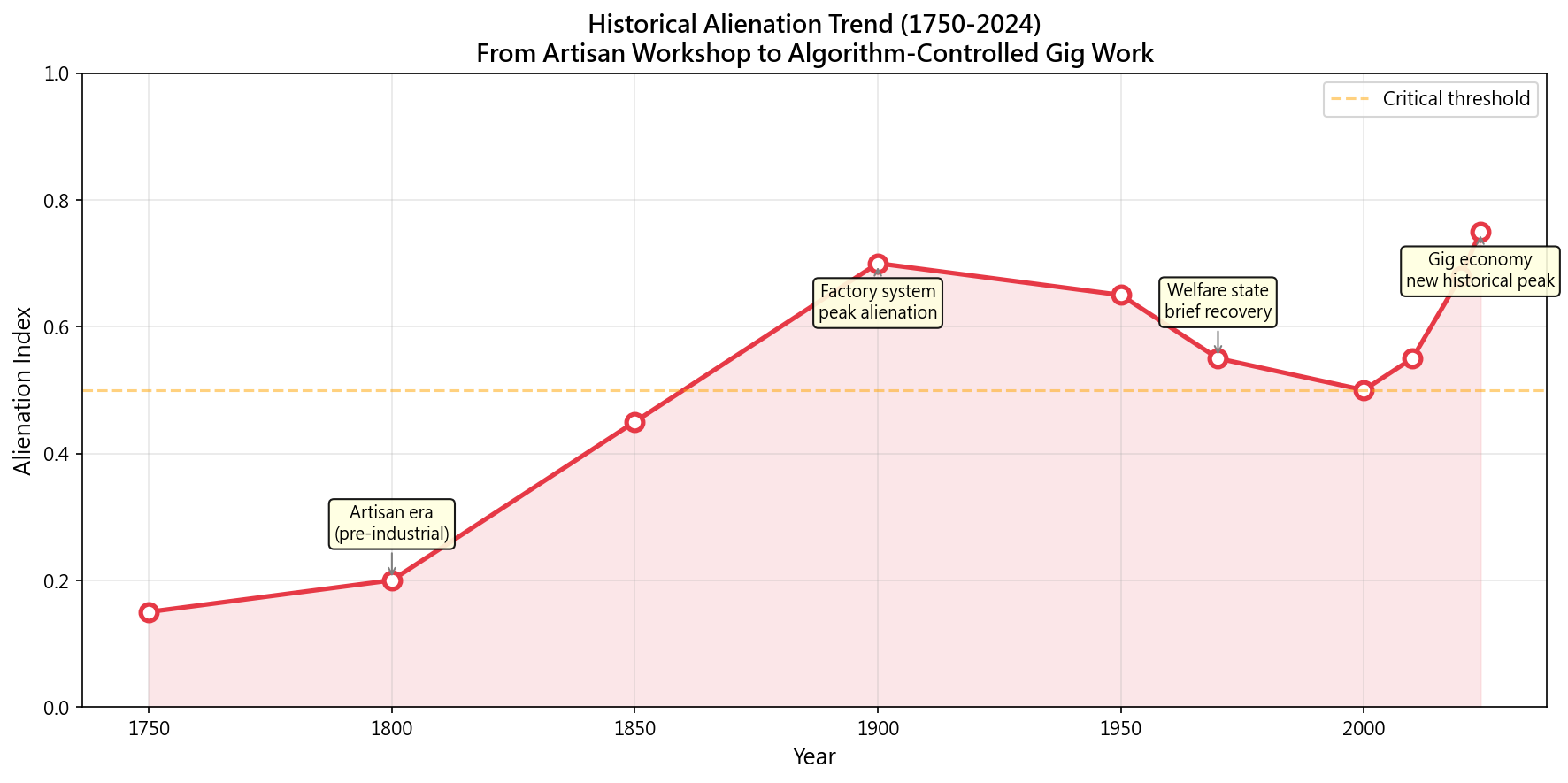
Feeding six different worker types from different historical periods into the model produces:
What Does This Analysis Reveal?
A striking finding:
| Worker Type | Alienation Index | Era |
|---|---|---|
| Factory worker | 0.75 | 1900 |
| Gig worker | 0.69 | 2024 |
| Office worker | 0.58 | 1960 |
| Content creator | 0.53 | 2024 |
| Knowledge worker | 0.45 | 2000 |
| Artisan | 0.19 | 1800 |
The gig worker’s alienation level approaches that of an industrial-era factory worker.
Why?
Ownership scores only 0.05 — the worker owns neither the platform nor the customer relationship. Autonomy appears moderate at 0.40 — on the surface, they choose their hours — but in practice, the algorithm shapes every decision. Creativity is 0.15 — standardized service, no room for craft. Social connection is 0.25 — isolated work, no colleagues, no shop floor solidarity.
Guy Standing identified precisely this pattern in The Precariat: a class of workers who have gained nominal independence while losing every substantive form of security and agency. The gig economy does not look like a Victorian factory. It feels like freedom. The alienation index suggests the resemblance to factory labor runs deeper than the aesthetics imply.
Analyzing Worker Sentiment with NLP
Mathematical models are illuminating, but can we validate them against real language?
Let us analyze the actual words of workers, and see what their emotions reveal.
Step 1: Sentiment Analysis of 19th-Century Worker Texts
We compared nineteenth-century worker testimonies — parliamentary factory investigation reports, Dickens’s Hard Times, Engels’s The Condition of the Working Class in England — with modern gig worker posts on Reddit, driver forums, and social media. Using negative sentiment keywords and alienation-related vocabulary as features, we calculated lexical density per text.
negative_keywords = [
    'exhausted', 'suffering', 'torment', 'hell', 'anxious', 'afraid',
    'noise', 'dust', 'danger', 'fired', 'replaced', 'tool', 'cog',
    'isolated', 'oppressed', 'exploited', 'black box', 'unfair'
]
alienation_keywords = [
    'not human', 'no name', 'just a number', 'cog in the machine',
    'tool', 'data point', 'alienated', 'repetitive', 'mechanical',
    'algorithm', 'dont know', 'dont understand', 'black box',
    'unfair', 'no control', 'cant appeal'
]

def analyze_sentiment(texts, text_type):
    negative_count = sum(
        1 for t in texts for kw in negative_keywords if kw in t
    )
    alienation_count = sum(
        1 for t in texts for kw in alienation_keywords if kw in t
    )
    return {
        'negative_density': negative_count / len(texts),
        'alienation_density': alienation_count / len(texts),
    }
Analysis results:
Modern gig worker negative sentiment density: 2.5 occurrences per post
Nineteenth-century worker negative sentiment density: 2.8 occurrences per post
The difference is marginal.
Even more striking is the evolution of alienation vocabulary:
| 19th Century | 21st Century |
|---|---|
| “machine” | “algorithm” |
| “just a number” | “just a data point” |
| “cog in the wheel” | “a tool for the app” |
| “the foreman” | “the platform” |
| “don’t know what I’m making” | “don’t know why my rating dropped” |
The vocabulary has changed. The experience has not.
Quantifying Autonomy: The Control vs Autonomy Index
At the heart of alienation is the loss of control.
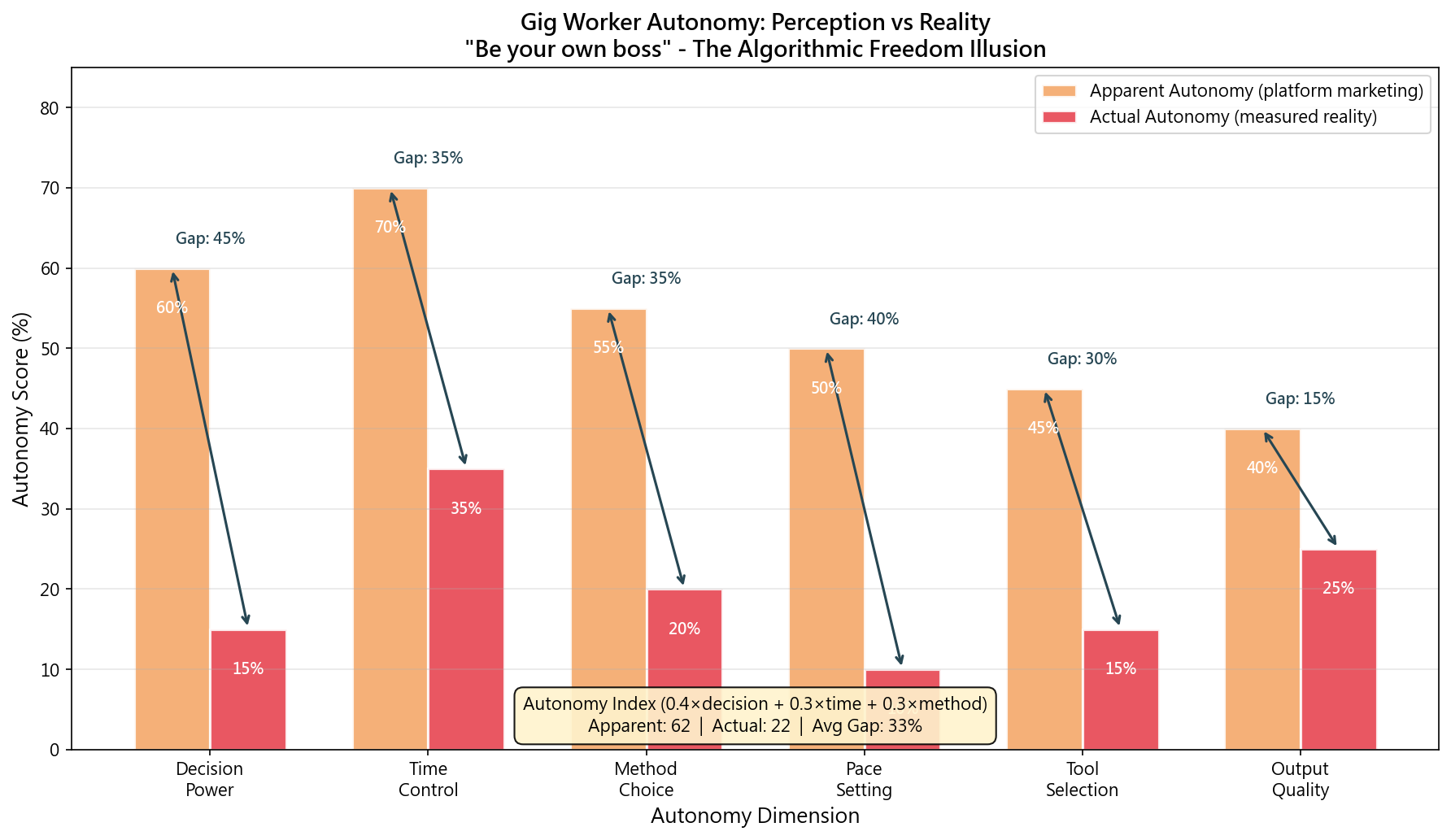
Let us build a Labor Autonomy Index, measuring four dimensions: decision authority (can you decide what work to do?), time control (can you decide when to work?), method choice (can you decide how to work?), and information transparency (do you understand the rules governing your work?). Each dimension is scored 0 to 1, with a weighted composite score.
Results:
The Key Insight
The gig worker’s paradox:
| Dimension | Score | Explanation |
|---|---|---|
| Time control | 0.70 | High — you choose your own hours |
| Decision authority | 0.20 | Low — you can only accept or reject orders |
| Method choice | 0.15 | Low — standardized service process |
| Information transparency | 0.10 | Extremely low — algorithmic black box |
Overall autonomy: 0.30
On the surface, gig workers are more autonomous than factory workers (0.30 vs 0.11).
But this is the illusion of autonomy:
You think you are “choosing when to work.”
In reality, the algorithm is “manipulating when you work” (surge pricing, gamification nudges).
You think you are “your own boss.”
In reality, you “cannot even see the rules” (rating logic, dispatch priorities).
This is what Uber drivers in London argued before the UK Supreme Court in the landmark Uber BV v Aslam (2021) case. The court agreed: despite being classified as independent contractors, drivers were in practice subject to pervasive control. The illusion of autonomy was precisely that — an illusion.
How Algorithms Deepen Alienation
Modern technology has created three new forms of alienation that Marx could not have anticipated:
New Alienation 1: Creators Estranged from Their Audience
You pour effort into creating content. But you do not know how the recommendation algorithm decides what to promote. You do not know why one post goes viral while another identical post is buried. You do not know how to “optimize” — you can only guess.
You are estranged from your own success.
Success no longer derives from talent. It derives from “algorithmic favor.”
New Alienation 2: Workers Estranged from Their Reputation
A DoorDash driver does not know who gave a low rating, why they gave it, or how to appeal.
You are estranged from your own reputation.
Your rating no longer reflects your work quality. It reflects the arbitrary judgment of customers, filtered through the opacity of the algorithm.
New Alienation 3: Consumers Estranged from Their Choices
The content, products, and services you see are all algorithmically recommended.
But you do not know why this particular item was recommended. You do not know what was not recommended. You do not know the algorithm’s objective function — your interest, or the platform’s revenue?
You are estranged from your own choices.
You believe you are freely choosing. In reality, you are being guided toward consumption.
Shoshana Zuboff’s The Age of Surveillance Capitalism traces this phenomenon to its logical conclusion: not merely the exploitation of labor, but the exploitation of human experience itself — behavior prediction as the raw material of a new extractive industry.
Simulating the Impact of Information Asymmetry with Python
What is the root cause of alienation?
Information asymmetry.
Factory workers at least knew the foreman was watching and what the standard was. Gig workers do not even know the rules.
We used Monte Carlo simulation to model three systems: a transparent system (workers know the scoring rules and can optimize accordingly), an opaque system (workers do not know the rules and must allocate effort randomly), and an algorithm-shift scenario (rules change from “punctuality 50%, quality 30%, attitude 20%” to “quality 60%, punctuality 30%, attitude 10%” without any notification). Each scenario simulates 200 workers.
What the Simulation Reveals
When the system is opaque, workers cannot optimize their behavior. Performance drops by approximately 10%. More critically, perception and reality diverge — workers believe they are performing well when they are not. Anxiety is pervasive, because outcomes are unpredictable.
The algorithm-shift scenario is even more brutal: over 70% of workers see their scores decline, and none of them understand why.
This is the mechanism by which algorithms deepen alienation.
Strategies Against Alienation
Marx’s prescription was unambiguous: abolish private property, establish communism.
Two centuries later, we know this is not the only answer. And the historical record of its implementation has been, at best, deeply ambiguous.
Modern counter-alienation strategies:
Strategy 1: Algorithmic Transparency
Require platforms to disclose scoring rules, dispatch logic, and algorithm update schedules. The EU’s Digital Services Act (2024) has taken a first step, requiring platforms to explain algorithmic decisions and granting users the right to understand why they see specific content.
In the US, the Algorithmic Accountability Act (reintroduced in Congress multiple times) represents a similar impulse, though it has yet to pass.
Strategy 2: Collective Bargaining
Gig workers are beginning to organize. In 2019, California’s AB5 reclassified many gig workers as employees. In 2021, the UK Supreme Court ruled in Uber BV v Aslam that Uber drivers are workers entitled to minimum wage and holiday pay. In 2023, New York City implemented minimum pay standards for food delivery workers.
History is repeating — the union’s adversary has merely changed from the factory owner to the algorithm.
Strategy 3: Platform Cooperativism
Platform cooperativism — a concept developed by Trebor Scholz — means workers collectively own the platform. Stocksy is a photographer cooperative. Fairbnb is a cooperative alternative to Airbnb. The core principles: profit sharing and democratic governance.
The idea has deep roots in the cooperative movement that emerged in response to nineteenth-century industrial capitalism — the Rochdale Pioneers, the cooperative banks, the mutual aid societies. The digital version faces the same challenge its predecessors did: competing with well-capitalized incumbents who benefit from network effects.
Strategy 4: Open-Source Algorithms
Make algorithms auditable: open-source recommendation systems on GitHub, explainable AI (XAI), algorithmic impact assessments.
Strategy 5: Redefining the Meaning of Work
Do not equate work with identity. Work is a means of livelihood, not the totality of life. Seek creativity outside of work. Build community connections independent of employment.
We simulated the effect of each strategy on the alienation index:
Strategy effectiveness ranking:
- Platform cooperativism: Alienation index drops from 0.69 to 0.33 (52% improvement) — but high difficulty, requires organization and capital
- Collective bargaining: Alienation index drops from 0.69 to 0.47 (32% improvement) — moderate difficulty, already underway
- Redefining work: Alienation index drops from 0.69 to 0.53 (23% improvement) — low difficulty, individually actionable
- Algorithmic transparency: Alienation index drops from 0.69 to 0.60 (13% improvement) — moderate difficulty, requires legislation
Conclusion: Will Alienation Ever Disappear?
Marx wrote about alienated labor in 1844. One hundred and eighty years later, alienation has not disappeared. It has changed form.
Industrial-era alienation:
– Workers estranged from their products
– Workers estranged from the labor process
– Visible oppression (foremen, stopwatches)
Digital-era alienation:
– Workers estranged from their ratings
– Workers estranged from the algorithm
– Invisible oppression (algorithms, black boxes)
But there is a difference:
In the industrial era, workers were compelled into factories (enclosure of common lands, subsistence pressure, the destruction of cottage industry).
In the digital era, gig workers choose to join platforms (flexibility, independence, the appeal of being your own boss).
This makes resistance harder.
It is difficult to rebel against something you chose.
The final questions:
Is alienation the inevitable consequence of capitalism? Or can there be “capitalism without alienation”? Does technological progress reduce alienation, or deepen it?
Marx had no answer, because he never encountered an algorithm.
But he gave us a tool: using rigorous analysis to understand estrangement.
The next time you see a delivery rider hesitating at a red light — to run it or not, because a low rating awaits —
The next time you find yourself altering your creative work to appease an algorithm you cannot see —
The next time you feel that your work has lost its meaning —
Remember what a twenty-six-year-old exile wrote in a Paris apartment, 180 years ago:
“The worker becomes poorer the more wealth he produces.”
In 2024, this remains true.
Afterword: Back to That Twenty-Six-Year-Old Manuscript
After finishing this article, I kept thinking about Paris in 1844.
A twenty-six-year-old German exile, writing in a dim room about the concept of “alienation.” He could not have imagined that 180 years later, someone would use Python to quantify his theory. Still less could he have imagined that the suffering he described — workers estranged from their labor — would reappear with nearly identical intensity in an algorithm-driven world.
What struck me most during this analysis was not the numbers themselves, but the linguistic parallels. Nineteenth-century workers called themselves “cogs in the machine.” Twenty-first-century delivery drivers call themselves “data points.” Nineteenth-century workers did not understand what they were manufacturing. Twenty-first-century drivers do not understand why their ratings dropped. The vocabulary has changed. The helplessness — that feeling of “I cannot comprehend the forces controlling me” — is precisely the same.
If you are feeling that your work has lost its meaning, I want to say this: it is not your fault. Alienation is structural. It is a product of system design, not personal failure. Understanding this is itself a form of liberation — at least you know what you are facing.
If you work on a platform, record your data. Try to understand the rules, insofar as you can. Join a workers’ organization, because collective bargaining won the eight-hour day for factory workers in the nineteenth century, and it can win algorithmic transparency and fair treatment for gig workers in the twenty-first. Do not be deceived by the illusion of freedom — when you cannot even see the rules of the game, that is not freedom.
If you design algorithms, remember that your code affects real human beings. Every line of scoring logic has a delivery rider on the other side, hesitating at a red light, calculating whether a low rating is worth the risk of running it. Pushing for transparency is not merely an ethical imperative — our simulation demonstrates that transparent systems outperform opaque ones by 10%. Transparency is good business, too.
One hundred and eighty years ago, factory workers organized unions and fought for basic labor rights. Today, digital-era workers are walking the same path — only the battlefield has moved from the factory floor to the phone screen. Marx’s theory of alienation is not obsolete. It has simply been ported to a new runtime environment.
Deep Dive: Complete Analysis Pack
This article shared the mathematical modeling of alienation theory, cross-era sentiment analysis, and Monte Carlo simulation of information asymmetry. The complete analysis pack goes further:
- Advanced alienation index model: Incorporates time-varying weights, tracking the qualitative transformation of alienation from 1800 to 2024 — the importance of ownership is declining; the importance of information transparency is rising
- Deep NLP sentiment analysis: Emotional trajectory tracking across six worker types, including cross-referencing 1820s-1890s worker diaries with modern social media posts
- Algorithmic alienation quantification framework: Separate models for creator alienation and consumer alienation, revealing how recommendation systems make “choice” itself an illusion
- Counter-alienation strategy Monte Carlo simulation: Adjustable parameters to observe the effects and interactions of different policy combinations
- ~400 lines of teaching-grade Python code, 14 advanced visualizations (300dpi PNG)
Get the Article 03 Deep Dive Pack ->
Next in the Series
- The Great Exhibition at the Crystal Palace, London. Queen Victoria marveled: “We have truly changed the world.” But the data tells a different story — the Industrial Revolution was not a “revolution” at all. It was an evolution, slow and uneven.
In the next article, we use Python to reconstruct the GDP trajectory from 1760 to 1850, model the explosion of urbanization, trace the structural transformation of industry, and map the patent innovation network — using data science to travel through time and witness what was really a “slow-motion detonation.”
References
- Marx, Karl. Economic and Philosophic Manuscripts of 1844. (Various editions; first published 1932).
- Standing, Guy. The Precariat: The New Dangerous Class. Bloomsbury Academic, 2011.
- Jaeggi, Rahel. Alienation. Columbia University Press, 2014.
- Rosenblat, Alex. Uberland: How Algorithms Are Rewriting the Rules of Work. University of California Press, 2018.
- Zuboff, Shoshana. The Age of Surveillance Capitalism. PublicAffairs, 2019.
- Thompson, E. P. The Making of the English Working Class. Victor Gollancz, 1963.
- Kalleberg, Arne L. Good Jobs, Bad Jobs: The Rise of Polarized and Precarious Employment. Russell Sage Foundation, 2011.
- Scholz, Trebor. Platform Cooperativism: Challenging the Corporate Sharing Economy. Rosa Luxemburg Stiftung, 2016.