
Steam Engine vs Cloud Computing: Two Cycles of the Energy Revolution
Series: Industrial Revolution & Data Revolution #01/05 | Read time: 35 min | Python (NumPy, Pandas, Matplotlib, SciPy, NetworkX)
Author: Wina @ Code & Cogito
When Watt Changed the World
- Birmingham, England.
James Watt stood in the Soho Manufactory, listening to the rhythmic pulse of his improved steam engine.
He was not the first to build one. Thomas Newcomen had managed that back in 1712. But Newcomen’s engine was a profligate beast — thermal efficiency of roughly one percent. For every hundred pounds of coal shoveled into its furnace, ninety-nine pounds’ worth of energy vanished into the atmosphere. The machine was so expensive to operate that only coal mine owners could afford it, and only because they did not have to pay for their own fuel.
Watt did something deceptively simple. He separated the condenser from the cylinder, so the engine no longer had to heat and cool the same chamber in an endless, wasteful cycle.
Efficiency rose from one percent to four percent.
That sounds like a marginal improvement. It was not.
It meant a seventy-five percent reduction in fuel costs. The line between “unprofitable curiosity” and “essential industrial tool” is not a gradient — it is a cliff edge. Watt’s engine fell off the right side of it.
Overnight, the steam engine went from a rare industrial toy to a necessity.
But Watt’s genius was not merely technical. He made a business decision that reshaped an entire industry.
He did not sell steam engines. He leased them.
His pricing model: one-third of the fuel savings the customer achieved by switching from a Newcomen engine to a Watt engine. No upfront capital expenditure. No risk if the machine underperformed. You paid only for results.
As the economic historian Joel Mokyr has observed, this was an alignment of incentives that would have made a modern venture capitalist weep with admiration.
Now fast forward 230 years.
- Seattle, Washington.
Amazon Web Services launched its first cloud computing service: EC2.
Andy Jassy stood on stage and delivered a pitch that would have been instantly recognizable to James Watt: “You don’t need to buy servers. You only need to pay for the computing power you use.”
Watt: You do not need to buy a steam engine. You only need to pay for the coal you save.
AWS: You do not need to buy a server. You only need to pay for the compute you use.
Two business models separated by 230 years. Why are they almost identical?
Because they both did the same thing: lowered the barrier to entry and created elastic scale.
In this article, I use Python to analyze the structural parallels between these two energy revolutions, visualize the patterns of technology diffusion, calculate the evolution of cost curves, and confront a question that Robert Allen, Joel Mokyr, and Nicholas Crafts have all circled in their studies of British industrialization: When infrastructure is monopolized by the few, does the free market still exist?
The First Question: Why Does Technical Breakthrough Not Equal Technical Revolution?
Between the invention and widespread adoption of the steam engine, eighty years elapsed.
1698: Thomas Savery patents the first steam pump
1712: Thomas Newcomen builds a working atmospheric engine
1776: James Watt’s separate condenser engine enters production
1785: First factory powered entirely by steam
1850: Steam engines are standard across British industry
Why did it take so long?
The answer is not engineering. It is economics.
Three Fatal Problems with Early Steam Engines
Problem 1: Abysmal Efficiency
Newcomen’s engine converted roughly one percent of thermal energy into mechanical work. For every hundred kilograms of coal burned, ninety-nine kilograms’ worth of energy was wasted.
Result: Operating costs were prohibitive. Only colliery owners, sitting on top of their own fuel supply, could justify the expense.
Problem 2: Chronic Unreliability
Parts failed constantly. Specialized mechanics were scarce. Downtime was long. Repair bills were enormous.
Result: Factory owners preferred the traditional waterwheel. It was slower, but at least it was predictable.
Problem 3: Geographic Constraint
Despite providing mechanical power, early steam engines required enormous quantities of water for cooling. Factories still had to be built near rivers.
Result: The promise of geographic liberation remained unfulfilled.
Watt’s Three Breakthroughs
Breakthrough 1: The Separate Condenser
By isolating the cooling process, Watt prevented the cylinder from being repeatedly heated and cooled — the thermodynamic equivalent of slamming the brakes and accelerator simultaneously.
Effect: Efficiency quadrupled. Fuel costs fell by seventy-five percent.
Breakthrough 2: Standardized Components
In partnership with Matthew Boulton — one of the great entrepreneurial figures of the eighteenth century — Watt established a factory producing interchangeable parts. This was the beginning of what economic historians call the “American system of manufactures,” though it started in Birmingham.
Effect: Lower maintenance costs. Higher reliability. A machine that factory owners could trust.
Breakthrough 3: The Business Model
No equipment sales. Lease only. Rent equals one-third of the customer’s coal savings.
Effect:
– Customers faced zero upfront capital expenditure
– Customers paid only when the engine actually delivered savings
– Watt had every incentive to keep improving efficiency — the more his customers saved, the more he earned
The brilliance of this model was its alignment of supplier and customer incentives.
As Robert Allen argues in The British Industrial Revolution in Global Perspective, it was not invention alone that drove industrialization — it was the economic conditions that made adoption rational. Watt’s pricing model turned a technical possibility into an economic inevitability.
Modeling Technology Diffusion with Python: The Bass Model
Let us use mathematics to understand how a technology crosses the chasm from “invention” to “revolution.”
The Bass Diffusion Model predicts the adoption curve of new technologies. It assumes two types of adopters:
– Innovators: influenced by external factors (advertising, demonstration)
– Imitators: influenced by internal factors (seeing their neighbor adopt)
The core logic:
def bass_model(t, p, q, m):
    """
    Bass Diffusion Model
    p: innovation coefficient (external influence)
    q: imitation coefficient (internal influence)
    m: market potential (ultimate adopters)
    When q > p, word-of-mouth dominates adoption
    """
    return m * (1 - np.exp(-(p+q)*t)) / (1 + (q/p) * np.exp(-(p+q)*t))

# Historical data: estimated number of steam engines in Britain
steam_years = [1760, 1770, 1780, 1790, 1800, 1810, 1820, 1830, 1840, 1850]
steam_count = [100, 280, 520, 1100, 2200, 4500, 8500, 15000, 25000, 38000]

# Fit model using scipy.optimize.curve_fit
# -> yields innovation coefficient p, imitation coefficient q, market potential m
Full code available on GitHub (free version with base analysis): View complete code ->
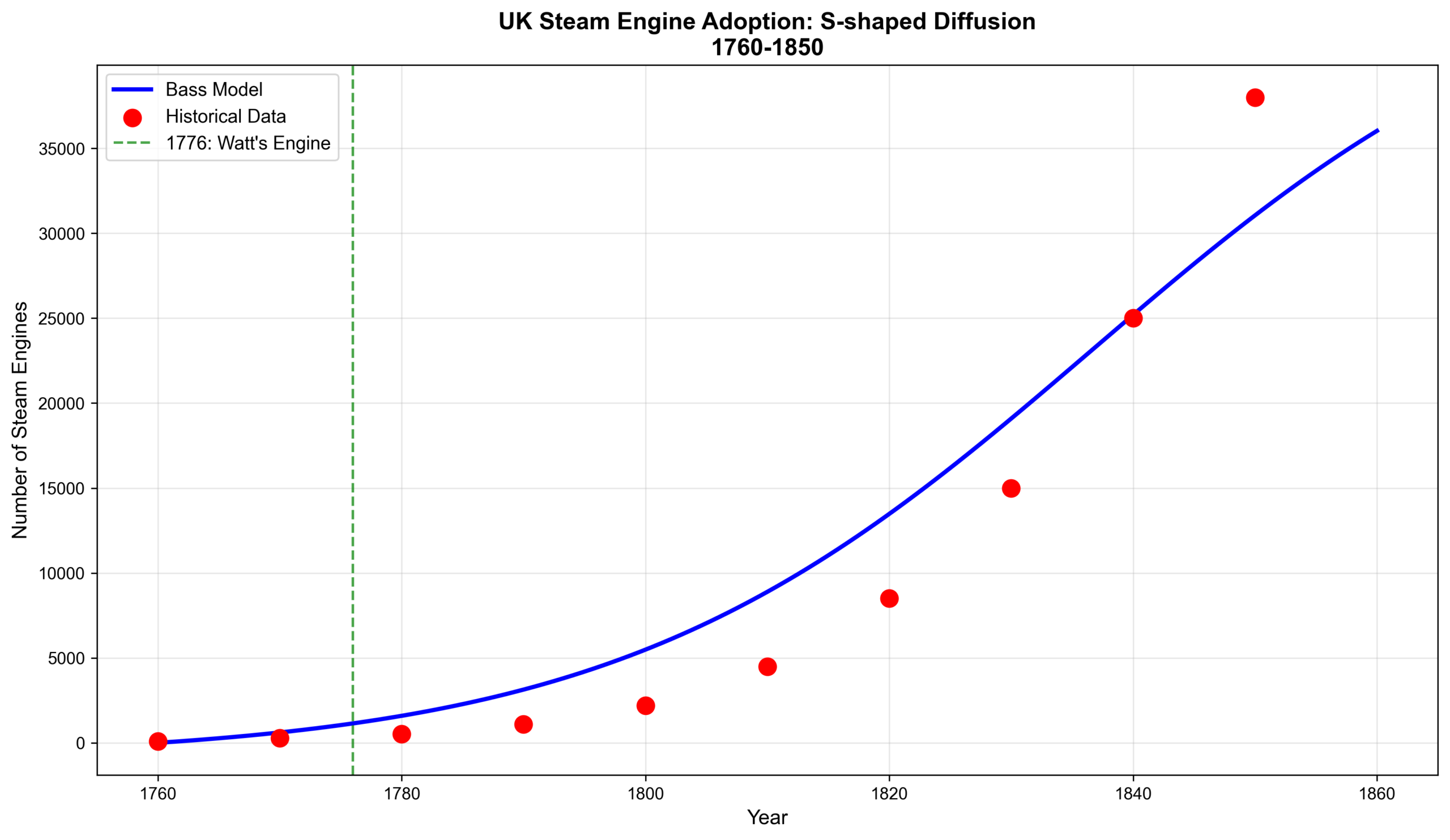
Feeding historical data into the model produces the following S-curve:
What Does This Analysis Reveal?
Finding 1: The q/p ratio is approximately 25 — the imitation effect dwarfs the innovation effect. Steam engine adoption was driven overwhelmingly by “my neighbor installed one, and his output doubled — I need one too.” This is an early form of what we now call network effects.
Finding 2: The delay effect — Watt improved the steam engine in 1776, but peak adoption growth occurred around 1800, a lag of twenty-four years. Why? Because adoption required a supporting ecosystem: coal supply chains, trained mechanics, standardized components. As Nick Crafts has documented, the aggregate productivity impact of steam was modest until the mid-nineteenth century precisely because of these complementary investments.
Finding 3: The S-curve — slow start, explosive growth, gradual plateau. This is the canonical diffusion pattern for all transformative technologies. AWS followed the same trajectory.
230 Years Later: AWS Did the Same Thing
When AWS launched EC2 in 2006, the reaction from corporate IT departments was predictable.
“Put our data on someone else’s computers? Far too risky.”
“Network latency makes it impractical.”
“We have our own data centers. Why would we pay Amazon?”
These objections were structurally identical to the skepticism that greeted Watt’s engine in the 1770s.
But AWS got three things right:
Right Move 1: Lowering the Barrier to Entry
Steam engine era:
– Purchasing a Boulton & Watt engine: approximately 350 pounds (two years’ wages for a skilled worker)
– Installation and maintenance: substantially more
– Small workshops could not afford it
Watt’s solution: Lease model. Pay for results.
Cloud era:
– Building a data center: millions of dollars
– IT staff: hundreds of thousands annually
– Startups could not afford it
AWS’s solution: Pay-as-you-go. Zero upfront investment.
The parallel is not a metaphor. It is a structural repetition. Both innovations democratized access to infrastructure that had previously been the preserve of the wealthy.
Right Move 2: Creating Elastic Scale
The steam revolution:
– Before: factories had to be built beside rivers (waterwheel power)
– After: factories could be built anywhere coal could be transported
– Geographic liberation
The cloud revolution:
– Before: companies had to predict peak capacity and purchase servers accordingly
– After: scale up automatically when demand surges, scale down when it subsides
– Capacity liberation
Right Move 3: Building an Ecosystem
Watt’s ecosystem:
– Standardized, interchangeable parts
– Trained mechanics deployed across the country
– Coal transportation networks
AWS’s ecosystem:
– Standardized APIs (composable services)
– Certification programs (AWS Certified)
– Third-party marketplace (AWS Marketplace)
In both cases, the ecosystem was as important as the core technology. A steam engine without coal supply chains was an expensive paperweight. EC2 without S3, Lambda, and the rest of the AWS stack was an underpowered virtual machine.
Comparing Cost Curves Across Two Eras with Python
Why does technology become ubiquitous? Because costs fall.
We fit exponential decay models (a * exp(-b*t) + c) to cost data from both eras, tracking the price trajectory:
# Core data
steam_cost = [12, 11, 10, 8, 6.5, 5, 4.5, 4, 3.5, 3]    # pence/hour, 1760-1850
ec2_price  = [0.10, 0.085, 0.068, 0.052, 0.040, 0.032,    # USD/hour, 2006-2024
              0.026, 0.021, 0.017, 0.0135]

# Fit exponential decay model, calculate cost halving period
# half_life = ln(2) / decay_rate
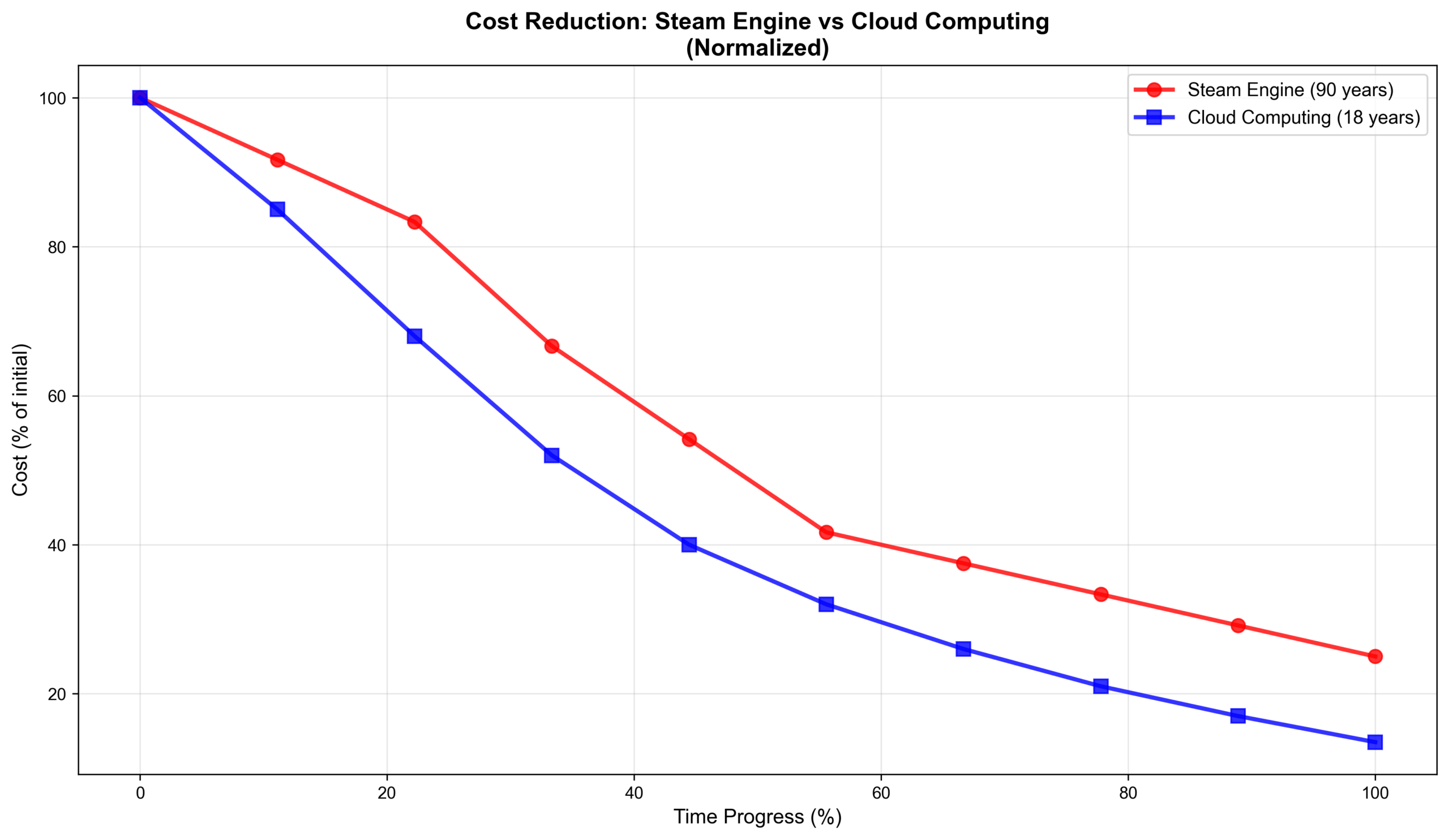
The fitted curves:
A Striking Discovery
Moore’s Law vs Watt’s Law — Steam engine costs halved approximately every 13 years. Cloud computing costs halve approximately every 2.3 years. Cloud pricing falls 5.6 times faster than steam engine pricing did. But the decay patterns are identical: both follow exponential decay curves, both have cost floors (prices cannot fall to zero), and both show deceleration after widespread adoption.
Steam engines were constrained by physics — material strength, thermodynamic limits. Cloud computing is constrained by technology — Moore’s Law, software optimization. Digital technology improves far faster than physical technology. But the underlying mathematical structure is invariant.
The Dark Side: Infrastructure Monopoly
Watt’s steam engine created coal barons.
AWS’s cloud computing created tech oligarchs.
Why?
Nineteenth-Century Coal Monopoly
The steam engine transformed coal from a domestic heating fuel into industrial lifeblood.
Consequences:
– Coal mine owners became the wealthiest class in Britain
– Controlling coal supply meant controlling the industrial economy
– Wealth inequality surged
London’s Gini coefficient (measure of income inequality):
– 1820: 0.45
– 1870: 0.59
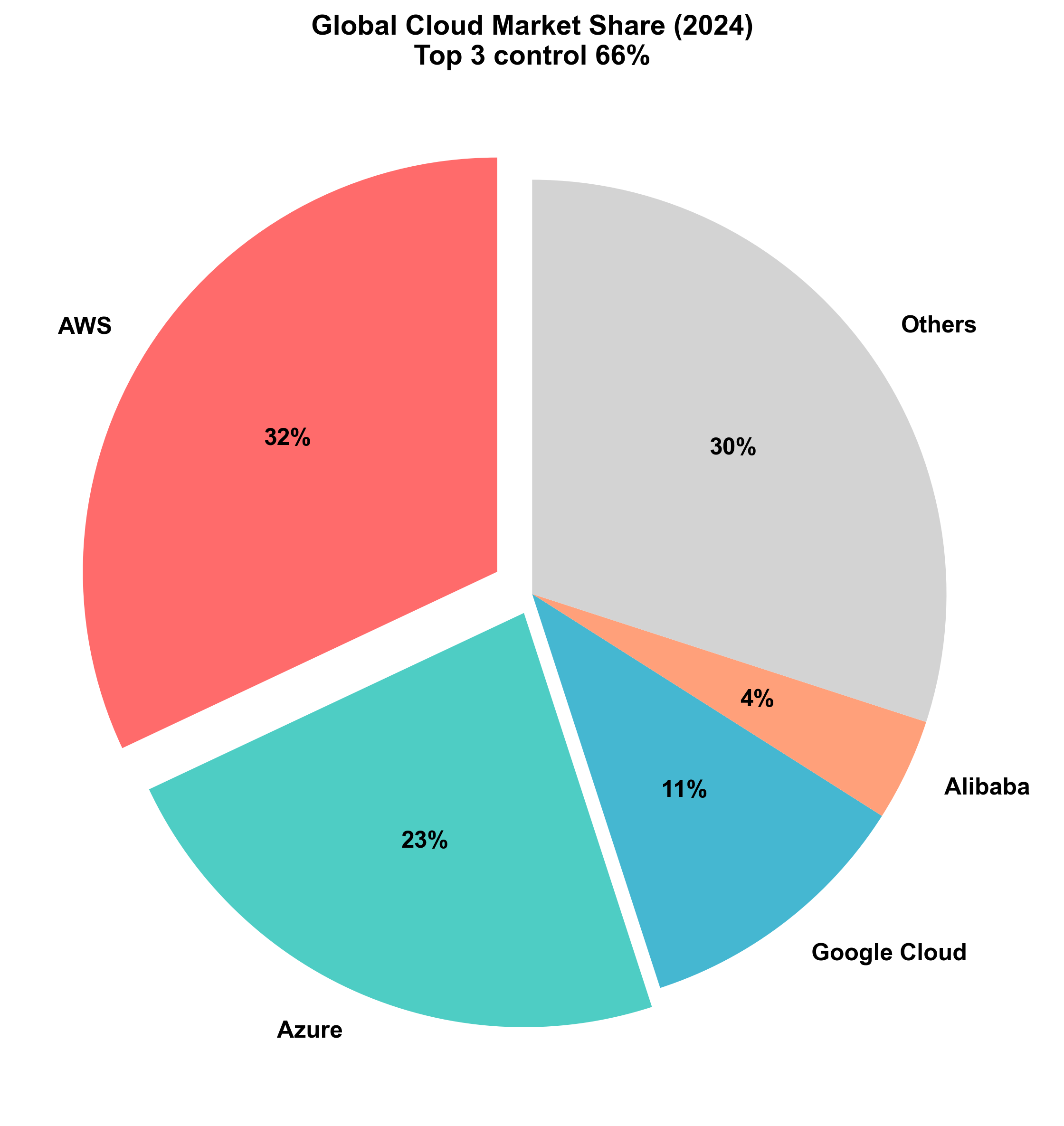
Using the HHI (Herfindahl-Hirschman Index) to measure market concentration — below 1,500 indicates a competitive market, 1,500-2,500 indicates moderate concentration, above 2,500 indicates high concentration.
The results are sobering:
| Market | HHI | Assessment |
|---|---|---|
| 1850 British Coal | 3,250 | Highly concentrated |
| 2024 Global Cloud | 1,834 | Moderately concentrated |
Both eras produced oligopolistic concentration. Infrastructure requires enormous capital investment, creating high barriers to entry. First-mover advantage compounds through network effects, tending toward natural monopoly.
The historical lesson:
In the 1850s, coal baron monopolies led to:
– Soaring coal prices
– Factory owners forced to accept exploitative terms
– Escalating social conflict
– Ultimately, government regulation (the 1842 Mines Act, the Factory Acts)
In 2024, will cloud oligarchs follow the same trajectory?
A New Geography: From Rivers to Computing Power
The Geographic Revolution of the Steam Age
Before the steam engine:
– Factories had to be built beside rivers (waterwheel power)
– Industrial geography was dictated by hydrology
– Where you were born determined what work you could do
After the steam engine:
– Factories could be built wherever coal was available
– Coal could be transported; rivers could not
– Industry migrated toward labor pools and markets
Result: The birth of the industrial city.
- Manchester: a small market town in 1750, the world’s first industrial metropolis by 1850
- Birmingham: population surged from 70,000 to 230,000
- Leeds: center of the textile revolution
E.A. Wrigley’s Energy and the English Industrial Revolution documents this transformation with extraordinary precision — the shift from an “organic economy” constrained by photosynthesis to a “mineral economy” powered by ancient sunlight stored in coal.
The New Geography of Cloud
Before the cloud:
– Companies needed physical data centers
– IT capability was geographically constrained
– Starting a tech company required massive capital for hardware
After the cloud:
– Companies can operate from anywhere with an internet connection
– Computing power is “transportable” via network
– The startup barrier collapsed
But this created new inequalities.
We calculate the Gini coefficient for AWS service distribution across eight major global regions: 0.31 — moderate inequality. The US East region (us-east-1) offers 200 services; Africa (af-south-1) offers only 100. A gap of exactly two to one.
Digital colonialism?
Just as nineteenth-century coal distribution created industrial centers and peripheries, twenty-first-century computing power distribution is creating a new digital divide:
- Latency inequality: Africa-to-Asia latency is three times higher than US domestic latency
- Service inequality: Emerging markets cannot access the latest technologies
- Cost inequality: Identical services carry different price tags in different regions
On the surface, anyone can “go to the cloud.”
In practice, your geographic location determines the quality of computing you can access.
Who Pays the Price of Progress?
The Nineteenth-Century Price: Human Suffering
The Industrial Revolution created unprecedented wealth. But who bore the cost?
Factory workers’ reality:
– Working hours: 14-16 hours per day, six days a week
– Working conditions: deafening noise, choking dust, lethal machinery
– Wages: barely enough for subsistence
– Child labor: children as young as eight working in factories and mines
The parliamentary investigations of the 1830s and 1840s — the Sadler Committee, the Ashley Commission — produced testimony that remains difficult to read two centuries later. Children describing their working conditions in cotton mills. Miners describing tunnels where they crawled on hands and knees for twelve-hour shifts.
The Luddite Movement (1811-1816):
Workers smashed machines, protesting the technology that was destroying their livelihoods and their craft traditions. The government responded with military force. Seventeen Luddites were executed. Machine-breaking was made a capital offense.
Why did the workers lose?
Because capital owners controlled the infrastructure:
– They owned the factories
– They owned the machines
– They owned the coal supply chains
Workers possessed only their labor — and labor was increasingly replaceable.
The Twenty-First-Century Price: Algorithmic Control
What is the modern cost?
On the surface, cloud computing has made entrepreneurship easier. But it has also created new forms of dependency:
Case 1: The AWS Outage (February 28, 2017)
AWS us-east-1 went down for four hours.
Result:
– Netflix could not stream video
– Slack could not deliver messages
– Thousands of companies experienced business interruption
– Estimated losses: $150 million
A single region’s failure paralyzed half the internet.
Case 2: Vendor Lock-in
Once your systems are built on AWS:
– Migrating to another cloud provider is prohibitively expensive (rewriting code, retraining staff)
– Price increase? You have no choice but to accept
– Service discontinued? You are forced to adapt
How is this different from a nineteenth-century factory owner’s control over workers?
Case 3: The Algorithmic Black Box
AWS’s pricing algorithms are proprietary:
– Why does this service cost this much? Unknown
– Why did my bill spike unexpectedly? Unclear
– How can I optimize costs? You can only guess
This is a new form of opacity.
Will History Repeat Itself?
Let us review the historical sequence:
1850s: Coal barons monopolize energy supply
1880s: Labor movements rise
1900s: Governments intervene, begin regulating energy industries
1940s: Many nations nationalize energy (UK, France, Italy)
2024: Tech oligarchs monopolize computing supply
2030s: ?
2040s: ?
Will there be a “digital labor movement”?
Will there be “cloud nationalization”?
Will there be demands for “computing power as a basic right”?
We constructed a four-quadrant model with “market concentration” and “regulatory intensity” as axes, simulating four possible futures:
| Scenario | Concentration | Regulation | Likely Outcome |
|---|---|---|---|
| Status quo | 66% | Weak | Oligarchs continue expanding |
| Antitrust action | 45% | Strong | Multiple mid-size competitors |
| Public utility movement | 30% | Very strong | Computing becomes a public service |
| Decentralization | 20% | Moderate | Edge computing erodes centralization |
Which future is most likely?
History suggests: infrastructure monopoly invariably provokes a political backlash.
The only question is: how long will it take?
Conclusion: Infrastructure Is Power
Watt’s steam engine and AWS’s cloud computing, separated by 230 years, follow identical logic:
1. Technical breakthrough creates new possibilities
– Steam engine: no longer tied to rivers
– Cloud: no longer tied to data centers
2. Business model innovation lowers the barrier to entry
– Watt: lease + pay-for-performance
– AWS: pay-as-you-go + zero upfront investment
3. Rapid cost decline drives adoption
– Steam engine: 75% price reduction over 90 years
– Cloud: 86.5% price reduction over 18 years
4. Oligopolistic concentration emerges
– Coal barons controlled energy supply
– Tech giants control computing supply
5. Social tensions escalate, driving institutional change
– 19th century: labor movements -> government regulation -> partial nationalization
– 21st century: ? -> ? -> ?
The critical insight:
Whoever owns the infrastructure controls the distribution of power.
In the nineteenth century, whoever controlled steam (energy) controlled industry.
In the twenty-first century, whoever controls the cloud (computing) controls the digital economy.
The technology changes. The logic of power does not.
These questions have no easy answers.
Will cloud computing become a public utility? Will computing power be recognized as a basic right? Will we repeat the mistakes of the nineteenth century, or will we find new solutions?
History does not provide answers, but it provides a framework.
When infrastructure is monopolized by the few, the “free market” is no longer free. This was true of the coal market in 1850. It is equally true of the cloud market in 2024.
Watt changed the world in 1776. AWS changed the world in 2006. Who will change it next?
Afterword: Back to the Sound of the Piston
After finishing this article, one image kept returning to me.
Birmingham, 1776. Watt listening to the steady rhythm of his improved engine. He could not have imagined that the logic of his machine — lowering barriers, charging for results, freeing users from owning underlying infrastructure — would be replicated almost perfectly 230 years later by an online bookstore in Seattle.
If you are a founder, the cloud has genuinely lowered the barrier to entry. But it has also quietly placed your lifeline in someone else’s hands. A multi-cloud strategy is not a technical choice — it is a survival strategy.
If you write code, the cloud lets you focus on business logic. But it also distances you from the infrastructure layer. Understanding how the underlying systems work is not about going back to the era of self-managed server rooms. It is about preserving the ability to choose when the moment demands it.
If you make policy, the regulatory history of the energy industry is the best available guide. The coal barons’ monopoly eventually provoked nationalization movements across Europe — and by the time governments intervened, the social cost was far higher than early regulation would have been.
Technological progress is good. But when only a few capture its fruits, history tells us that society will eventually find its own way to restore balance.
Watt’s steam engine brought the Industrial Revolution — and with it, the labor movement. AWS’s cloud computing brought the digital revolution. What will it bring next?
That is the question our generation must answer.
Deep Dive: Complete Analysis Pack
This article shared the structural comparison between steam power and cloud computing — from Bass diffusion models to cost curves, from HHI market concentration to future scenario analysis. The complete analysis pack goes further:
- Bass model sensitivity analysis: If Watt’s efficiency improvement had been 2x rather than 4x, how much would diffusion have been delayed? The answer is 40 years
- HHI historical trend tracking: AWS’s individual share is declining, but the top three’s combined share is actually rising (58% -> 66%) — monopoly is deepening, just distributed across three players
- AWS global expansion path analysis: NetworkX network graphs reveal that computing power distribution almost perfectly replicates 19th-century coal trade routes
- Four future scenario simulation framework: Adjustable concentration and regulation parameters to observe outcomes under different assumptions
- ~400 lines of teaching-grade Python code, 11 advanced visualizations (300dpi PNG)
Get the Article 01 Deep Dive Pack ->
Next in the Series
When Frederick Winslow Taylor stood in a Philadelphia steel mill in the 1900s with a stopwatch in his hand, timing every motion, decomposing every process, he invented “Scientific Management.” A century later, Uber’s algorithm does exactly the same thing — except the stopwatch has become a GPS tracker, and the foreman has become an app.
Has the nature of control changed? Or has it merely shifted from a visible hand to an invisible algorithm?
In the next article, we build Python models of both the Taylorist factory and the Uber algorithm, quantifying the similarities and differences between two systems of control.
References
- Mokyr, Joel. The Lever of Riches: Technological Creativity and Economic Progress. Oxford University Press, 1990.
- Allen, Robert C. The British Industrial Revolution in Global Perspective. Cambridge University Press, 2009.
- Crafts, Nicholas. “Steam as a General Purpose Technology: A Growth Accounting Perspective.” The Economic Journal, 114(495), 2004.
- Bass, Frank M. “A New Product Growth Model for Consumer Durables.” Management Science, 15(5), 1969.
- Wrigley, E. A. Energy and the English Industrial Revolution. Cambridge University Press, 2010.
- Mazzucato, Mariana. The Value of Everything: Making and Taking in the Global Economy. Penguin, 2018.
- Nuvolari, Alessandro. The Making of Steam Power Technology. Eindhoven University Press, 2004.
- AWS. Cloud Computing Market Reports, 2024.
- Maddison, Angus. Contours of the World Economy, 1-2030 AD. Oxford University Press, 2007.
Further reading: This series resonates with the “Digital Rebirth of the Renaissance” and “Quantum Mechanics Meets Eastern Philosophy” series. The logic of power concentration in the Industrial Revolution will be further explored in the forthcoming “Finance, Bubbles, and Crises” series.
About Code & Cogito
Decoding history through code. Understanding philosophy through data.
Newsletter — codecogito.com/subscribe
GitHub — Code-and-Cogito/code-cogito-public
Written by: Wina
Series: Industrial Revolution & Data Revolution #01/05
Tags: Steam Engine, Cloud Computing, Bass Diffusion Model, Market Monopoly, Infrastructure
(c) 2025 Code & Cogito. CC BY-NC-SA 4.0