


Philosophy for Programmers
Code & Philosophy: A Programmer’s Guide to Thinking
When you debug, you’re actually doing philosophy
3 AM, you’re staring at the screen:
- All tests pass
- Logs look normal
- But it blew up after deployment
You check assumptions one by one until you discover:“You assumed the world works this way, but it doesn’t.”
In that moment, you’re not finding a bug — you’re calibrating your world model.
And “world models” — that’s philosophy’s domain.
Philosophy isn’t overthinking — it’s thinking more clearly
The problems programmers face daily actually map to philosophy’s core questions:
| Engineering Problem | Philosophy Question | Skill You Need |
|---|---|---|
| Is this code correct? | What is truth? | Verification & evidence |
| Is this architecture sound? | What is knowledge? | Structure & traceability |
| Does AI have consciousness? | What is consciousness? | Definition & testability |
| Should we build this feature? | What is morality? | Trade-offs & responsibility |
| Why am I doing this? | What is meaning? | Goals & value prioritization |
The only difference: you use programming languages; philosophers use conceptual languages.
Why do programmers need philosophy?
Because of three inescapable realities:
1. AI makes “looking reasonable” nearly free
- Text, images, audio can all be generated
- Truth is no longer about “can it be produced”
- But “can it be traced, can it be verified”
- You need philosophy’s judgment tools
2. System complexity exceeds individual human comprehension
- Microservices, cloud-native, async, supply chain dependencies
- Determining responsibility increasingly resembles a philosophical question
- Causal chains, responsibility chains, accountability
- You need philosophy’s analytical framework
3. Technology is no longer just a tool — it’s part of the system
- Recommendation systems, risk models, content moderation algorithms
- Are directly shaping human behavior
- You’re not writing features — you’re writing norms and boundaries
- You need philosophy’s ethical thinking
Not to make you a philosopher, but to make your thinking as clean as your systems
Mature systems should have:
- Understandable (clear abstraction layers)
- Maintainable (modular, testable)
- Evolvable (refactoring, version control)
- Observable (observability)
- Repairable (rollback, post-mortems)
Mature thinking should also have:
- Understandable (clear premises and definitions)
- Maintainable (updatable beliefs)
- Evolvable (accepting mistakes)
- Observable (metacognition)
- Repairable (acknowledging blind spots, correcting course)
This series teaches you: treat philosophy as your thinking’s infrastructure.
What you’ll learn
Understanding philosophy’s core questions through programming thinking:
#01 Is Truth a Function?
- Correspondence vs Coherence vs Pragmatism
- Can unit tests prove truth?
- Type systems and the scope of logical guarantees
- Property-based testing and counterexample search
#02 Is Knowledge Just Data?
- Data → Information → Knowledge → Understanding → Wisdom
- Schema as worldview
- Knowledge graphs and traceability
- Do LLMs have knowledge? Why does RAG matter?
#03 cogito_ergo_sum.py
- Consciousness vs self-monitoring
- Recursion and self-reference
- Programming metacognition
- Criteria for AI consciousness
#04-06 Time, Identity, Causality
- Time complexity vs the nature of time
- Pointers and memory: continuity of personal identity
- Call stack and causal chains
#07-09 Freedom, Ethics, Meaning
- Free will vs algorithmic determinism
- Moral norms vs programming conventions
- The meaning of existence vs the purpose of a program
#10 Perfect Society vs Perfect System
- Technical implementation of utopia
- Distributed systems and governance
- Fault tolerance vs control
Each article includes
- Engineering scenario opening Starting from familiar debugging, architecture design, code review
- Conceptual analogies Mapping abstraction, types, testing, architecture to philosophical concepts
- Python demonstration code Turning abstract ideas into executable code
- Modern parallels Placing ancient questions back in the AI and platform era
- Thinking exercises Turning theory into actionable methods
Who is this series for?
- Software engineers Wanting more systematic thinking
- Tech leads Needing to make complex trade-off decisions
- Product managers Wanting to understand technology’s ethical boundaries
- Data scientists Wanting to handle the relationship between truth and evidence
- Those curious about AI ethics Wanting practical thinking frameworks
- Anyone who feels “thinking a lot but not thinking clearly”
Ongoing Series | 30+ code demos | Actionable thinking tools
You don’t need to become a philosopher — you just need your thinking to be as clean as your code.
Series Articles
-
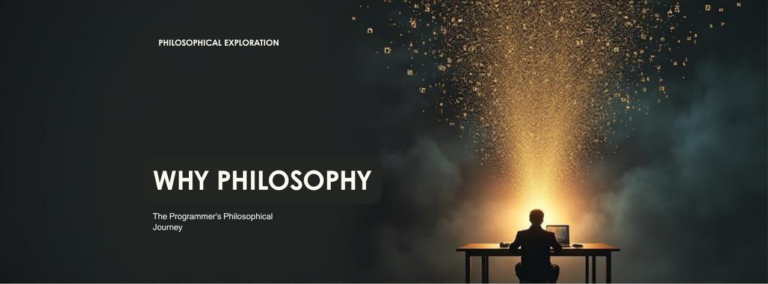
Introduction: Why Programmers Need Philosophy
ByWina3 AM. All tests passed, but production exploded. After three hours of debugging, I realized — the bug wasn’t in the code. It was in my assumptions about reality.